
Increasing and Decreasing Functions
Let \( y = f(x) \) be a function with domain \( D \subseteq \mathbb{R} \). Let \( I \) be an interval contained in \( D \). For any two values \( x_1 \) and \( x_2 \) in \( I \), with \( x_1 < x_2 \), the function is defined as:
- strictly increasing, if \( f(x_1) < f(x_2) \)
- increasing (or non-decreasing), if \( f(x_1) \le f(x_2) \)
- strictly decreasing, if \( f(x_1) > f(x_2) \)
- decreasing (or non-increasing), if \( f(x_1) \ge f(x_2) \)
A function that is consistently increasing or consistently decreasing on an interval \( I \) is said to be monotonic on \( I \).
Monotonicity concerns how the values of a function compare as the independent variable increases. It is a relational property between function values, not a qualitative description of the visual shape of the graph.
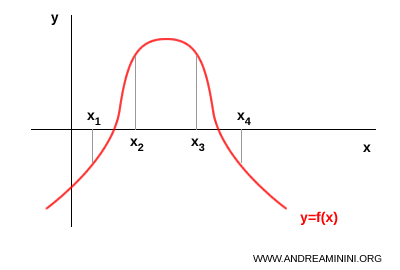
Example. This function f(x) is strictly increasing on the interval $ ( x_1,x_2) $ and strictly decreasing on the interval $ ( x_3 , x_4) $
Monotonicity Criterion for Functions
To determine whether a function is increasing or decreasing, we can use the monotonicity criterion, which establishes a connection between the first derivative of a function f(x) and its growth or decline.
Increasing Function
A function f(x) that is continuous on [a, b] and differentiable on (a, b) is said to be increasing on [a, b] if its first derivative satisfies $$ f'(x) \ge 0 $$ for every x ∈ (a, b).
Decreasing Function
A function f(x) that is continuous on [a, b] and differentiable on (a, b) is said to be decreasing on [a, b] if its first derivative satisfies $$ f'(x) \le 0 $$ for every x ∈ (a, b).
Why Is This Important?
The sign of the first derivative f'(x) is one of the key pieces of information used in analyzing and sketching the graph of a function.
Converse of the Monotonicity Theorem
The converse of the Monotonicity Theorem is also true.
- If a function \( f(x) \) is continuous on \([a,b]\), differentiable on \((a,b)\), and increasing throughout \((a,b)\), then \( f'(x) \ge 0 \) for every \( x \in (a,b) \).
- If a function \( f(x) \) is continuous on \([a,b]\), differentiable on \((a,b)\), and decreasing throughout \((a,b)\), then \( f'(x) \le 0 \) for every \( x \in (a,b) \).
A Practical Example
Consider the function:
$$ f(x)=x^2 $$
The first derivative of the function is:
$$ f'(x)=2x $$
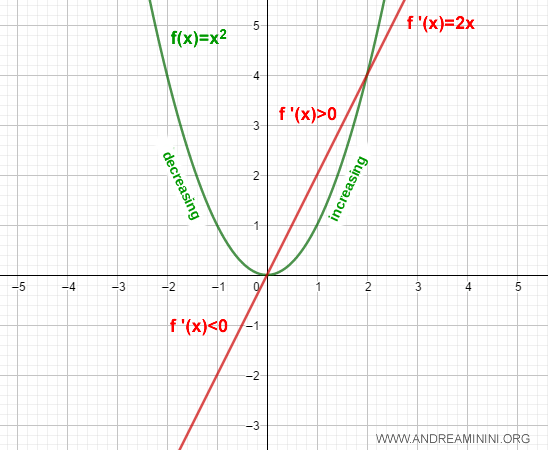
From -∞ to 0, the derivative f'(x)=2x is negative, whereas from 0 to +∞, it’s positive:
$$ f'(x)= \begin{cases} 2x > 0 \text{ if } x > 0 \\ 2x < 0 \text{ if } x < 0 \end{cases} $$
Therefore, the function f(x)=x2 is decreasing on (-∞, 0) and increasing on (0, ∞).
Proof and Explanation
Case 1 (Positive First Derivative)
Let’s start with the hypothesis that the first derivative f'(x) is nonnegative on the interval (a, b):
$$ f'(x) \ge 0 $$
We want to verify whether the function is indeed increasing.
Choose two points x1 and x2 in (a, b) such that:
$$ a \le x_1 \le x_2 \le b $$
If the function is increasing, then the following inequality should hold:
$$ f(a) \le f(x_1) \le f(x_2) \le f(b) $$
According to Lagrange’s Mean Value Theorem, there exists a point x0 in the interval (x1, x2) such that:
$$ f'(x_0)=\frac{f(x_2)-f(x_1)}{x_2 - x_1} $$
Rewriting this, we have:
$$ f(x_2)-f(x_1) = f'(x_0)\,(x_2 - x_1) $$
Since f'(x0) ≥ 0 by hypothesis, and (x2 - x1) > 0 because x2 > x1, it follows that:
$$ f(x_2)-f(x_1) \ge 0 $$
Hence, the function is increasing on the interval (x1, x2).
This establishes the connection between a nonnegative first derivative and an increasing function.
Note. The relationship between a nonpositive first derivative f'(x) ≤ 0 and a decreasing function f(x) can be proved similarly, assuming f'(x) ≤ 0. In that case, since (x2 - x1) > 0, we have f(x2) - f(x1) ≤ 0.
Case 2 (Function Increasing)
Now suppose that the function is increasing on the interval (a, b), without yet considering its derivative.
This means that at any point x0 ∈ (a, b), the function is increasing.
To determine the derivative at x0, we evaluate the limit of the difference quotient at that point:
$$ f'(x_0) = \lim_{h \rightarrow 0} \frac{f(x+h)-f(x)}{h} \ge 0 $$
Since the function is increasing, the numerator of the difference quotient satisfies:
- f(x+h) - f(x) ≥ 0 for h > 0
- f(x+h) - f(x) ≤ 0 for h < 0
Thus, the difference quotient is nonnegative for h > 0 (right-hand derivative):
$$ f'(x_0+) = \lim_{h \rightarrow 0} \frac{f(x+h)-f(x)}{h} \ge 0 $$
and also nonnegative for h < 0 (left-hand derivative):
$$ f'(x_0-) = \lim_{h \rightarrow 0} \frac{f(x+h)-f(x)}{h} \ge 0 $$
Note. For the left-hand derivative, the denominator h is negative (h < 0). Since the numerator f(x+h) - f(x) is also nonpositive, their ratio remains nonnegative.
Therefore, the first derivative of the function at x0 is nonnegative:
$$ f'(x_0) \ge 0 $$
And so on.


