
Increasing Functions
A function y = f(x) is called increasing on an interval I = (a, b) if, for any two points x1 and x2 in the interval such that x1 < x2, the following holds: $$ f(x_1) \le f(x_2) $$. It is called strictly increasing if: $$ f(x_1) < f(x_2) $$
A strictly increasing function is sometimes referred to as increasing in the strict sense.
Both increasing and strictly increasing functions are part of the broader family of monotonic functions.
Note: A function is said to be monotonic over an interval of its domain if it is either consistently increasing or consistently decreasing throughout that interval.
Example
Consider the function:
$$ y = x^2 $$
This function is strictly increasing on the interval (1, 5), since for any two points x1 and x2 with x1 < x2, the inequality f(x1) < f(x2) holds true.
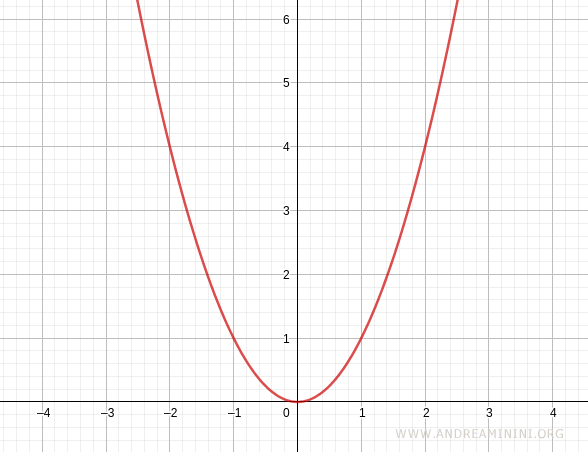
However, the same function is not increasing on the interval (-5, -1).
Note: If a function is continuous and differentiable, its increasing or decreasing behavior can also be analyzed using the first derivative.
And so on.


