
Discontinuous Function
A function f(x) is said to be discontinuous at a point x0 if the limit of f(x) as x approaches x0 is not equal to the value of the function at that point. $$ \lim_{x \rightarrow x_0} f(x) \ne f(x_0) $$ The point x0 is called a point of discontinuity.
Example of a discontinuous function
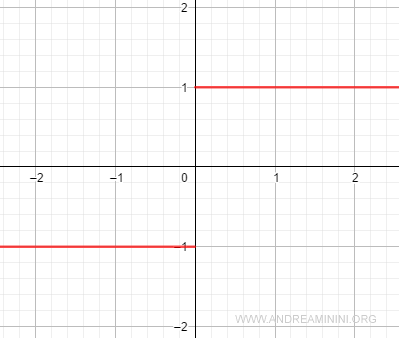
Removable vs. non-removable discontinuities
- A discontinuity is called removable if it can be eliminated by appropriately redefining the function to make it continuous.
- It is called non-removable if it cannot be eliminated in this way.
What causes discontinuities?
Discontinuities can arise for several reasons:
Jump Discontinuity (First Kind)
At the point x0, a jump discontinuity occurs when both the right-hand and left-hand limits exist and are finite, but differ from each other. $$ \lim_{x \rightarrow x_0^+} f(x) \ne \lim_{x \rightarrow x_0^-} f(x) $$ The difference between these two one-sided limits is called the jump of the function.
The function may or may not be defined at x0.
Example
The sign function has a discontinuity at x0 = 0:
$$ \frac{|x|}{x} $$
because the right-hand and left-hand limits differ:
$$ \lim_{x \rightarrow 0^+} \frac{|x|}{x} = 1 $$
$$ \lim_{x \rightarrow 0^-} \frac{|x|}{x} = -1 $$
Here is the graph:
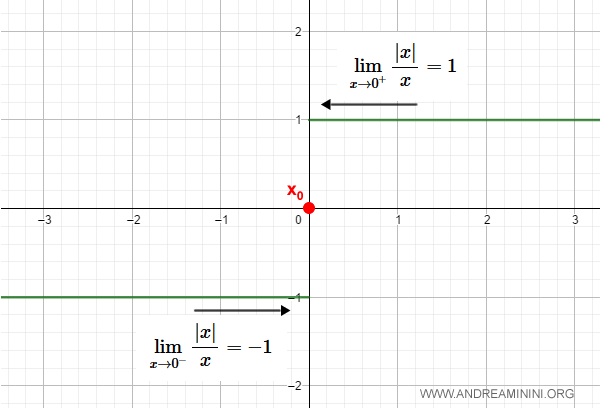
At x0, the function jumps from -1 to +1.
Infinite discontinuity (second kind)
At the point x0, an infinite discontinuity occurs when at least one of the one-sided limits is infinite or fails to exist. $$ \lim_{x \rightarrow x_0^±} f(x) = \{ ±∞ , \text{does not exist} \} $$
Example
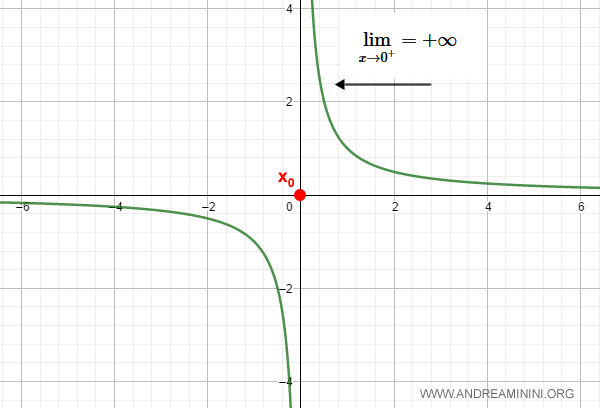
The function $$ \frac{1}{x} $$ is discontinuous at x0 = 0,
because the right-hand limit tends to infinity:
$$ \lim_{x \rightarrow 0^+} = +\infty $$
Note. In this case, the left-hand limit tends to negative infinity: $$ \lim_{x \rightarrow 0^-} = -\infty $$ In general, a discontinuity of the second kind occurs if at least one of the one-sided limits is infinite (±\infty).
Here is the graph:
Removable discontinuity
At the point x0, a removable discontinuity occurs when the limit of the function f(x) exists and is finite as $ x \to x_0$, but is not equal to the value of the function at that point, or the function is not defined at x0. $$ \lim_{x \rightarrow x_0} f(x) \ne f(x_0) $$
This is known as a removable discontinuity because the discontinuity can be eliminated by redefining the function value at x0 to match the limit.
This type of discontinuity often occurs in piecewise-defined functions.
Example
Consider the function:
$$ f(x) = \frac{\sin x}{x} $$
At x0 = 0, the function is undefined, but the limit exists:
$$ \lim_{x \rightarrow 0} \frac{\sin x}{x} = 1 $$
This is a well-known limit.
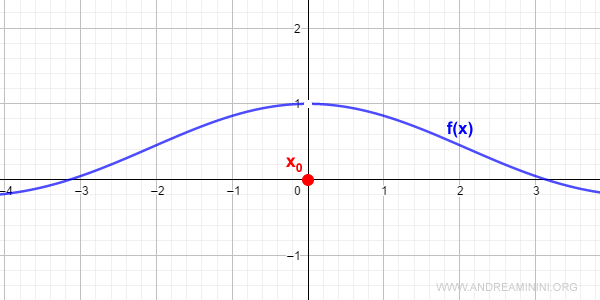
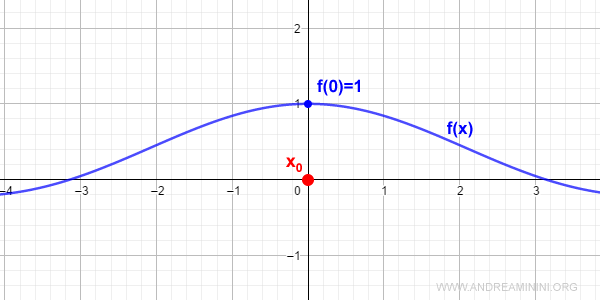
We can eliminate the discontinuity by defining f(0) = 1:
$$ f(x) = \begin{cases} \frac{\sin x}{x} \: \text{if} \: x \ne 0 \\ 1 \: \text{if} \: x = 0 \end{cases} $$
This redefinition makes the function continuous:
Example 2
Now consider this piecewise function:
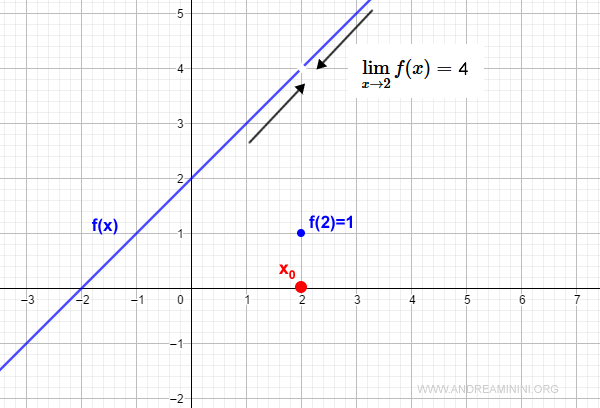
$$ f(x) = \begin{cases} x+2 \: \text{if} \: x \ne 2 \\ 1 \: \text{if} \: x = 2 \end{cases} $$
This function has a point of discontinuity at x0 = 2.
The limit as x approaches 2 exists:
$$ \lim_{x \rightarrow 2} f(x) = 4 $$
In other words, both the left-hand and right-hand limits are equal.
However, the function value at x = 2 is:
$$ f(2) = 1 $$
So the limit exists at x0, but the function takes on a different value.
To eliminate this discontinuity, we simply redefine the function as:
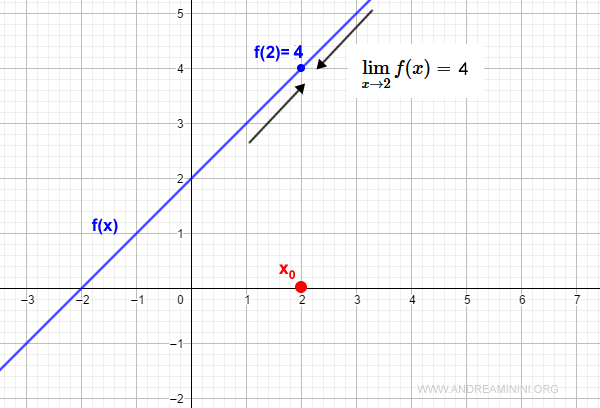
$$ f(x) = \begin{cases} x+2 \: \text{if} \: x \ne 2 \\ 4 \: \text{if} \: x = 2 \end{cases} $$
This removes the discontinuity:
And so on.


