
Symmetries in graphs of functions
The symmetry of a graph refers to a geometric transformation that preserves the shape of a function, either entirely or in a well-defined partial sense.
Several fundamental symmetries are defined with respect to the Cartesian axes and the origin.
Moreover, additional and systematic changes to a graph arise when absolute values are introduced.
Symmetry with respect to the x-axis
A function exhibits symmetry with respect to the x-axis when the following relation holds:
\[ y = -f(x) \]
Under this transformation, every point of the graph of f(x) is reflected across the x-axis.
Equivalently, if a point belongs to the graph of f(x), then the point with the opposite y-coordinate belongs to the graph of -f(x).
Example
Consider the function
$$ f(x) = \sqrt{x} $$
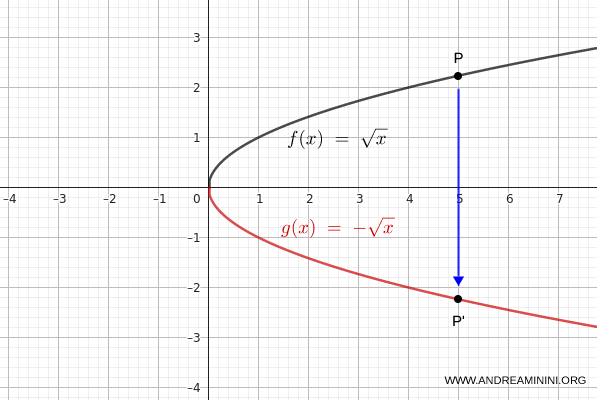
The symmetry of the function with respect to the x-axis is obtained by reversing the sign of the function values:
\[ g(x) = -f(x) \]
Substituting the explicit expression for f(x), we obtain
$$ g(x) = -f(x) = -\sqrt{x} $$
The domain remains unchanged, namely \( x \ge 0 \), while the graph of \( g(x) \) is the mirror image of the graph of \( y = \sqrt{x} \) across the x-axis.
Symmetry with respect to the y-axis
A function is symmetric with respect to the y-axis if the following condition is satisfied:
$$ y = f(-x) $$
In this case, the graph is reflected across the y-axis. Each point of the graph with x-coordinate x corresponds to a point whose x-coordinate is the opposite value -x.
Example
Consider the function
$$ f(x) = x^3 $$
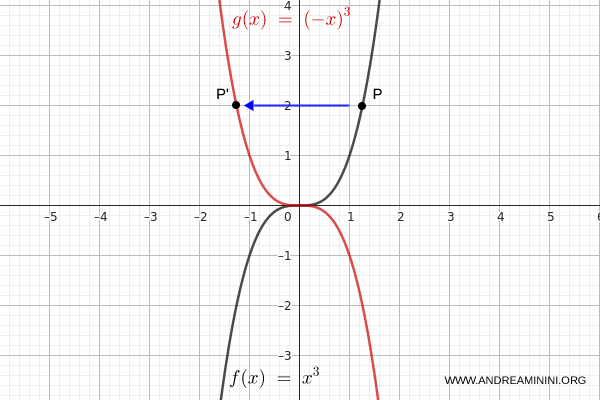
The symmetry of the function with respect to the y-axis is obtained by replacing \( x \) with \( -x \):
\[ g(x) = f(-x) \]
Evaluating the expression explicitly, we find
$$ g(x) = f(-x) = (-x)^3 = -x^3 $$
Therefore, the graph of \( g(x) \) is the reflection of the graph of \( y = x^3 \) across the y-axis.
Central symmetry with respect to the origin
A function is symmetric with respect to the origin (O) if the following relation holds:
$$ y = -f(-x) $$
The graph is reflected first across the y-axis and then across the x-axis. This transformation is known as central symmetry because each point \( (x, f(x)) \) is mapped to the diametrically opposite point \( (-x, -f(x)) \).
Example
Consider the function
$$ f(x) = x^2 $$
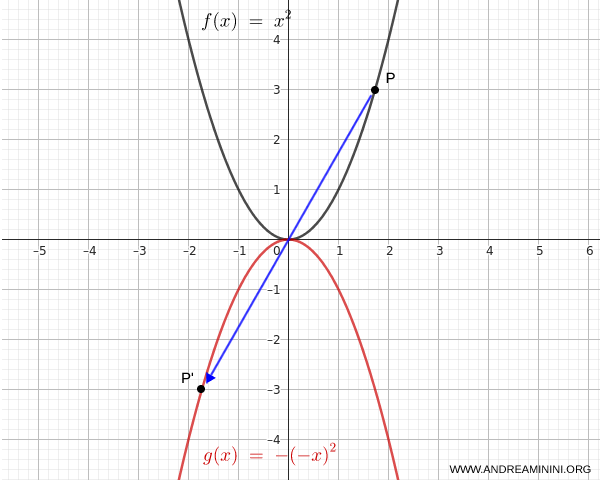
The central symmetry of the function with respect to the origin \( O \) is obtained by applying the transformation
\[ g(x) = -f(-x) \]
Substituting the expression for \( f(x) \), we obtain
$$ g(x) = -f(-x) = -(-x)^2 = -x^2 $$
Hence, the graph of \( g(x) \) is the central reflection of the graph of \( y = x^2 \) with respect to the origin.
The graph of the absolute value of a function
The function \( y = |f(x)| \) exhibits a piecewise-defined behavior:
- where \( f(x) \ge 0 \), the graph coincides with that of f(x).
- where \( f(x) < 0 \), the negative portion of the graph is reflected across the x-axis.
Example
If \( f(x) = x \), then the absolute value of the function is
\[ |f(x)| = |x| \]
To eliminate the absolute value, we distinguish the following cases:
\[
|f(x)| = |x| =
\begin{cases}
x & \text{if } x \ge 0 \\ \\
-x & \text{if } x < 0
\end{cases}
\]
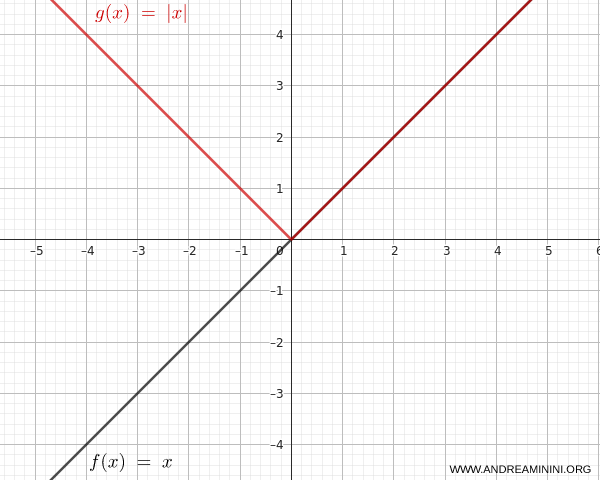
The graph coincides with the line \( y = x \) for \( x \ge 0 \) and with the line \( y = -x \) for \( x < 0 \).
Overall, the resulting graph is a V-shaped curve, symmetric with respect to the y-axis.
The graph of a function with absolute value in the argument
The function \( y = f(|x|) \) is constructed from the graph of f(x) restricted to the domain \( x \ge 0 \). This portion is then reflected across the y-axis.
- For \( x > 0 \), the graph coincides with f(x).
- For \( x < 0 \), the graph is obtained by reflecting the portion of f(x) defined for \( x > 0 \) across the y-axis.
Example
Consider the function:
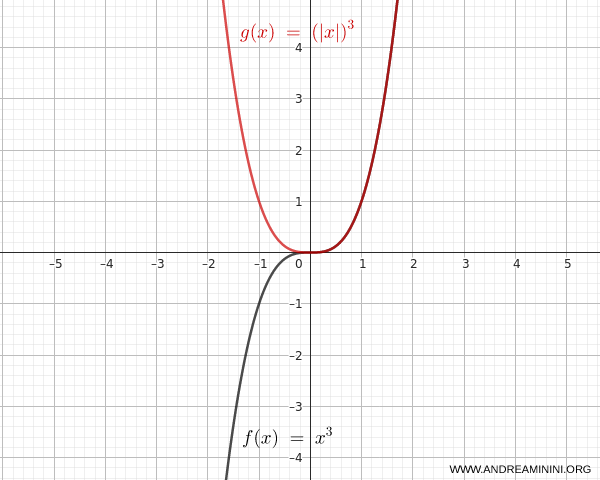
$$ f(x) = ( |x| )^3 $$
To remove the absolute value, we again distinguish two cases.
\[
f(|x|) =
\begin{cases}
x^3 & \text{if } x \ge 0 \\ \\
(-x)^3 = -x^3 & \text{if } x < 0
\end{cases}
\]
Thus, for \( x \ge 0 \) the graph coincides with that of \( y = x^3 \), while for \( x < 0 \) it is the mirror image of this graph across the y-axis.
And so on.


