Weierstrass Extreme Value Theorem
If a function $ f(x) $ is continuous on a closed and bounded interval [a,b], then there exist points $ x_1, x_2 \in [a,b] $ such that $ m = f(x_1) $ and $ M = f(x_2) $ are, respectively, the minimum and maximum values of the function on the interval. In particular, $$ f(x_1) \le f(x) \le f(x_2) \:\:\: \forall x \in [a,b] $$ The values \( m \) and \( M \) are called the absolute minimum and absolute maximum, respectively.
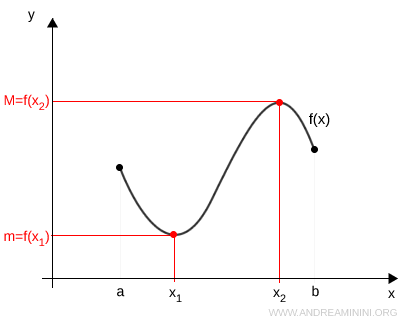
The Extreme Value Theorem provides a sufficient condition for the existence of absolute extrema.
In other words, any function that is continuous on a closed and bounded interval necessarily attains both an absolute maximum and an absolute minimum. If these conditions are not met, such extrema may still exist, but their existence is no longer guaranteed.
Note. More generally, the theorem extends to functions of several variables (for example \( f(x,y) \)), provided that the domain is compact (that is, closed and bounded in \( \mathbb{R}^n \)) and the function is continuous on it.
A Practical Example
Consider the following function:
$$ f(x) = \frac{1}{x} $$
This function is unbounded on the interval (0,5] because it has no finite upper limit, and therefore cannot have a maximum value (M).
Likewise, it’s unbounded on the interval [5,+∞) because, although it tends towards zero (acting as a lower limit), there’s no value of x such that f(x)=0. So it doesn’t possess a minimum value (m) either.
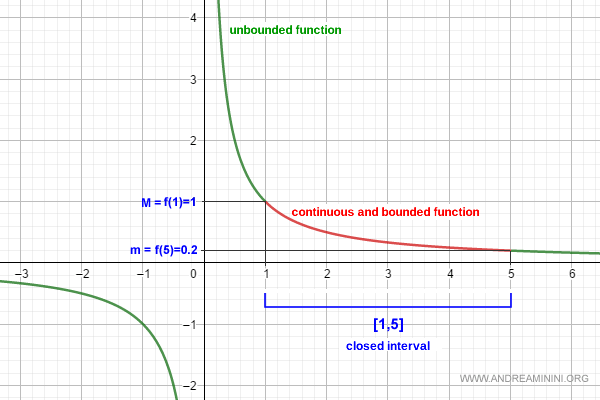
However, if we restrict the function to the closed interval [1,5], f(x) becomes a bounded function.
$$ 0.2 \le f(x) \le 1 \:\:\: \forall x \in [1,5] $$
In this scenario, there are two points, \( x_1 \) and \( x_2 \), within the interval [a,b] where the function attains its minimum and maximum values.
$$ M = f(1) = 1 $$
$$ m = f(5) = 0.2 $$
Note. In this case, the minimum and maximum values occur at the endpoints of the closed interval [a,b]. However, that’s not always the case; in other situations, the absolute minimum or maximum might lie inside the interval. I mention this because it’s a common source of confusion.
The Proof Explained
Let’s examine a function f(x) defined over a closed interval [a,b], and suppose it attains a maximum value M.
$$ M = sup(f(x):x \in [a,b]) $$
Example. This graph depicts the cosine function over the interval [-1,1]. The function reaches its maximum at \( x_0 = 0 \), where f(x) equals M = 1.
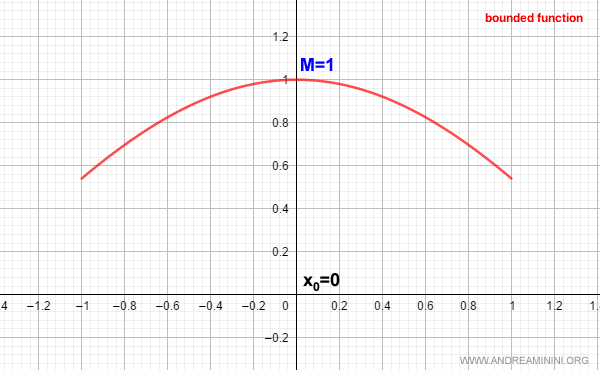
Since an upper bound M exists, we can find a sequence \( x_n \) whose function values approach this maximum:
$$ \lim_{n \rightarrow \infty;} f(x_n) = M $$
Two possibilities arise:
- M is infinite
If \( M = +\infty \), then for every \( n \in \mathbb{N} \), there’s an \( x_n \) in [a,b] such that $$ f(x_n) > n $$ Therefore, the sequence diverges to infinity: $$ M = \lim_{n \rightarrow \infty;} f(x_n) = \infty $$ - M is finite
If \( M < +\infty \), then for each \( n \in \mathbb{N} \), there’s an \( x_n \) in [a,b] such that $$ M - \frac{1}{n} < f(x_n) \le M $$ Thus, the sequence converges to a finite value: $$ M = \lim_{n \rightarrow \infty;} f(x_n) = f(x_0) $$
The next step is to determine whether M is finite or infinite.
Because [a,b] is bounded, the sequence \( x_n \) is bounded as well. Therefore, by the Bolzano-Weierstrass theorem, there exists a subsequence \( x_{nk} \) that converges to some point within [a,b].
Example. Here’s an example of a convergent subsequence.
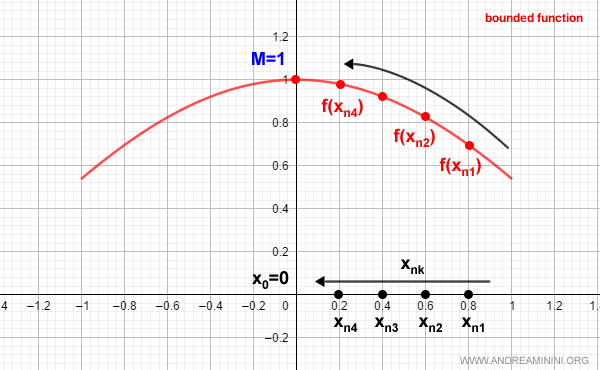
Consider a subsequence \( x_{nk} \) converging to the point \( x_0 \) in [a,b]:
$$ \lim_{n \rightarrow \infty;} x_{nk} = x_0 $$
Note. The point \( x_0 \) is where the function f(x) may converge if it has a finite maximum. $$ M = \lim_{n \rightarrow \infty;} f(x_n) = f(x_0) $$
Since f(x) is continuous, the sequence \( f(x_{nk}) \) converges to \( f(x_0) \):
$$ \lim_{n \rightarrow \infty;} f(x_{nk}) = f(x_0) $$
Hence:
$$ \begin{cases} M = \lim_{n \rightarrow \infty;} f(x_n) = f(x_0) \\ \\ \lim_{k \rightarrow \infty;} f(x_{nk}) = f(x_0) \end{cases} $$
which leads to the following equality:
$$ M = \lim_{n \rightarrow \infty;} f(x_n) = \lim_{k \rightarrow \infty} f(x_{nk}) = f(x_0) $$
This shows that the supremum of the function is indeed a finite maximum:
$$ M = f(x_0) = sup \{ f(x) \: \forall x \in [a,b] \} $$
Thus, the limit of the sequence \( f(x_n) \) converges to a finite value M rather than diverging to infinity:
$$ \lim_{n \rightarrow \infty} f(x_n) = M $$
Note. The same reasoning applies for finding the point of minimum, starting from the infimum m = f(x) over the closed interval [a,b].
Weierstrass’ Theorem for Functions of Two or More Variables
Let \( A \subseteq \mathbb{R}^n \) be a compact set (meaning it’s closed and bounded), and let \( f : A \to \mathbb{R} \) be continuous. Then \( f \) attains both an absolute minimum and an absolute maximum on \( A \). In other words, there exist points \( x_{\text{min}}, x_{\text{max}} \in A \) such that \[f(x_{\text{min}}) \le f(x) \le f(x_{\text{max}}) \quad \forall x \in A.\]
This is the natural generalization of Weierstrass’ theorem to multivariable functions.
Here, we speak of compactness because the domain must be both closed and bounded.
Note. For single-variable functions \( f(x) \), the domain in Weierstrass’ theorem is a closed and bounded interval \( [a,b] \) on the real number line, with two endpoints. For functions of two variables \( f(x,y) \), the domain instead consists of a set of points in the plane \( \mathbb{R}^2 \), such as a closed disk \( x^2+y^2 \le r^2 \). In this context, the “boundaries” of the domain correspond to the perimeter of the set - for example, the circle defining the edge of the disk.
Example
Let’s examine a function of two variables:
\[ f(x,y) = x^2 + y^2 \]
and define the domain as the closed disk of radius 1 centered at the origin (0,0):
\[ A = \{ (x,y) \in \mathbb{R}^2 \mid x^2 + y^2 \leq 1 \} \]
The set \( A \) is closed because it includes its boundary \( x^2 + y^2 = 1 \), and bounded because it lies within a circle of radius 1.
Hence, the set \( A \) is compact.
The function \( f(x,y) = x^2 + y^2 \) is continuous throughout \( \mathbb{R}^2 \) and therefore also continuous over the domain \( A \).
By Weierstrass’ theorem, \( f \) must attain both an absolute maximum and minimum over \( A \).
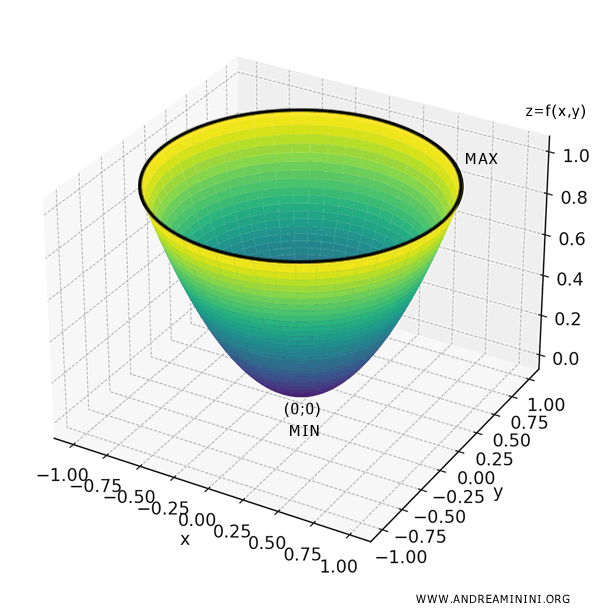
In this case, the absolute minimum occurs at \( x=0 \) and \( y=0 \), the center of the disk, where \( f(0,0) = 0 \).
The absolute maximum occurs along the entire boundary of the disk, where \( x^2 + y^2 = 1 \) and \( f(x,y) = 1 \). Thus, instead of a single point of absolute maximum, there are infinitely many points lying along the circle.
And so on.