
Theorem on the Preservation of Sign for the Limit of a Function
Let f(x) be a function defined and continuous in a neighborhood of the point x0. If f(x0) > 0, then there exists a number δ > 0 such that f(x) > 0 for all x in the interval (x0 - δ, x0 + δ).
Example
Consider the function:
$$ f(x) = \frac{1}{x} $$
At the point x0 = 2, the function evaluates to f(x0) = 0.5:
$$ f(2) = 0.5 $$
Let’s look at a neighborhood around x0 = 2 with δ = 0.2:
$$ (x_0 - \delta, \, x_0 + \delta) $$
$$ (2 - 0.2, \, 2 + 0.2) $$
$$ (1.8, \, 2.2) $$
Within the interval (1.8, 2.2), the function f(x) remains strictly positive:
$$ f(1.8) = \frac{1}{1.8} = 0.55 \\ f(2.2) = \frac{1}{2.2} = 0.45 $$
Graphically, this can be illustrated as follows:
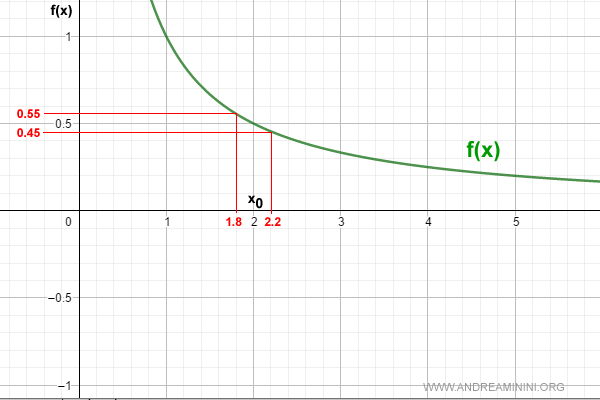
Note. For any x0 such that f(x0) > 0, it is always possible to find some δ > 0 that defines a neighborhood in which f(x) > 0 for all x ∈ (x0 - δ, x0 + δ).
Proof
Since the function is positive at the point x0:
$$ f(x_0) > 0 $$
We choose:
$$ \epsilon = \frac{f(x_0)}{2} $$
By the definition of the limit, there exists a δ > 0 such that:
$$ |f(x) - f(x_0)| < \epsilon $$
which is equivalent to:
$$ |f(x) - f(x_0)| < \frac{f(x_0)}{2} $$
This leads to the double inequality:
$$ -\frac{f(x_0)}{2} < f(x) - f(x_0) < \frac{f(x_0)}{2} $$
Adding f(x0) to all sides gives:
$$ f(x_0) - \frac{f(x_0)}{2} < f(x) < f(x_0) + \frac{f(x_0)}{2} $$
Since f(x0) - f(x0)/2 simplifies to f(x0)/2:
$$ f(x_0) - \frac{f(x_0)}{2} = \frac{f(x_0)}{2} $$
And because f(x0) > 0, it follows that f(x0)/2 > 0. Therefore, f(x) remains strictly positive in the neighborhood:
$$ 0 < \frac{f(x_0)}{2} < f(x) < \frac{3f(x_0)}{2} $$
Alternative proof
Suppose that the function f(x) has a finite limit $ l \ne 0 $ as $ x \to x_0 $.
$$ \lim_{x \to x_0} f(x) = l $$
By the definition of a finite limit, for every $ \varepsilon > 0 $ there exists a neighborhood of $ x_0 $ such that
$$ | f(x) - l | < \varepsilon $$
By the basic property of absolute values, this inequality is equivalent to
$$ l - \varepsilon < f(x) < l + \varepsilon $$
Choosing $ \varepsilon = | l | $, we obtain
$$ l - | l | < f(x) < l + | l | $$
We now distinguish two cases
- If the limit is positive ( $ l > 0 $ ), then $$ 0 < f(x) < 2l $$ hence the function is strictly positive, $ f(x) > 0 $, in a neighborhood $ I $ of $ x_0 $
- If the limit is negative ( $ l < 0 $ ), then $$ 2l < f(x) < 0 $$ hence the function is strictly negative, $ f(x) < 0 $, in a neighborhood $ I $ of $ x_0 $
This establishes the claim.
Converse theorem
Let f(x) be a function that admits a finite limit $ l $ as $ x \to x_0 $. If, throughout a neighborhood of $ x_0 $, the function is:
- nonnegative ( $ f(x) \ge 0 $ ), then the limit is nonnegative ( $ l \ge 0 $ )
- nonpositive ( $ f(x) \le 0 $ ), then the limit is nonpositive ( $ l \le 0 $ )
Proof
Argue by contradiction. Assume that f(x) is nonnegative, $ f(x) \ge 0 $, in a neighborhood $ I(x_0) $, while its limit is negative ( $ l < 0 $ ).
By the theorem on the permanence of sign, if $ l < 0 $, then there exists a neighborhood $ I'(x_0) $ in which
$$ f(x) < 0 $$
Consider the intersection \( I(x_0) \cap I'(x_0) \), which is still a neighborhood of $ x_0 $. Within this neighborhood, the inequalities
\[ f(x) \ge 0 \quad \text{and} \quad f(x) < 0 \]
would have to hold simultaneously.
This is impossible, since a function cannot be both nonnegative and negative at the same point.
Therefore, the assumption \( l < 0 \) is untenable, and the limit must satisfy
\[ l \ge 0 \]
This completes the proof.
Note The second statement is proved analogously. Assume \( f(x) \le 0 \) in a neighborhood of \( x_0 \), then rule out by contradiction the possibility \( l > 0 \), again invoking the theorem on the permanence of sign.
And so on.


