
Bolzano’s Theorem
According to the Intermediate Value Theorem, also known as Bolzano’s Theorem, if a function \( f(x) \) is continuous on a closed interval \( [a,b] \) and takes on values of opposite sign at the endpoints, that is \( f(a)<0 \) and \( f(b)>0 \), then there exists at least one point \( x_0 \) in the open interval \( (a,b) \) such that \( f(x_0)=0 \). In other words, the function has at least one zero within the interval.
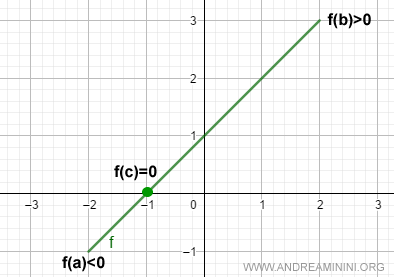
The theorem also applies in the opposite case, where \( f(a) > 0 \) and \( f(b) < 0 \).
The essential condition for the theorem to hold is that the function takes on opposite signs at the endpoints \( f(a) \) and \( f(b) \).
A Practical Example
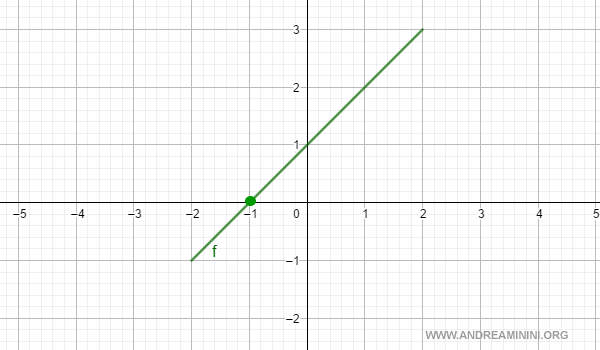
Consider the function:
$$ f(x) = x + 1 $$
over the closed interval [-2, +2].
At the intermediate point x0 = -1, the function equals zero:
$$ f(-1) = 0 $$
Although simple, this example clearly illustrates the theorem’s significance.
Proof Explained
Let f(x) be a continuous function defined on [a, b].
At the endpoints, the function takes values of opposite sign:
$$ f(a) < 0 $$
$$ f(b) > 0 $$
Consider the midpoint c of the interval [a, b]:
$$ c = \frac{a + b}{2} $$
Example. Let’s revisit the previous example. The function f(x) = x + 1 is defined on [-2, 2]. Here, f(a) = f(-2) = -1, while f(b) = f(2) = 3. At the midpoint c = 0, the function takes the value f(c) = f(0) = 1.
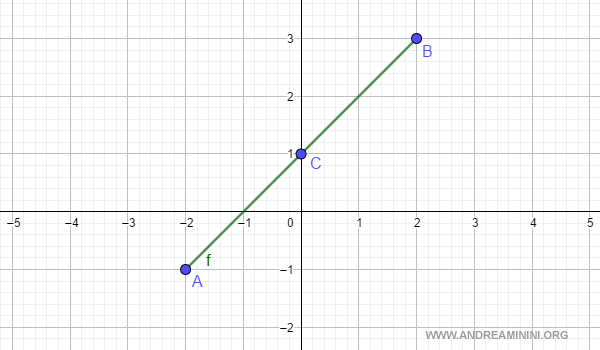
We now examine the value of f(x) at the midpoint c:
- If f(c) > 0: $$ f(c) > 0 $$ The function has the opposite sign compared to f(a) < 0. We then consider the subinterval [a, c]: $$ [a_1, b_1] = [a, c] $$ and find its new midpoint: $$ c_2 = \frac{a_1 + c_1}{2} $$ and continue this process iteratively.
- If f(c) < 0: $$ f(c) < 0 $$ The function has the same sign as f(a) < 0. In this case, we focus on the subinterval [c, b]: $$ [a_1, b_1] = [c, b] $$ and determine its midpoint: $$ c_2 = \frac{c_1 + b_1}{2} $$ repeating the procedure as needed.
Example. In the previous example, f(c) = 1, so f(c) > 0. Therefore, we choose the new interval [a1, b1] = [a, c]. Next, we find a new midpoint c1.
![the new midpoint [a, c]](/data/andreaminininet/bolzanoas-theorem-amnet-2025-4.gif)
We repeat this procedure as many times as necessary until we reach a point where f(c) = 0 - that is, until we locate a root. Once f(c) = 0, the iteration terminates.
Through this iterative method, we generate three sequences:
$$ a_n, \; b_n, \; c_n $$
As long as f(c) ≠ 0, the function maintains opposite signs at the endpoints of the interval:
$$ f(a_n) < 0 $$ $$ f(b_n) > 0 $$
With each iteration, the length of the interval [an, bn] is halved:
$$ b_1 - a_1 = \frac{b - a}{2} $$
$$ b_2 - a_2 = \frac{b - a}{2^2} $$
$$ \vdots $$
Therefore, after n iterations, the length of the interval is:
$$ b_n - a_n = \frac{b - a}{2^n} $$
The sequence an is clearly increasing, since:
$$ a_1 \le a_2 \le \dots \le a_n $$
Moreover, the sequence an is bounded because it remains confined within the interval [a, b].
Since it is increasing and bounded, by the Monotone Convergence Theorem, the sequence an converges to a finite limit, which we denote as x0:
$$ \lim_{n \rightarrow \infty} a_n = x_0 $$
The sequence bn can be determined from the interval length:
$$ b_n - a_n = \frac{b - a}{2^n} $$
$$ b_n = a_n + \frac{b - a}{2^n} $$
Since $$ \frac{b - a}{2^n} \rightarrow 0 $$ as n → ∞, it follows that the limit of bn coincides with that of an:
$$ \lim_{n \rightarrow \infty} b_n $$
$$ \lim_{n \rightarrow \infty} \left(a_n + \frac{b - a}{2^n}\right) = x_0 $$
Thus, both sequences an and bn converge to x0 as n approaches infinity:
$$ \lim_{n \rightarrow \infty} a_n = x_0 $$
$$ \lim_{n \rightarrow \infty} b_n = x_0 $$
Moreover, the sequence an approaches x0 from below, while bn approaches it from above:
$$ a_n \le x_0 \le b_n $$
The value of the function f(x) at the point x0 can be approximated by the limits of the function values at an and bn as n → ∞:
$$ f(x_0) = \lim_{n \rightarrow \infty} f(a_n) $$
$$ f(x_0) = \lim_{n \rightarrow \infty} f(b_n) $$
However, the first is an underestimate of f(x0), while the second is an overestimate:
Given that f(an) ≤ 0 and f(bn) ≥ 0, we have:
$$ f(x_0) = \lim_{n \rightarrow \infty} f(a_n) \le 0 $$
$$ f(x_0) = \lim_{n \rightarrow \infty} f(b_n) \ge 0 $$
Thus, the only possibility is:
$$ f(x_0) = 0 $$
This completes the proof of the Zero Existence Theorem.
And so on.


