
Indeterminate Forms in Limits
When working with limits, you may come across an indeterminate form - a situation where the result isn’t immediately clear and further analysis is required. These are the most common indeterminate forms in limit problems:
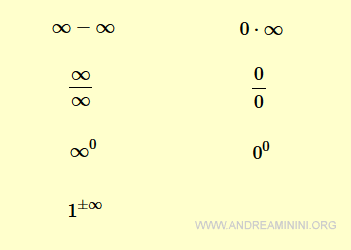
Just because a limit results in an indeterminate form doesn’t mean the limit doesn’t exist.
To evaluate it, the expression must be rewritten or simplified in a way that removes the source of indeterminacy.
- How to Resolve an Indeterminate Form
- Using the Conjugate
- Factoring out the highest power of \(x\)
- Limits Involving the Indeterminate Form \( 0 \cdot \infty \)
- Limits with the indeterminate form \( \frac{\infty}{\infty} \)
- Limits with the indeterminate form \( \frac{\infty}{\infty} \)
- Limits with the indeterminate form \( \frac{0}{0} \)
- Limits with indeterminate forms \( 0^0 , 1^\infty , \infty^0 \)
- Determinate Forms
How to Resolve an Indeterminate Form
There are several strategies you can use to evaluate limits that take on an indeterminate form:
- Algebraic manipulation. Sometimes, a limit becomes solvable after applying a few algebraic transformations. Rewriting the expression in an equivalent form can often eliminate the ambiguity. However, this approach isn’t always straightforward, and a suitable transformation may not always exist.
Example 1. This limit presents an indeterminate form of type 0/0: $$ \lim_{n \rightarrow \infty} \ \frac{\frac{1}{n^2}}{\frac{1}{n}} = \frac{0}{0} $$ By simplifying the expression algebraically, we can resolve the indeterminacy: $$ \lim_{n \rightarrow \infty} \frac{1}{n^2} \cdot \frac{n}{1} = \lim_{n \rightarrow \infty} \frac{1}{n} = 0 $$
- Special limits. Some limits that produce indeterminate forms can be evaluated by applying the special limits studied in mathematical analysis. In these cases, the expression of the limit is algebraically transformed until it can be reduced to one of the well known fundamental limits.
- Taylor series expansions. Some limits can be evaluated by replacing exponential, logarithmic, or trigonometric functions with their Taylor series expansions, approximating the functions with polynomials that describe their local behavior.
- L'Hôpital's rule. If the function is differentiable and the indeterminate form is \(0/0\) or \(\infty/\infty\), L'Hôpital's rule can be applied by studying the limit of the derivatives of the numerator and the denominator. The procedure may be repeated by taking the first, second, third derivative, and so on, until the limit becomes determined, either finite or infinite. In practice, L'Hôpital's rule is frequently used when logarithmic, exponential, or trigonometric functions appear.
Example. This limit has the indeterminate form \(\infty/\infty\) $$ \lim_{x \rightarrow \infty} \frac{e^x}{x} = \frac{\infty}{\infty} $$ Apply L'Hôpital's rule and compute the derivatives of the numerator and the denominator $$ \lim_{x \rightarrow \infty} \frac{D[e^x]}{D[x]} = \lim_{x \rightarrow \infty} \frac{e^x}{1} = + \infty $$ Therefore, the limit diverges.
Using the Conjugate
In some limits we encounter a difference between two terms that contain a square root. This situation often leads to an indeterminate form of the type \(+\infty - \infty \).
In these cases it is often useful to multiply the expression by the conjugate.
The idea is to multiply and divide the expression by the conjugate of the difference, that is, the same expression with the opposite sign between the terms. This allows us to apply the algebraic identity \( (a-b)(a+b)=a^2-b^2 \), which removes the square root and simplifies the expression.
Example
Consider the following limit as $ x \to \infty $, where the expression contains a difference between two terms involving a square root
\[ \lim_{x \to \infty} x-\sqrt{x^2+1} \]
This expression produces an indeterminate form of the type \(+\infty - \infty \).
\[ \lim_{x \to \infty} x-\sqrt{x^2+1} = +\infty - \infty \]
To evaluate the limit, multiply and divide by the conjugate of \( x-\sqrt{x^2+1} \), namely \( x + \sqrt{x^2+1} \).
\[ x-\sqrt{x^2+1} = x-\sqrt{x^2+1} \cdot \frac{ x + \sqrt{x^2+1} }{ x + \sqrt{x^2+1} } \]
The expression \( ( x-\sqrt{x^2+1} ) \cdot ( x + \sqrt{x^2+1} ) \) is a difference of squares \( x^2 - ( \sqrt{x^2+1} )^2 \). Therefore we can rewrite the expression in an equivalent form:
\[ \frac{ x^2 - ( \sqrt{x^2+1} )^2 }{ x + \sqrt{x^2+1} } \]
At this point the square root disappears from the numerator
\[ \frac{ x^2 - ( x^2+1) }{ x + \sqrt{x^2+1} } \]
\[ \frac{ -1 }{ x + \sqrt{x^2+1} } \]
The expression is now much easier to analyze.
As $ x \to \infty $, the denominator grows without bound, so the limit of the equivalent function tends to zero.
\[ \lim_{x \to \infty} \frac{ -1 }{ x + \sqrt{x^2+1} } = 0 \]
Therefore, the original limit as $ x \to \infty $ also tends to zero
\[ \lim_{x \to \infty} x-\sqrt{x^2+1} = \lim_{x \to \infty} \frac{ -1 }{ x + \sqrt{x^2+1} } = 0 \]
This example shows that multiplying by the conjugate is a useful algebraic technique for evaluating limits that involve a difference between expressions containing square roots.
Factoring out the highest power of \(x\)
When evaluating the limit of a polynomial function as \( x \to +\infty \) or \( x \to -\infty \), the expression may take the indeterminate form \( \infty - \infty \).
\[ \lim_{x \to +\infty \atop (x \to -\infty)} \left( a_0 x^n + a_1 x^{n-1} + \dots + a_n \right) = \infty - \infty \]
This indeterminate form can be resolved by factoring out the highest power of \( x \) that appears in the polynomial.
\[ \lim_{x \to +\infty \atop (x \to -\infty)} x^n \left( a_0 + \frac{a_1}{x} + \frac{a_2}{x^2} + \dots + \frac{a_n}{x^n} \right) \]
In this way, the polynomial is rewritten as the product of \( x^n \) and a factor containing terms such as \( \frac{a_1}{x}, \frac{a_2}{x^2}, \dots \).
Since the terms \( \frac{a_1}{x}, \frac{a_2}{x^2}, \dots \) tend to \( 0 \) as \( x \to \pm \infty \), the expression inside the parentheses approaches the coefficient of the highest-degree term.
The behavior of the limit is therefore determined by the dominant term \( a_0 x^n \), which establishes whether the limit diverges to \( +\infty \) or to \( -\infty \).
\[ \lim_{x \to +\infty \atop (x \to -\infty)} \left( a_0 x^n + a_1 x^{n-1} + \dots + a_n \right) = \lim_{x \to +\infty \atop (x \to -\infty)} a_0 x^n \]
The sign of the limit follows from the usual sign rules applied to the product \( a_0 x^n \).
Example
Consider the limit
\[ \lim_{x \to +\infty} (3x^2 - 5x + 1) \]
To remove the indeterminate form, factor out the highest power of \( x \), which is \( x^2 \):
\[ 3x^2 - 5x + 1 = x^2 \left(3 - \frac{5}{x} + \frac{1}{x^2}\right) \]
The limit then becomes
\[ \lim_{x \to +\infty} x^2 \left(3 - \frac{5}{x} + \frac{1}{x^2}\right) \]
As \( x \to \infty \), the terms \( \frac{5}{x} \) and \( \frac{1}{x^2} \) approach zero. The expression inside the parentheses therefore approaches \( 3 \), and the behavior of the limit is governed by the dominant term \( 3x^2 \).
\[ \lim_{x \to +\infty} x^2 \left(3 - \frac{5}{x} + \frac{1}{x^2}\right) = \lim_{x \to +\infty} 3x^2 = +\infty \]
Therefore, the original limit also diverges
\[ \lim_{x \to +\infty} (3x^2 - 5x + 1) = +\infty \]
This technique allows us to resolve indeterminate forms \( \infty - \infty \) that arise in limits of polynomial functions as \( x \to \pm \infty \).
Note. In limits of polynomial functions as \( x \to \pm\infty \), it is often sufficient to consider only the highest-degree term without carrying out all intermediate steps. A polynomial is asymptotically equivalent to its dominant term \( a_0 x^n \), while the lower-degree terms become negligible as \( x \to \pm\infty \). Consequently, the behavior of the limit coincides with that of \( a_0 x^n \). For example, the previous exercise could have been solved more quickly in this way \[ \lim_{x \to +\infty} (3x^2 - 5x + 1) = \lim_{x \to +\infty} 3x^2 = +\infty \]
Limits Involving the Indeterminate Form \( 0 \cdot \infty \)
The indeterminate form \( 0 \cdot \infty \) arises when, in a limit, one factor approaches zero while the other tends to infinity.
\[ \lim_{x \to a} f(x) g(x) = 0 \cdot \infty \]
In this situation the value of the limit cannot be determined immediately, because the result depends on how rapidly the two factors approach \( 0 \) and \( \infty \), respectively.
To evaluate this type of limit, the product is usually rewritten as a quotient.
\[ f(x) g(x) = \frac{f(x)}{\frac{1}{g(x)}} \]
or
\[ f(x) g(x) = \frac{g(x)}{\frac{1}{f(x)}} \]
After this transformation, the limit often becomes one of the simpler indeterminate forms \( \frac{0}{0} \) or \( \frac{\infty}{\infty} \), which can then be studied using standard techniques.
Example
Consider the limit
\[ \lim_{x \to +\infty} x e^{-x} \]
This is an indeterminate form of type \( 0 \cdot \infty \) because \( x \to \infty \) while \( e^{-x} \to 0 \).
\[ \lim_{x \to +\infty} x e^{-x} = 0 \cdot \infty \]
Rewrite the product as a quotient
\[ x e^{-x} = \frac{x}{e^{x}} \]
The limit becomes
\[ \lim_{x \to +\infty} \frac{x}{e^{x}} = \frac{\infty}{\infty} \]
Since the exponential function grows faster than any polynomial, the limit is
\[ \lim_{x \to +\infty} \frac{x}{e^{x}} = 0 \]
Therefore, when the form \( 0 \cdot \infty \) appears, the key step is to rewrite the product as a quotient.
This transformation converts the limit into a simpler indeterminate form that can be analyzed using standard methods.
Limits with the indeterminate form \( \frac{\infty}{\infty} \)
When a limit takes the indeterminate form \( \frac{\infty}{\infty} \), both the numerator and the denominator diverge as the variable approaches a given value, most commonly \( x \to \infty \) or \( x \to -\infty \).
In this situation, the limit cannot be evaluated by direct substitution. The expression must first be rewritten or simplified.
Three techniques are commonly used.
1] Factoring out the highest power
This is the simplest method when the limit involves polynomials. The highest power of the variable is factored out from both the numerator and the denominator.
Example
\[ \lim_{x \to \infty} \frac{3x^2 - 5x + 1}{2x^2 + x} \]
Factor out the highest power \( x^2 \)
\[ \frac{x^2(3 - \frac{5}{x} + \frac{1}{x^2})}{x^2(2 + \frac{1}{x})} \]
Then simplify \( x^2 \)
\[ \frac{3 - \frac{5}{x} + \frac{1}{x^2}}{2 + \frac{1}{x}} \]
As \( x \to \infty \), the terms \( \frac{5}{x} \) and \( \frac{1}{x^2} \) tend to zero.
\[ \lim_{x \to \infty} \frac{3x^2 - 5x + 1}{2x^2 + x} = \frac{3}{2} \]
In practice, the behavior of the limit is determined by the terms of highest degree.
Note. When a limit involves only polynomials, it is usually unnecessary to carry out all the intermediate steps. The value of the limit depends solely on the ratio of the leading terms. In other words, it is sufficient to compare the degrees of the two polynomials. \[ \lim_{x \to \pm \infty}
\frac{a_0 x^n + a_1 x^{n-1} + \dots + a_n} {b_0 x^m + b_1 x^{m-1} + \dots + b_m} = \begin{cases} \pm \infty & \text{if } n > m \\ \\ \dfrac{a_0}{b_0} & \text{if } n = m \\ \\ 0 & \text{if } n < m \end{cases} \] For example, consider the limit \[ \lim_{x \to \infty} \frac{5x^4 + x}{2x^4 - 3x^2} \] The behavior of the function is determined by the ratio of the leading terms \( \frac{5x^4}{2x^4} \), so the limit approaches \( \frac{5}{2} \) \[ \lim_{x \to \infty} \frac{5x^4 + x}{2x^4 - 3x^2} = \frac{5}{2} \]
2] Dividing by the highest power
This method relies on the same idea as the previous one, but it is written explicitly as a division.
For example, consider the following limit
\[ \lim_{x \to \infty} \frac{4x^3 + x}{2x^3 - 5} \]
Divide every term in the numerator and the denominator by the highest power \( x^3 \)
\[ \lim_{x \to \infty} \frac{4 + \frac{1}{x^2}}{2 - \frac{5}{x^3}} \]
As \( x \to \infty \), the terms \( \frac{1}{x^2} \) and \( \frac{5}{x^3} \) tend to zero.
Therefore, the limit approaches two.
\[ \lim_{x \to \infty} \frac{4 + \frac{1}{x^2}}{2 - \frac{5}{x^3}} = \frac{4}{2} = 2 \]
3] L'Hôpital's rule
If the limit involves more complex functions, such as logarithms, exponentials, or trigonometric functions, we can apply L'Hôpital's rule.
For example, consider the limit
\[ \lim_{x \to \infty} \frac{\ln x}{x} = \frac{\infty}{\infty} \]
Differentiate the numerator and the denominator
\[ \lim_{x \to \infty} \frac{ D[\ln x] }{ D[x] } \]
Since \( D[\ln x] = \frac{1}{x} \) and \( D[x] = 1 \), substitute these results
\[ \lim_{x \to \infty} \frac{ \frac{1}{x} }{ 1 } \]
\[ \lim_{x \to \infty} \frac{1}{x} = 0 \]
Therefore, the limit of the original function as \( x \to \infty \) is also zero.
\[ \lim_{x \to \infty} \frac{\ln x}{x} = 0 \]
Note. In addition to the three methods described above, other techniques may be used depending on the form of the expression when dealing with limits of the indeterminate form \( \frac{\infty}{\infty} \). For instance, one can apply special limits when trigonometric, logarithmic, or exponential functions appear in the expression. In other situations, it may be useful to perform algebraic transformations, such as factorization, extracting common factors, or rationalization. Sometimes the expression can also be simplified by identifying the dominant terms of the function. The most appropriate method therefore depends on the structure of the expression and on the types of functions involved in the limit.
Limits with the indeterminate form \( \frac{\infty}{\infty} \)
When a limit leads to the indeterminate form \( \frac{\infty}{\infty} \), both the numerator and the denominator diverge as the variable approaches a certain value, typically \( x \to \infty \) or \( x \to -\infty \).
In this situation the limit cannot be evaluated by direct substitution. The expression must first be rewritten in an equivalent form.
The following three techniques are the most commonly used.
1] Factoring out the highest power
This is the simplest method when the limit involves polynomials. The highest power of the variable is factored out in both the numerator and the denominator.
Example
\[ \lim_{x \to \infty} \frac{3x^2 - 5x + 1}{2x^2 + x} \]
Factor out the highest power \( x^2 \)
\[ \frac{x^2(3 - \frac{5}{x} + \frac{1}{x^2})}{x^2(2 + \frac{1}{x})} \]
Then simplify \( x^2 \)
\[ \frac{3 - \frac{5}{x} + \frac{1}{x^2}}{2 + \frac{1}{x}} \]
As \( x \to \infty \), the terms \( \frac{5}{x} \) and \( \frac{1}{x^2} \) approach zero.
\[ \lim_{x \to \infty} \frac{3x^2 - 5x + 1}{2x^2 + x} = \frac{3}{2} \]
In practice, the behavior of the limit is determined solely by the highest degree terms.
Note. When a limit involves only polynomials, it is often unnecessary to perform all the intermediate steps. The limit depends only on the ratio of the leading terms. Therefore it is sufficient to compare the degrees of the two polynomials. \[ \lim_{x \to \pm \infty}
\frac{a_0 x^n + a_1 x^{n-1} + \dots + a_n} {b_0 x^m + b_1 x^{m-1} + \dots + b_m} =\begin{cases} \pm \infty & \text{if } n > m \\ \\ \dfrac{a_0}{b_0} & \text{if } n = m \\ \\ 0 & \text{if } n < m \end{cases} \] For example, consider the limit \[ \lim_{x \to \infty} \frac{5x^4 + x}{2x^4 - 3x^2} \] The behavior is determined by the ratio of the leading terms \( \frac{5x^4}{2x^4} \). Therefore the limit tends to \( \frac{5}{2} \). \[ \lim_{x \to \infty} \frac{5x^4 + x}{2x^4 - 3x^2} = \frac{5}{2} \]
2] Dividing by the highest power
This method follows the same principle as the previous one, but the procedure is written explicitly as a division.
For example, consider the following limit.
\[ \lim_{x \to \infty} \frac{4x^3 + x}{2x^3 - 5} \]
Divide every term by the highest power \( x^3 \)
\[ \lim_{x \to \infty} \frac{4 + \frac{1}{x^2}}{2 - \frac{5}{x^3}} \]
As \( x \to \infty \), the terms \( \frac{1}{x^2} \) and \( \frac{5}{x^3} \) approach zero.
Therefore the limit approaches two.
\[ \lim_{x \to \infty} \frac{4 + \frac{1}{x^2}}{2 - \frac{5}{x^3}} = \frac{4}{2} = 2 \]
3] L'Hôpital's rule
If the limit involves more complex functions, such as logarithmic, exponential, or trigonometric functions, L'Hôpital's rule can also be applied.
For example, consider the limit
\[ \lim_{x \to \infty} \frac{\ln x}{x} = \frac{\infty}{\infty} \]
Differentiate the numerator and the denominator.
\[ \lim_{x \to \infty} \frac{ D[ \ln x] }{ D[x] } \]
Since $ D[ \ln x ] = \frac{1}{x} $ and $ D[x] = 1 $, substitute these results.
\[ \lim_{x \to \infty} \frac{ \frac{1}{x} }{ 1 } \]
\[ \lim_{x \to \infty} \frac{1}{x} = 0 \]
Therefore the limit of the original function as $ x \to \infty $ also tends to zero.
\[ \lim_{x \to \infty} \frac{\ln x}{x} = 0 \]
Note. In addition to the three methods described above, other techniques can sometimes be used to evaluate limits with the indeterminate form \( \frac{\infty}{\infty} \). For example, standard limits are particularly useful when trigonometric, logarithmic, or exponential functions appear in the expression. In other situations, algebraic transformations such as factorization, factoring out common terms, or rationalization may be applied. Sometimes it is also helpful to simplify the expression by identifying the dominant terms of the function. The most appropriate method therefore depends on the structure of the expression and on the type of functions involved in the limit.
Limits with the indeterminate form \( \frac{0}{0} \)
When evaluating a limit, it may happen that direct substitution of the variable produces the indeterminate form \( \frac{0}{0} \).
$$ \lim_{x \to x_0} f(x) = \frac{0}{0} $$
In this case, the expression must be rewritten in an equivalent form in order to remove the indeterminacy, that is, to eliminate the factor responsible for the zero in the denominator.
Several techniques are available, and the choice depends on the structure of the expression and on the specific case. In practice, the following methods are commonly used.
1] Algebraic simplification
Sometimes it is sufficient to factor and simplify the expression.
For example, consider the limit
\[ \lim_{x \to 2} \frac{x^2-4}{x-2} = \frac{0}{0} \]
Factor the numerator \( x^2-4=(x-2)(x+2) \) as a difference of squares, then simplify.
\[ \lim_{x \to 2} \frac{(x-2) \cdot (x+2)}{x-2} \]
\[ \lim_{x \to 2} x+2 \]
Therefore, as $ x \to 2 $ the limit tends to 4.
\[ \lim_{x \to 2} x+2 = 4 \]
In this way we also obtain the value of the original limit.
\[ \lim_{x \to 2} \frac{x^2-4}{x-2} = 4 \]
2] Rationalization
This method is used when radicals appear in the expression.
Here is a practical example.
\[ \lim_{x \to 0} \frac{\sqrt{1+x}-1}{x} = \frac{0}{0} \]
Multiply the numerator and the denominator by the conjugate.
\[ \lim_{x \to 0} \frac{\sqrt{1+x}-1}{x} \cdot \frac{\sqrt{1+x}+1}{\sqrt{1+x}+1} \]
This gives
\[ \lim_{x \to 0} \frac{(1+x)-1}{x(\sqrt{1+x}+1)} \]
\[ \lim_{x \to 0} \frac{x}{x(\sqrt{1+x}+1)} \]
\[ \lim_{x \to 0} \frac{1}{\sqrt{1+x}+1} \]
Now the limit can be evaluated.
\[ \lim_{x \to 0} \frac{1}{\sqrt{1+x}+1}=\frac{1}{2} \]
3] L'Hôpital's rule
When the limit has the form \( \frac{0}{0} \), L'Hôpital's rule can also be applied by differentiating the numerator and the denominator separately until the indeterminate form disappears.
For example, consider the limit
\[ \lim_{x \to 0} \frac{\sin x}{x} \]
Differentiate the numerator and the denominator. The derivative of the numerator is \( D[ \sin(x) ] = \cos(x) \), while the derivative of the denominator is \( D[ x] = 1 \).
\[ \lim_{x \to 0} \frac{\cos x}{1} \]
Now evaluate the limit knowing that as $ x \to 0 $ the trigonometric function $ \cos x \to 1 $.
\[ \lim_{x \to 0} \frac{\cos x}{1} = 1 \]
4] Standard limits
Another useful technique consists of applying well known standard limits, that is, limits whose values are already known.
For example, consider the limit
\[ \lim_{x \to 0} \frac{\sin x}{x^2} = \frac{0}{0} \]
Rewrite the function in the following equivalent form.
\[ \lim_{x \to 0} \frac{\sin x}{x} \cdot \frac{1}{x} \]
In this way one of the most important standard limits is isolated: \( \lim_{x \to 0} \frac{\sin x}{x}=1 \).
Moreover, since as $ x \to 0 $ the term \( \frac{1}{x} \to \infty \), we obtain the result.
\[ \lim_{x \to 0} \frac{\sin x}{x} \cdot \frac{1}{x} = 1 \cdot \infty = \infty \]
Therefore the original limit diverges to infinity.
\[ \lim_{x \to 0} \frac{\sin x}{x^2} = \infty \]
Limits with indeterminate forms \( 0^0 , 1^\infty , \infty^0 \)
The indeterminate forms \(0^0 \), \(1^\infty \), and \( \infty^0 \) arise in limits where a function raised to a power approaches extreme values.
$$ \lim_{x \to a} f(x)^{g(x)} \quad \text{ where } f(x)>0 $$
To evaluate limits of this type, mathematicians typically transform the expression into a form that is easier to study analytically.
1] Exponential transformation
The most important technique consists of rewriting the power by means of the natural logarithm, using the identity
\( a = e^{\ln a} \)
\[ f(x)^{g(x)} = e^{\ln(f(x)^{g(x)})} \]
Using the properties of logarithms, this expression becomes
\[ f(x)^{g(x)} = e^{g(x)\ln f(x)} \]
In this way, the original problem of computing the limit of a power is reduced to studying the limit of the exponent \( g(x)\ln f(x) \), which frequently takes the indeterminate form \( 0 \cdot \infty \).
Once this limit has been evaluated, the final result is obtained by applying the exponential function.
Note. In practice, limits involving the indeterminate forms \(0^0 \), \(1^\infty \), and \( \infty^0 \) are almost always handled through the following procedure:
- Take the natural logarithm of the power
- Analyze the limit of the exponent
- If necessary, use algebraic manipulations, notable limits, Taylor expansions, or L'Hôpital's rule
- Finally apply the exponential function.
Example
Compute the limit
\[ \lim_{x \to +\infty} x^{\frac{1}{\ln x}} \]
As \( x \to +\infty \), the variable \( x \) diverges to infinity, while the term \( \frac{1}{\ln x} \to 0 \).
Therefore the expression has the indeterminate form \( \infty^0 \).
Apply the exponential transformation
\[ x^{\frac{1}{\ln x}} = e^{\ln\left(x^{\frac{1}{\ln x}}\right)} \]
The limit can therefore be rewritten as
\[ \lim_{x \to +\infty} x^{\frac{1}{\ln x}} = \lim_{x \to +\infty} e^{\ln\left(x^{\frac{1}{\ln x}}\right)} \]
Apply the properties of logarithms \( \ln\left(x^{\frac{1}{\ln x}}\right) = \frac{1}{\ln x}\ln x \)
\[ \lim_{x \to +\infty} e^{\frac{1}{\ln x}\ln x} \]
Simplifying the exponent gives
\[ \lim_{x \to +\infty} e \]
Since \( e \) is a constant, the limit is simply
\[ \lim_{x \to +\infty} e = e \]
Therefore the original limit also approaches \( e \).
\[ \lim_{x \to +\infty} x^{\frac{1}{\ln x}} = e \]
In this way the indeterminate form has been removed and the limit can be computed directly.
2] Comparison of growth rates
In some situations it is sufficient to analyze how quickly the functions involved grow or decay.
For example, consider the limit
\[ \lim_{x \to \infty} x^{\frac{1}{x}} = \infty^0 \]
Rewrite the limit in an equivalent form using the exponential function and the natural logarithm
\[ \lim_{x \to \infty} x^{\frac{1}{x}} = \lim_{x \to \infty} e^{ \ln ( x^{\frac{1}{x}} ) } \]
Applying the properties of logarithms gives
\[ \lim_{x \to \infty} e^{ \frac{1}{x} \ln ( x ) } \]
\[ \lim_{x \to \infty} e^{ \frac{ \ln ( x ) }{x} } \]
Now examine the ratio \( \frac{\ln x}{x} \).
As \( x \to \infty \), both the numerator \( \ln x \) and the denominator \( x \) diverge to infinity.
However, the denominator grows much faster than the numerator. Consequently, the ratio \( \frac{\ln x}{x} \to 0 \).
\[ \lim_{x \to \infty} e^{ \frac{ \ln ( x ) }{x} } = e^0 = 1 \]
Therefore the original limit also approaches 1.
\[ \lim_{x \to \infty} x^{\frac{1}{x}} = 1 \]
In this case the limit is obtained simply by comparing the growth rates of the functions involved.
Determinate Forms
Not every occurrence of zero or infinity in a limit leads to an indeterminate form.
For example, the following expressions are not indeterminate:
| $$ k + \infty = +\infty $$ | A real number k added to infinity |
| $$ k - \infty = -\infty $$ | A real number k minus infinity |
| $$ \infty+\infty = \infty $$ | Infinity plus infinity |
| $$ k \cdot \infty = \infty $$ | A nonzero constant k multiplied by infinity |
| $$ \infty \cdot \infty = \infty $$ | Infinity times infinity |
| $$ \frac{k}{\infty} = 0 $$ | A constant k divided by infinity |
| $$ \frac{0}{\infty} = 0 $$ | Zero divided by infinity |
| $$ \frac{\infty}{k} = \infty $$ | Infinity divided by a nonzero constant k |
| $$ \frac{k}{0} = \infty $$ | A nonzero constant k divided by zero |
In these cases, the outcome is algebraically clear and well-defined. They are not considered indeterminate forms.
And so on.


