Infinities of Increasing Order
Sequences that diverge to infinity as n→∞ can be compared using the Ratio Test for sequences. Such sequences are referred to as infinities of increasing order.
What is an infinity of increasing order?
An infinity of increasing order grows unboundedly faster than other divergent sequences used as a benchmark for comparison.
A Practical Example
Let’s consider the following two sequences for k > 0:
$$ n^k $$
$$ k^n $$
Both sequences have strictly positive terms and diverge to infinity as n→∞:
$$ \lim_{ n \rightarrow ∞} n^k = ∞ $$
$$ \lim_{ n \rightarrow ∞} k^n = ∞ $$
But which one grows faster as n increases?
To answer this, we define a new sequence an as the ratio of the two sequences:
$$ a_n = \frac{ n^k }{ k^n } $$
Next, we define a sequence bn as the ratio between consecutive terms of an:
$$ b_n = \frac{a_{n+1}}{a_n} $$
$$ b_n = \frac{ \frac{ (n+1)^k }{ k^{(n+1)} } }{ \frac{ n^k }{ k^n } } $$
$$ b_n = \frac{ (n+1)^k }{ k^{n+1} } \cdot \frac{ k^n }{ n^k } $$
$$ b_n = \frac{ (n+1)^k }{ k \cdot n^k } $$
$$ b_n = \frac{1}{k} \cdot \frac{ (n+1)^k }{ n^k } $$
$$ b_n = \frac{1}{k} \cdot \left( \frac{ n+1 }{ n } \right)^k $$
Let’s evaluate the limit of bn as n→∞:
$$ \lim_{ n \rightarrow ∞} b_n $$
$$ \lim_{ n \rightarrow ∞} \frac{1}{k} \cdot \left( \frac{ n+1 }{ n } \right)^k $$
Since (n+1)/n tends to 1 as n grows without bound, we obtain:
$$ \lim_{ n \rightarrow ∞} \frac{1}{k} \cdot \left( \frac{ n+1 }{ n } \right)^k = \frac{1}{k} < 1 $$
Because the limit of bn is less than 1, by the Ratio Test for sequences, the sequence an converges to zero.
$$ \lim_{ n \rightarrow ∞} a_n = \lim_{ n \rightarrow ∞} \frac{ n^k }{ k^n } = 0 $$
This means the denominator sequence kn is an infinity of higher order relative to nk.
The graph below clearly illustrates this relationship between the two sequences.
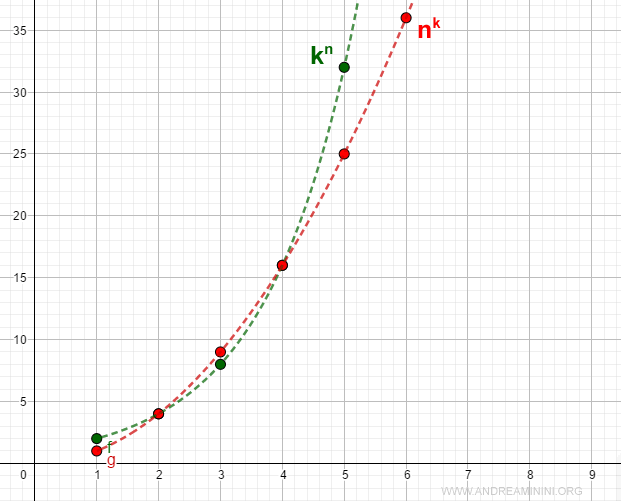
The sequence kn grows towards infinity significantly faster than the sequence nk.
And so on.