Bolzano-Weierstrass Theorem
Every bounded sequence an contains at least one convergent subsequence.
Proof
If a sequence is bounded, then there exist real numbers a and b such that:
$$ a \le a_n \le b $$
Here, a and b represent the lower and upper bounds of the sequence, respectively (or vice versa).
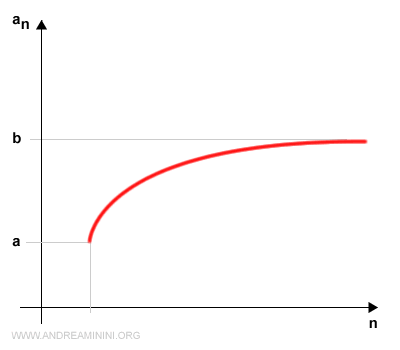
These bounds define a closed interval containing all terms an of the sequence along the vertical axis (y-axis).
On the horizontal axis (x-axis), we plot the index n of the sequence.
Note. A sequence an consists of infinitely many terms because its index n ranges over the natural numbers, which form an infinite set.
We divide the interval [a, b] into two equal parts by identifying the midpoint c = (a + b)/2.
We thus obtain two subintervals: [a, c] and [c, b].
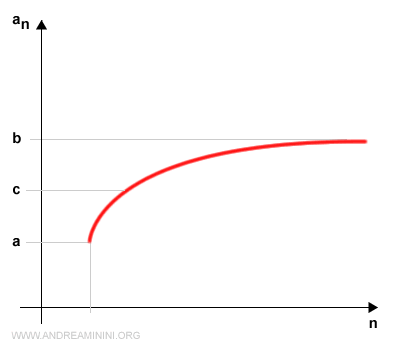
Exactly one of these two subintervals must contain infinitely many terms of the sequence; the other can contain at most finitely many.
By hypothesis, suppose the interval [c, b] contains infinitely many terms of the sequence.
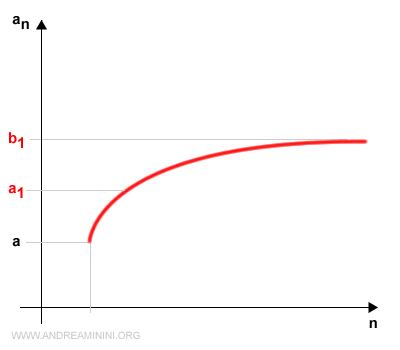
We then relabel this interval as [a1, b1]:
$$ [c, b] = [a_1, b_1] $$
No matter which interval we choose, the following inequalities hold:
$$ a \le a_1 $$ $$ b_1 \le b $$
and the length of this new interval is exactly half that of the preceding one:
$$ b_1 - a_1 = \frac{b - a}{2} $$
Let n1 denote the smallest index of the sequence an lying in [a1, b1].
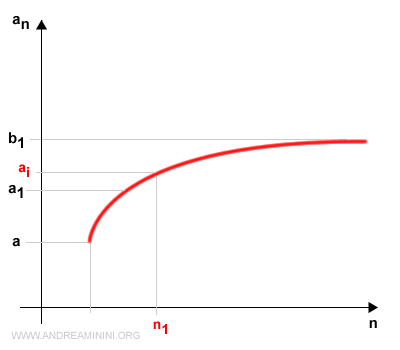
We now subdivide [a1, b1] into two subintervals: [a1, c1] and [c1, b1].
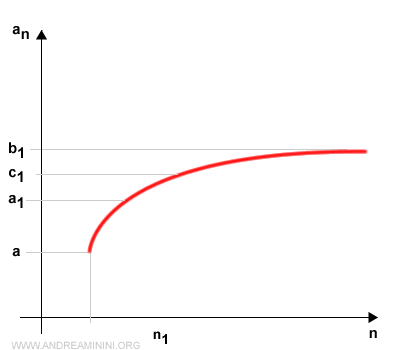
Again, exactly one of these subintervals will contain infinitely many terms of the sequence.
By hypothesis, let [c1, b1] be that subinterval containing infinitely many terms.
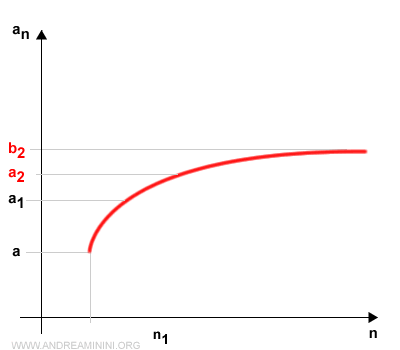
We relabel this interval as [a2, b2]:
$$ [c_1, b_1] = [a_2, b_2] $$
Again, we have:
$$ a_1 \le a_2 $$ $$ b_2 \le b_1 $$
and the length of this interval is half that of the previous one:
$$ b_2 - a_2 = \frac{b_1 - a_1}{2} = \frac{b - a}{4} $$
Let n2 denote the smallest index of the sequence an contained in [a2, b2].
By construction, n2 is an integer greater than n1.
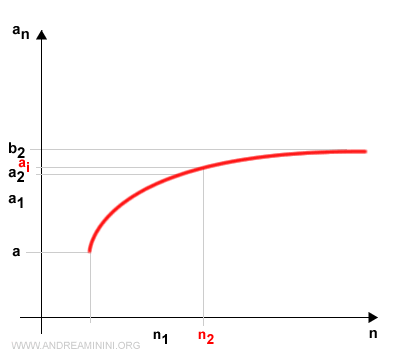
We continue this process iteratively for k steps.
After k iterations, we obtain the chain of inequalities:
$$ a \le a_k \le b_k \le b $$
The length of the interval [ak, bk] is:
$$ b_k - a_k = \frac{b - a}{2^k} $$
Let nk denote the smallest index of an in the interval [ak, bk].
Each index nk is strictly greater than the preceding one, nk-1.
Thus, we construct a sequence of indices:
$$ n_1, n_2, \dots, n_{k-1}, n_k $$
Since these are indices of an, all nk are natural numbers.
Moreover, these indices satisfy:
$$ n_1 < n_2 < \dots < n_{k-1} < n_k $$
Associated with these indices is a subsequence of an:
$$ a_{n_1}, a_{n_2}, \dots, a_{n_k} $$
Each term of this subsequence ank lies within the interval [ak, bk]:
$$ a_{n_k} \in [a_k, b_k] $$
Therefore:
$$ a_k \le a_{n_k} \le b_k $$
From this procedure, we identify three sequences:
- The sequence of lower bounds ak (the left endpoints of the intervals [ak, bk])
- The sequence of first terms ank within each interval [ak, bk]
- The sequence of upper bounds bk (the right endpoints of the intervals [ak, bk])
The sequences ak and bk are monotonic and bounded and each consists of k terms, since:
$$ a \le a_k \le b_k \le b $$
That is:
$$ a \le a_1 \le a_2 \le \dots \le a_k \le b_1 \le b_2 \le \dots \le b_k \le b $$
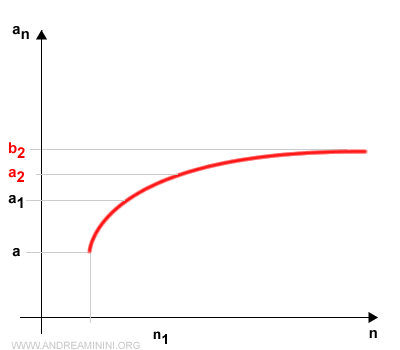
Taking the limits of these sequences as k → ∞, we have:
$$ \lim_{k \rightarrow \infty;} a_k \le \lim_{k \rightarrow \infty;} a_{n_k} \le \lim_{k \rightarrow \infty;} b_k $$
Because ak and bk are monotonic and bounded, by the Monotone Convergence Theorem, they both converge to finite limits:
$$ l_1 \le \lim_{k \rightarrow \infty;} a_{n_k} \le l_2 $$
In this construction, the two limits l1 and l2 are actually equal (i.e., l1 = l2):
$$ l \le \lim_{k \rightarrow \infty;} a_{n_k} \le l $$
Explanation. Since: $$ b_k - a_k = \frac{b - a}{2^k} $$ we have: $$ b_k = a_k + \frac{b - a}{2^k} $$ Hence, the limit of the sequence bk as k → ∞ equals the limit of ak: $$ l_2 = \lim_{k \rightarrow \infty;} b_k = \lim_{k \rightarrow \infty;} \left(a_k + \frac{b - a}{2^k}\right) = \lim_{k \rightarrow \infty;} a_k + \lim_{k \rightarrow \infty;} \frac{b - a}{2^k} = \lim_{k \rightarrow \infty;} a_k + 0 = l_1 $$ because the term (b - a)/2k tends to zero as k → ∞.
By the Squeeze Theorem, the subsequence ank also converges to this same finite limit l:
$$ \lim_{k \rightarrow \infty;} a_{n_k} = l $$
Therefore, the subsequence ank is convergent.
This concludes the proof of the Bolzano-Weierstrass Theorem.
And so on.