Ratio Test for Sequences
Consider a sequence an with positive terms. If the sequence defined by bn = an+1/an converges to a limit lb where lb < 1, then an converges to zero.
A Practical Example
Example 1
Take, for instance, the sequence
$$ a_n = \frac{n^2+1}{2^n} $$
This sequence has positive terms for all n > 0.
Let’s define its ratio sequence, bn:
$$ b_n = \frac{a_{n+1}}{a_n} = \frac{ \frac{(n+1)^2+1}{2^{n+1}} } { \frac{n^2+1}{2^n} } = \frac{(n+1)^2+1}{2^{n+1}} \cdot \frac{2^n}{n^2+1} $$
$$ b_n = \frac{n^2+2n+1}{2 \cdot 2^n} \cdot \frac{2^n}{n^2+1 }= \frac{n^2+2n+1}{2n^2+2 } $$
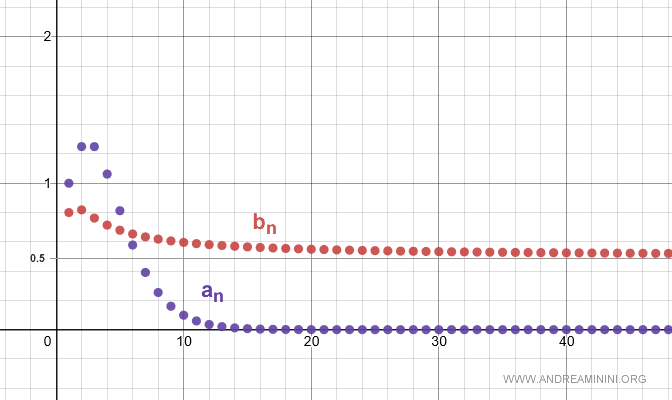
As n approaches infinity, the sequence bn converges to 1/2, which is less than 1. This result comes from the fact that we’re dealing with a rational function where the numerator and denominator are polynomials of the same degree.
So, when computing the limit, we only keep the leading terms, yielding n2/2n2 = 1/2.
$$ \lim_{ n \rightarrow ∞} b_n = \lim_{ n \rightarrow ∞} \frac{n^2+2n+1}{2n^2+2 } =\lim_{ n \rightarrow ∞} \frac{n^2}{2n^2} = \frac{1}{2} < 1 $$
Therefore, by the Ratio Test, the sequence an converges to zero as n approaches infinity. In other words, an is an infinitesimal sequence.
$$ \lim_{ n \rightarrow ∞ } a_n = \lim_{ n \rightarrow ∞ } \frac{n^2+1}{2^n} = 0 $$
Below is a graphical representation of the two sequences.
Proof
Let’s consider a monotonic sequence an whose terms are all positive.
$$ a_n $$
We define a new sequence as the ratio of consecutive terms of an:
$$ b_n = \frac{a_{n+1}}{a_n} $$
By hypothesis, the limit of bn is strictly less than 1:
$$ \lim_{n \rightarrow ∞} b_n < 1 $$
This implies that the limit of (1 - bn) is greater than zero:
$$ \lim_{n \rightarrow ∞} (1-b_n) > 0 $$
According to the permanence of sign theorem, there exists some index v such that bn < 1 for all n > v.
$$ b_n = \frac{a_{n+1}}{a_n} < 1 $$
Which leads to:
$$ a_{n+1} < a_n $$
This shows that the sequence an is decreasing.
Note. The limit of (1 - bn) can only be positive if bn itself is less than 1.
Furthermore, based on our initial assumption, the sequence an is monotonic and all its terms are positive.
Since it’s decreasing, monotonic, and made up of positive terms, it’s also a bounded sequence because its limit cannot fall below zero.
Therefore, by the theorem for bounded monotonic sequences, an must converge to a finite limit.
This limit is non-negative because the sequence’s terms are all positive.
$$ \lim_{n \rightarrow ∞} a_n = l_a \ge 0 $$
In summary, the limit la exists, is finite, and is non-negative.
There are only two possible cases:
- The limit la is greater than zero
- The limit la equals zero
If, by contradiction, the limit were greater than zero (la > 0), then:
$$ \lim_{n \rightarrow ∞} a_n = l_a > 0 $$
The limit of the sequence bn would be 1:
$$ \lim_{n \rightarrow ∞} b_n = \lim_{n \rightarrow ∞} \frac{a_{n+1}}{a_n} = \frac{ \lim_{n \rightarrow ∞} a_{n+1} }{ \lim_{n \rightarrow ∞} a_n } = \frac{l_a}{l_a} = 1 $$
But this contradicts our hypothesis because we know bn must be less than 1:
$$ b_n = \frac{a_{n+1}}{a_n} < 1 $$
Therefore, by elimination, the only possibility is that the limit la is zero:
$$ \lim_{n \rightarrow ∞} a_n = l_a = 0 $$
And that completes the proof of the theorem.
And so on.