Continuity Theorem for Inverse Functions
A function f(x) that is strictly monotonic over a closed interval [a,b] is continuous if and only if its inverse function f-1(x) is continuous.
A Practical Example
Consider the following function, which is strictly increasing on the closed interval [-2,2]:
$$ y = f(x) = 2x $$
This function is invertible, and its inverse is given by:
$$ x = f^{-1}(y) = \frac{y}{2} $$
Here’s its graph on the Cartesian plane:
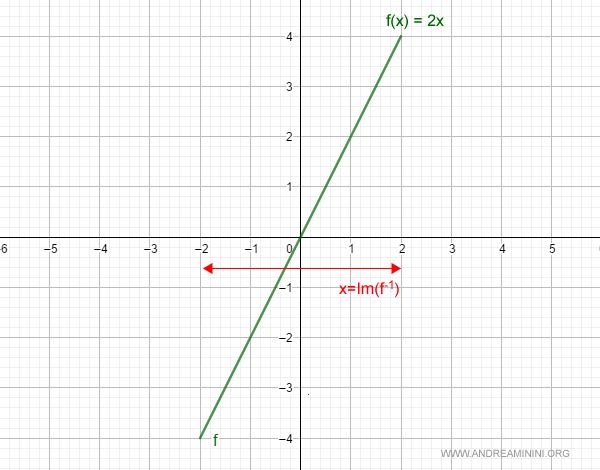
To determine whether f(x) is continuous, we apply the continuity criterion for monotonic functions to its inverse.
Note. According to the continuity criterion for monotonic functions, a function is continuous if its image Im(f) contains every value between its endpoints f(a) and f(b) over the interval [a,b].
In this case, the function under consideration is:
$$ f^{-1}(y) = \frac{y}{2} $$
The domain of the inverse function f-1 is:
$$ y \in [-4,4] $$
The values of the inverse function at the endpoints are:
$$ f^{-1}(-4) = -2 \\ f^{-1}(4) = 2 $$
Therefore, the image of the inverse function (i.e. its codomain) is:
$$ Im(f^{-1}) = [-2,2] $$
The image of f-1 spans all values between f-1(-4) and f-1(4).
Hence, by the theorem, the strictly monotonic function f(x) = 2x is continuous.
Proof Explained
A strictly monotonic function f(x) defined over a closed interval [a,b] is always invertible.
As such, it necessarily has an inverse function f-1(y):
$$ y = f(x) $$
$$ x = f^{-1}(y) \quad \text{(inverse function)} $$
Note. A function is strictly monotonic if it is either strictly increasing or strictly decreasing throughout the entire interval. Unlike functions that are merely monotonic, a strictly monotonic function can never remain constant over any portion of its domain.
Two scenarios are possible:
- If f(x) is strictly increasing on [a,b]: $$ f:[a,b] \rightarrow [f(a), f(b)] $$ $$ f^{-1}:[f(a), f(b)] \rightarrow [a,b] $$
- If f(x) is strictly decreasing on [a,b]: $$ f:[a,b] \rightarrow [f(b), f(a)] $$ $$ f^{-1}:[f(b), f(a)] \rightarrow [a,b] $$
In both situations, the image Im(f) covers the entire range of values between f(a) and f(b).
Therefore, the inverse function f-1(y) is continuous.
Note. According to the continuity criterion for monotonic functions, a monotonic function is continuous if its image Im(f) encompasses all values between f(a) and f(b).
Thus, if the inverse function f-1(x) is continuous, then the original strictly monotonic function f(x) must also be continuous.
And so on.