
Continuous functions
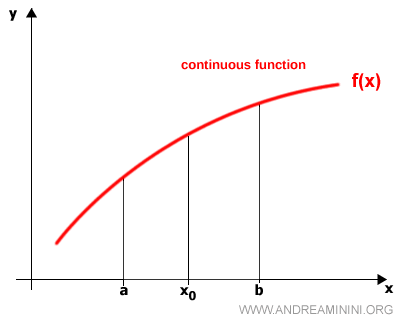
A function f(x) is said to be continuous at a point x0 if it is defined at x0, that is, if $ f(x_0) $ exists, and if the limit of the function as x approaches x0 exists, is finite, and equals f(x0). $$ \lim_{x \rightarrow x_0} f(x) = f(x_0) $$
If the (finite) limit as $ x \to x_0 $ exists, then the right-hand and left-hand limits both exist and are equal.
$$ \lim_{x \to x_0^+} f(x) = \lim_{x \to x_0^-} f(x) = f(x_0) $$
The graph of a continuous function is a single, unbroken curve with no jumps or gaps.
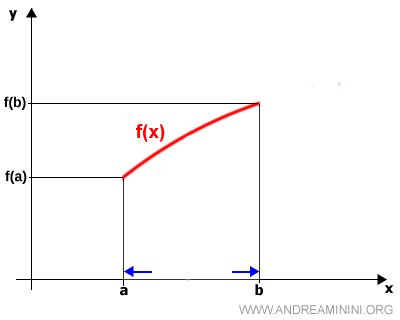
Continuity at the endpoints of an interval. When continuity is characterized only by a one-sided limit, as occurs at the endpoints of an interval, the function is said to be right-continuous or left-continuous, respectively.
- If $ \lim_{x \to x_0^+} f(x) = f(x_0) $, the function is right-continuous
- If $ \lim_{x \to x_0^-} f(x) = f(x_0) $, the function is left-continuous
Example
Consider the function
$$ f(x) = x^2 $$
We check whether the function is continuous at x0=2.
$$ \lim_{x \rightarrow 2} x^2 = 4 $$
At the point x0=2, the function takes the value
$$ f(2) = 4 $$
The limit coincides with the value of the function.
$$ \lim_{x \rightarrow 2} x^2 = f(2) $$
Therefore, the function x2 is continuous at x0=2.
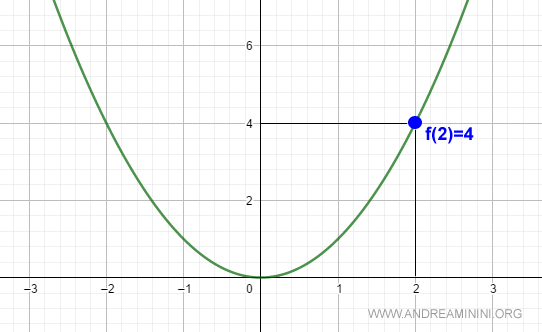
When the limit exists and is finite, it is independent of the direction of approach to $ x_0 = 2 $, since the right-hand and left-hand limits agree.
$$ \lim_{x \to 2^+} x^2 = 4 $$
$$ \lim_{x \to 2^-} x^2 = 4 $$
The same reasoning applies to every point x in the domain (-∞,∞) of the function.
Continuity on an interval
A function is continuous on an interval [a,b] if it is continuous at every point of the interval.
$$ \lim_{x \rightarrow x_0} f(x) = f(x_0) \:\:\: \forall x_0 \in [a,b] $$
In practical terms, this means that the graph of the function can be drawn without lifting the pen from the paper.
Continuity at the endpoints
At the endpoints of the interval, continuity is defined using one-sided limits. At the initial point a, we consider the right-hand limit
$$ \lim_{x \rightarrow a^+} f(x) = f(a) $$
At the final point b, we consider the left-hand limit
$$ \lim_{x \rightarrow b^-} f(x) = f(b) $$
Example
Consider the function on the interval [0,2].
\[ f(x) = x^2 \]
The function is defined at every point of the interval.
For every \( x_0 \in [0,2] \), we have
\[ \lim_{x \to x_0} x^2 = x_0^2 = f(x_0) \]
Therefore, the function is continuous on the entire interval [0,2].
The function also satisfies the definition of continuity at the endpoints.
At the initial endpoint \( 0 \), the right-hand limit equals the value of the function
\[ \lim_{x \to 0^+} x^2 = 0 = f(0) \]
At the final endpoint \( 2 \), the left-hand limit equals the value of the function
\[ \lim_{x \to 2^-} x^2 = 4 = f(2) \]
Thus, the function \( f(x) = x^2 \) is continuous on the interval \( [0,2] \), since it has no discontinuities.
And so on.


