
Monotonic Functions
What Is a Monotonic Function?
- A function f(x) is said to be monotonic on an interval [a, b] if, for any two values x1 and x2 in that interval such that x2 > x1, the following holds:
- Increasing $$ f(x_1) \le f(x_2) $$
- Strictly increasing $$ f(x_1) < f(x_2) $$
- Decreasing $$ f(x_1) \ge f(x_2) $$
- Strictly decreasing $$ f(x_1) > f(x_2) $$
Examples
Example 1
This function is monotonically increasing.

However, it's not strictly increasing since it remains constant over some intervals.
In technical terms, it is a non-decreasing function.
Example 2
This function is strictly increasing as it consistently rises and never flattens out.

Example 3
This function is monotonically decreasing.

It's not strictly decreasing because there are segments where the function remains constant.
Therefore, it is classified as a non-increasing function.
Example 4
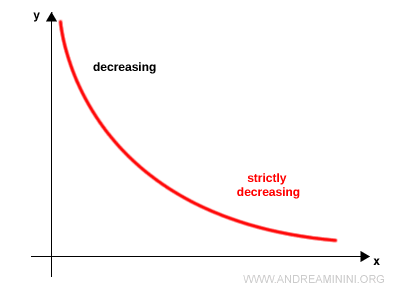
This function is strictly decreasing since it continuously decreases without ever staying constant.
Strictly Monotonic Functions
A function is strictly monotonic if it is either strictly increasing or strictly decreasing throughout its domain.
In simpler terms, strictly monotonic functions never have flat intervals - they either always increase or always decrease.
Key Properties of Strictly Monotonic Functions
Strict monotonicity plays a central role in mathematical analysis, as it ensures the function is invertible.
Every strictly monotonic function is invertible, meaning it always has an inverse function.
Example
The function f(x) = x + 1 is strictly increasing:
$$ f(x)=x+1 $$
As such, it is also invertible, and its inverse is:
$$ f^{-1}(y)=y-1 $$
This principle applies broadly to all strictly monotonic functions.


