Asymptotes
Definition of an asymptote
In mathematics, an asymptote is a line or curve that a function’s graph approaches arbitrarily closely as the independent variable x tends to plus or minus infinity, or approaches a specific finite value.

More precisely, a line qualifies as an asymptote if the distance between the graph of the function and the line tends to 0 as the independent variable x tends to infinity or to a finite limit.
Equivalently, the graph progressively converges toward the line, becoming arbitrarily close to it.
- If the asymptote is a straight line, it is referred to as a linear asymptote.
- If the asymptote is a curve, it is referred to as a curvilinear asymptote.
In mathematical analysis, three principal categories of asymptotes are identified when studying a function f(x): horizontal, vertical, and oblique.
Horizontal Asymptotes
A horizontal asymptote is determined by evaluating the limit of the function as x approaches positive or negative infinity:
$$ \lim_{x \rightarrow ±∞ } f(x) = c $$
A horizontal asymptote exists if this limit equals a finite real number.
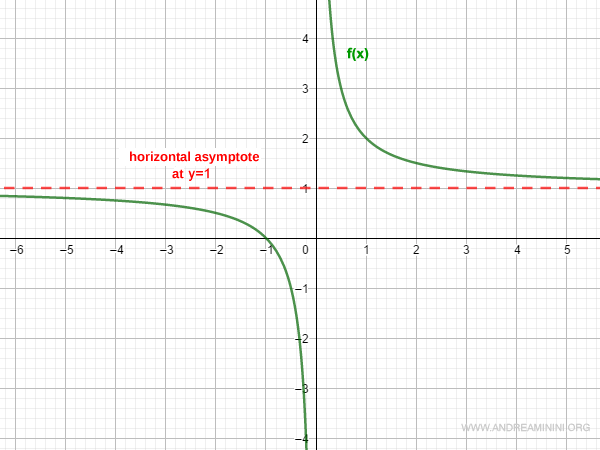
Here’s a simple example of a horizontal asymptote:
In practice, the horizontal asymptote is a line that runs parallel to, or coincides with, the x-axis.
Note that the horizontal asymptotes as x → +∞ and x → -∞ do not necessarily have to be the same.
Example
Let’s determine the horizontal asymptotes of the function:
$$ f(x) = \frac{x+1}{x} $$
First, we compute the limit as x → +∞:
$$ \lim_{x \rightarrow +∞ }\frac{x+1}{x} = 1 $$
Therefore, the function has a horizontal asymptote at y = 1 as x → +∞.
Note. This is an indeterminate form ∞/∞, which can easily be resolved using L'Hôpital’s Rule.
Now, we compute the limit as x → -∞:
$$ \lim_{x \rightarrow -∞ }\frac{x+1}{x} = 1 $$
Thus, the function also has a horizontal asymptote at y = 1 as x → -∞.
Vertical Asymptotes
A vertical asymptote occurs at points where the function is undefined. It is determined by evaluating the limit of f(x) as x approaches x0 from the right and from the left: $$ \lim_{x \rightarrow x_0^+ } f(x) = ±∞ $$ $$ \lim_{x \rightarrow x_0^- } f(x) = ±∞ $$ where x0 is a point of discontinuity.
A vertical asymptote exists at x0 if these limits tend to positive or negative infinity.
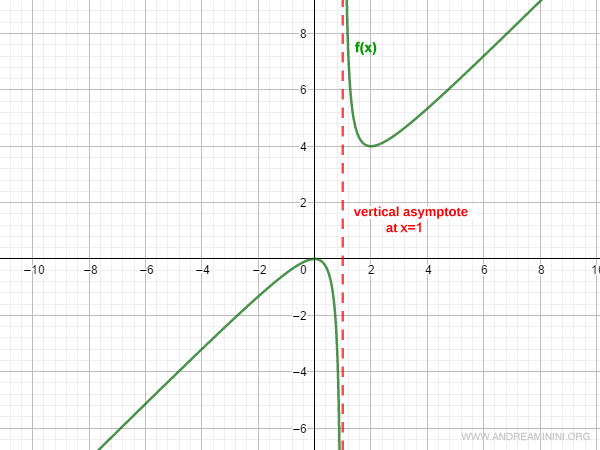
Here’s a practical example of a vertical asymptote:

In practice, a vertical asymptote is a line parallel to, or coinciding with, the y-axis.
Example
Let’s check whether the following function has any vertical asymptotes:
$$ f(x) = \frac{x^2}{x-1} $$
This function is undefined at x = 1.
We now evaluate the limit as x approaches 1 from both sides:
$$ \lim_{x \rightarrow 1^+ } \frac{x^2}{x-1} = +∞ $$
$$ \lim_{x \rightarrow 1^- } \frac{x^2}{x-1} = -∞ $$
Therefore, the function has a vertical asymptote at x = 1.
Oblique Asymptotes
A function has an oblique asymptote if the limit, as x approaches +∞ or -∞, of the difference between the function $ f(x) $ and the line $ y = mx + q $ is zero: $$ \lim_{x \rightarrow \pm \infty} \left[ f(x) - (mx + q) \right] = 0 $$ If the graph of the function admits an oblique asymptote with equation $ y = mx + q $, then the slope $ m \ne 0 $ and the intercept $ q $ are finite, and can be computed as: $$ m = \lim_{x \to \infty} \frac{f(x)}{x} $$ $$ q = \lim_{x \to \infty} \left[ f(x) - mx \right] $$
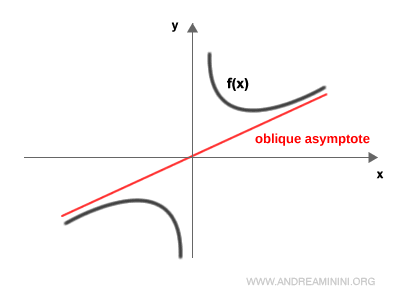
Here’s a practical example of an oblique asymptote:
To determine whether an oblique asymptote exists as x → +∞, we first calculate the slope m:
$$ m = \lim_{x \rightarrow +∞ } \frac{f(x)}{x} \ne 0 $$
Proof. If $$ \lim_{x \rightarrow +∞ } f(x) - (mx+q) = 0 $$ then we can initially set q = 0 and compute: $$ \lim_{x \rightarrow +∞ } f(x) - mx = 0 $$ Since the limit tends to zero as x → ∞, we can safely divide by x: $$ \lim_{x \rightarrow +∞ } \frac{f(x) - mx}{x} = 0 $$ $$ \lim_{x \rightarrow +∞ } \frac{f(x)}{x} - m = 0 $$ $$ \lim_{x \rightarrow +∞ } \frac{f(x)}{x} = m $$
If the slope m exists and is non-zero, we then compute the intercept q:
$$ q= \lim_{x \rightarrow ±∞ } f(x) - mx \ne ∞ $$
Proof. If $$ \lim_{x \rightarrow +∞ } f(x) - (mx+q) = 0 $$ then: $$ \lim_{x \rightarrow +∞ } f(x) - mx - q = 0 $$ $$ \lim_{x \rightarrow +∞ } f(x) - mx = q $$
If q exists and is finite, the function has an oblique asymptote y = mx + q as x → +∞. Otherwise, it does not.
The same method applies to check for an oblique asymptote as x → -∞.
Example
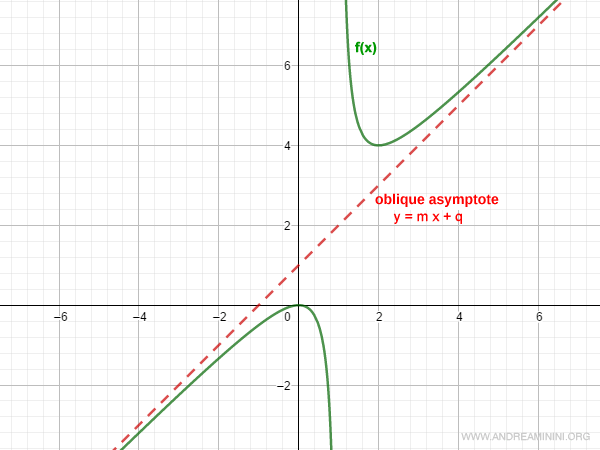
Let’s check whether the following function has an oblique asymptote:
$$ f(x) = \frac{x^2}{x-1} $$
First, we verify that the limit as x → ∞ is infinite:
$$ \lim_{x \rightarrow ∞} \frac{x^2}{x-1} = ∞ $$
Note. This is an indeterminate form ∞/∞, which can easily be resolved using L'Hôpital’s Rule.
Next, we determine whether the slope m is non-zero:
$$ m = \lim_{x \rightarrow ∞} \frac{ \frac{x^2}{x-1} }{x} $$
$$ m = \lim_{x \rightarrow ∞} \frac{x^2}{x(x-1)} $$
$$ m = \lim_{x \rightarrow ∞} \frac{x}{(x-1)} = 1 $$
Since m = 1 is finite and non-zero, we now compute the intercept q:
$$ q = \lim_{x \rightarrow ∞} \frac{x^2}{x-1} - mx $$
Since m = 1:
$$ q = \lim_{x \rightarrow ∞} \frac{x^2}{x-1} - x $$
$$ q = \lim_{x \rightarrow ∞} \frac{x^2-x^2+x}{x-1} $$
$$ q = \lim_{x \rightarrow ∞} \frac{x}{x-1} = 1 $$
Thus, the function has an oblique asymptote with slope m = 1 and intercept q = 1:
Oblique Asymptotes of Rational Functions
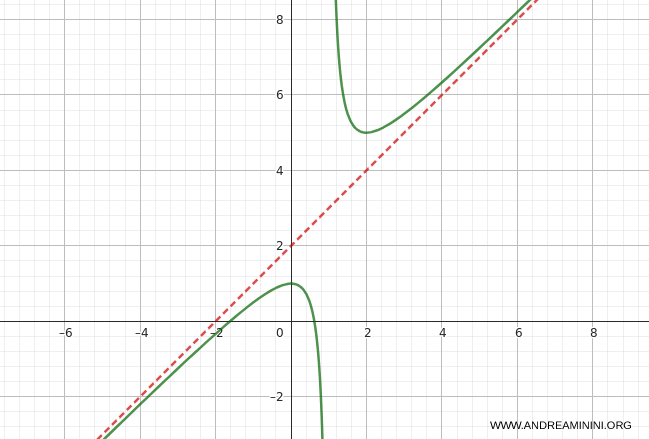
A rational function $ f(x)=\frac{A(x)}{B(x)} $ admits exactly one oblique (slant) asymptote if and only if the degree $ n $ of the numerator polynomial $ A(x) $ is exactly one greater than the degree $ m $ of the denominator polynomial $ B(x) $. $$ n = m+1 $$
Example
Consider the rational function:
\[ f(x) = \frac{x^3 + 2x^2 - 1}{x^2 - 1} \]
The numerator has degree 3, while the denominator has degree 2.
$$ n=3 $$
$$ m=2 $$
The difference is $ 3-2=1 $, so an oblique asymptote exists.
To determine it, carry out polynomial division
$$ \begin{array}{cccc|cc} x^3 & +2x^2 & 0x & -1 & x^2 & -1 \\ -x^3 & & +x & & x +2 \\ \hline & 2x^2 & +x & \\ & -2x^2 & & +2 \\ \hline & & -x & +1 \end{array} $$
Thus, the quotient is \( Q(x) = x+2 \) and the remainder is \( R(x) = -x+1 \)
The division of two polynomials can be written as
$$ \frac{A(x)}{B(x)} = Q(x) + \frac{ R(x) }{B(x)} $$
Explanation. Since $$ A(x):B(x) = Q(x) \text{ with remainder } R(x) $$ it follows that $$ A(x) = Q(x) \cdot B(x) + R(x) $$ Dividing both sides by $ B(x) $ gives $$ \frac{A(x)}{B(x)} = Q(x) + \frac{R(x)}{B(x)} $$
Substituting, we obtain
$$ \frac{x^3+2x^2-1}{x^2-1} = (x+2) + \frac{-x+1}{x^2-1} $$
As $ x \to \infty $, the remainder term tends to zero
$$ \lim_{x \to \infty} \frac{-x+1}{x^2-1} = 0 $$
Therefore, the graph of the function approaches the line $ y=x+2 $ as $ x \to \infty $.
In other words, for large values of $ x $, the function behaves like $ f(x) \approx x + 2 $.
Hence, the oblique asymptote is
$$ y = x + 2 $$
The key idea is that, asymptotically, the linear term \( x + 2 \) dominates, while the remainder becomes negligible. As a result, the graph gets arbitrarily close to the line \( y = x + 2 \).
And so on.