Accumulation Points
Consider a set I of real numbers. A point x0 is called an accumulation point of I if, for any δ > 0, there exists at least one real number x in I such that $$ 0 \ne |x - x_0| < \delta $$

If there’s at least one point x in the interval (x0 - δ, x0 + δ) belonging to I and distinct from x0, then x0 is an accumulation point of I.
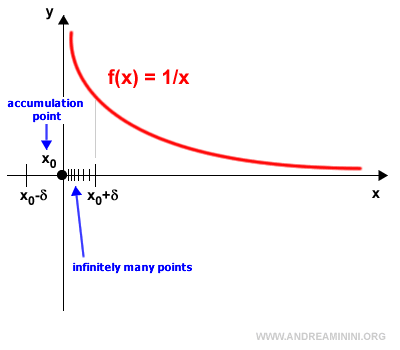
In simpler terms, a point $ x_0 $ is an “accumulation point” of the set $ I $ if every full neighborhood of $ x_0 $ contains infinitely many points of $ I $. The term “accumulation” reflects the fact that points cluster, that is, they become densely packed, around $ x_0 $.
It is important to note that an accumulation point may either belong to the set $ I $ or lie outside the set itself.
Note. If the set I consists of a single point [a,b] where a = b, then I has no accumulation points, since there are no other points around x0 besides x0 = a.
The Case of Closed and Open Intervals
It’s essential to distinguish between closed and open intervals:
- In a closed interval [a, b] where a < b, every point within [a, b] is an accumulation point of the interval.
- In an open interval (a, b) where a < b, every point inside (a, b) is an accumulation point, and the endpoints a and b are also accumulation points of (a, b).
Therefore, the accumulation points of an open interval (a, b) are the same as those of the closed interval [a, b].
Infinitely Many Real Numbers in the Neighborhood
If I is a subset of the set of real numbers R, $$ I \subseteq R $$ then the point x0 ∈ R is an accumulation point of I only if every neighborhood (x0 - δ, x0 + δ) contains infinitely many points of I distinct from x0.
Proof
Suppose x0 is an accumulation point. Assume, for the sake of contradiction, that there are only finitely many, say k, real numbers in the neighborhood of x0 for some δ > 0.
$$ | x_0 - x_i | < \delta \quad \forall i = 1, \dots, k $$
Define a new δ1 as the smallest distance between x0 and any of these points:
$$ \delta_1 = \min | x_0 - x_i | \quad \forall i = 1, \dots, k $$
In the neighborhood (x0 - δ1, x0 + δ1), there would be no points of I other than x0 itself.
$$ (x_0 - \delta_1, x_0 + \delta_1) $$
But this contradicts our initial assumption that x0 is an accumulation point.
Therefore, if x0 is an accumulation point in the real numbers R, every neighborhood around x0 must contain infinitely many points of R.
Sequences Drawn from the Neighborhood Converge to the Accumulation Point
If x0 is an accumulation point of a set I in R, then there exists a sequence of points xn in I, all distinct from x0, that converges to x0.

Proof
Take any natural number n ∈ N to define the neighborhood radius δ:
$$ \delta = \frac{1}{n} $$
This determines a neighborhood around x0:
$$ ( x_0 - \delta, \; x_0 + \delta ) $$
Since x0 is an accumulation point, there are infinitely many points in I, distinct from x0, within this neighborhood.
$$ x_0 - \frac{1}{n} < x_n < x_0 + \frac{1}{n} $$
This inequality defines three sequences taken from I for each n ∈ N.
Let’s evaluate the limits of these three sequences as n approaches infinity:
$$ \lim_{n \rightarrow \infty} \left(x_0 - \frac{1}{n}\right) < \lim_{n \rightarrow \infty} x_n < \lim_{n \rightarrow \infty} \left(x_0 + \frac{1}{n}\right) $$
The limits of the first and third sequences both converge to x0 as n → ∞:
$$ x_0 < \lim_{n \rightarrow \infty} x_n < x_0 $$
By the Squeeze Theorem, the limit of the intermediate sequence must also converge to x0.
This completes the proof.
Given an accumulation point x0 of the set I, if every sequence xn drawn from I \ {x0} converging to x0 results in a sequence f(xn) converging to some limit l, then the function f(x) has a limit equal to l as x approaches x0. $$ \lim_{x \rightarrow x_0} f(x) = l $$
Example
Consider the function f(x) = x2 + 1. The point x0 = 0 is an accumulation point relative to the set I = (-1, 0).
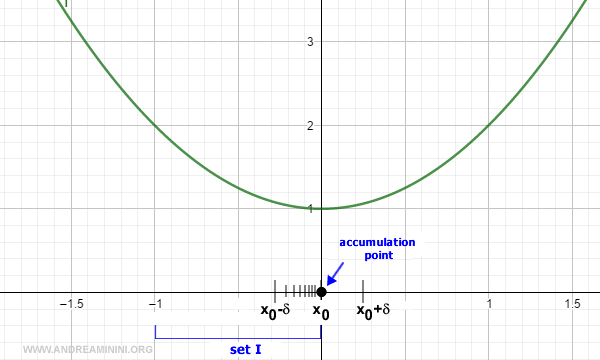
For any neighborhood (x0 - δ, x0 + δ), any sequence xn drawn from I and converging to x0 produces a sequence f(xn) that converges to l = 1.
Hence, the limit of the function as x → 0 is 1.
$$ \lim_{x \rightarrow 0} \; x^2 + 1 = 1 $$
Infinity as an Accumulation Point
An accumulation point can also be at infinity (+∞ or -∞) for a set I ⊆ R if there’s at least one point from I in a neighborhood of infinity.

In this case, the neighborhood of the accumulation point x0 is an interval of the form (M, +∞) that includes all real numbers x > M.
Of course, +∞ is an accumulation point only if it’s the least upper bound of the set I.
Note. The same holds for the neighborhood (-∞, -M), for any x < -M. In this case, -∞ is an accumulation point only if it’s the greatest lower bound of I.

And so on.