
Limits
What Is a Limit?
A limit is a fundamental concept in mathematics that helps us analyze how a function or a sequence behaves as its input x (for functions) or its index n (for sequences) approaches a particular value x0, whether finite or infinite. $$ \lim_{x \rightarrow x_0 } $$
Limit of a Sequence
The limit of a sequence an describes how the terms of the sequence behave as the index n grows larger and larger.
$$ \lim_{n \rightarrow x_0 } a_n = l $$
Here, x0 may be a finite real number or positive or negative infinity.
Limit of a Function
The limit of a function f(x) tells us how the function behaves as its variable x approaches a particular value x0.
$$ \lim_{x \rightarrow x_0 } f(x) = l $$
Again, x0 can be finite or extend to positive or negative infinity.
The General Definition of a Limit
The concept of a limit can be defined in a unified way for both sequences and functions, since a sequence is simply a special kind of function f: N → R.
Moreover, from any function f(x), we can construct a sequence by defining an = f(n) for all n ∈ N.
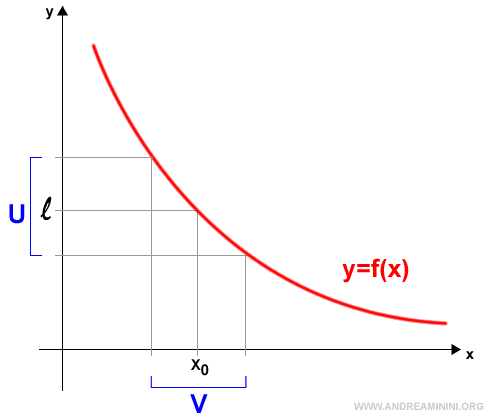
Let f(x) be a function defined on a set I ⊆ R, and let x0 ∈ (-∞, +∞) be an accumulation point of I. We say that f(x) has a limit equal to l ∈ (-∞, +∞) as x approaches x0 if, for every neighborhood U of l, there exists a neighborhood V of x0 such that $$ x \in V \setminus \{x_0\} \Rightarrow f(x) \in U $$
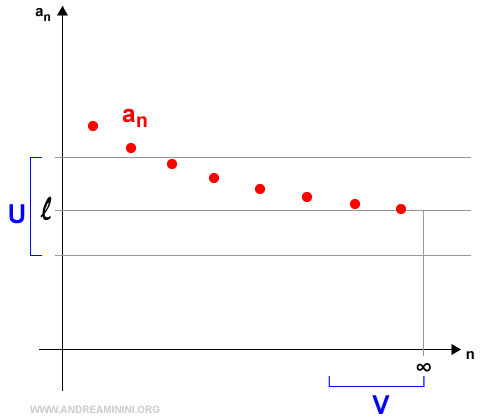
Since the set of natural numbers N has only one accumulation point at positive infinity, when dealing with sequences we consider the limit solely as n → ∞.
$$ \lim_{n \rightarrow \infty} a_n = l $$
Below is a graphical illustration of the limit of a sequence an.
And so on.


