Left-Hand Limit
A function f(x), defined on an interval (a, c), is said to have a left-hand limit as x approaches c from the left if: $$ \lim_{x \rightarrow c^-} f(x) = l $$ In other words, for any ε > 0, there exists a δ > 0 such that whenever $$ c - δ < x < c, \text{ then } |f(x) - l| < ε. $$
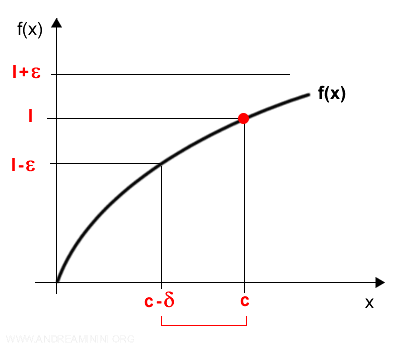
For the left-hand limit to exist, the definition must hold over the open interval (c - δ, c), which includes values strictly less than c.
Note. When evaluating the left-hand limit of a function at a point c, we only consider values approaching c from the left. We do not take into account values to the right of c (which pertain to the right-hand limit), nor the function’s value exactly at c itself. These may or may not exist independently of the left-hand limit.
A Practical Example
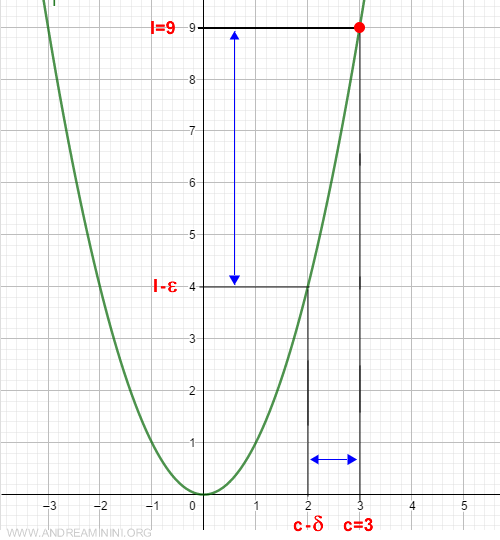
Let’s examine the function f(x) = x2 at the point c = 3.
The left-hand limit of the function is:
$$ \lim_{x \rightarrow 3^-} f(x) = 9 $$
Verification
First, choose an arbitrary value ε = 5, which is greater than zero.
$$ l - ε = 9 - 5 = 4 $$
This allows us to find a value δ = 1, also greater than zero, and define the interval:
$$ (c - δ, c) = (3 - 1, 3) = (2, 3) $$
For any x within the open interval (2, 3) along the x-axis, the absolute difference between f(x) and the left-hand limit l is less than ε.
Therefore, the left-hand limit of the function f(x) at the point c is indeed 9.
Left-hand infinite limit as x approaches x₀
Left-hand limit +∞
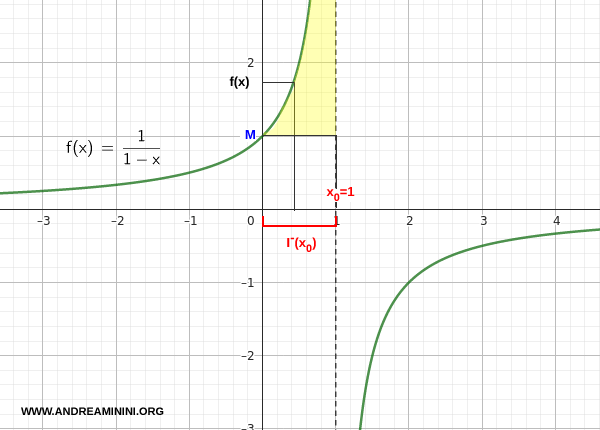
Let f(x) be a function defined in a left-hand neighborhood of $ x_0 $ (though not necessarily at $ x_0 $). We say that f(x) tends to +∞ as x approaches $ x_0 $ from the left, and we write: \[ \lim_{x \to x_0^-} f(x) = +\infty \] if, for every positive real number $ M > 0 $, there exists a left-hand neighborhood $ I^-(x_0) $ such that: \[ f(x) > M \] for every $ x $ belonging to $ I^-(x_0) $. \[ \forall \ M > 0 \ \exists \ I^-(x_0) \ | \ f(x) > M,\ \forall \ x \in I^-(x_0) \]
In this case, we also say that the function f diverges positively to the left of $ x_0 $.
For example, consider the function
\[ f(x) = \frac{1}{1 - x} \]
We examine the limit as $ x $ approaches 1 from the left.
For $ x < 1 $, we have $ 1 - x > 0 $ and $ 1 - x \to 0^+ $. As a consequence, f(x) takes positive values that become arbitrarily large.
Therefore:
\[ \lim_{x \to 1^-} \frac{1}{1 - x} = +\infty \]
The function diverges positively to the left of 1.
Left-hand limit -∞
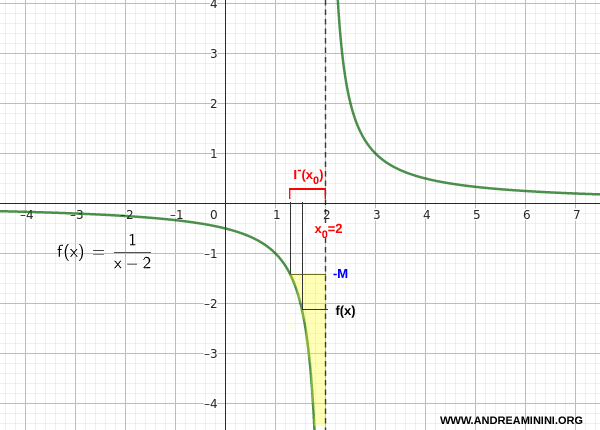
We say that f(x) tends to -∞ as x approaches x₀ from the left, and we write: \[ \lim_{x \to x_0^-} f(x) = -\infty \] if, for every positive real number $ M > 0 $, there exists a left-hand neighborhood $ I^-(x_0) $ such that: \[ f(x) < -M \] for every $ x $ belonging to $ I^-(x_0) $. \[ \forall \ M > 0 \ \exists \ I^-(x_0) \ | \ f(x) < -M,\ \forall \ x \in I^-(x_0) \]
In this case, we also say that the function f diverges negatively to the left of x₀.
For example, consider the function
\[ f(x) = \frac{1}{x - 2} \]
We study the limit as x approaches 2 from the left.
For $ x < 2 $, the denominator is negative and tends to zero. As a result, f(x) takes negative values whose absolute value grows without bound.
Therefore:
\[ \lim_{x \to 2^-} \frac{1}{x - 2} = -\infty \]
The function diverges negatively to the left of 2.