Neighborhood in Mathematics
A neighborhood is an open interval that contains a point x0.
$$ (x_0-\delta, \, x_0+\delta) $$
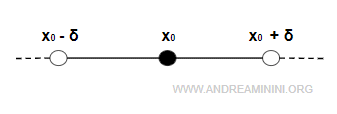
Typically, a neighborhood is an open interval that does not include its endpoints.
A Practical Example
Suppose the point x0 equals ten:
$$ x_0 = 10 $$
and we choose delta equal to two:
$$ \delta = 2 $$
Then the neighborhood is the interval extending from eight to twelve:
$$ (x_0-\delta, \, x_0+\delta) $$
$$ (10-2, \, 10+2) $$
$$ (8, 12) $$
This interval includes all numbers strictly between eight and twelve, excluding the endpoints.
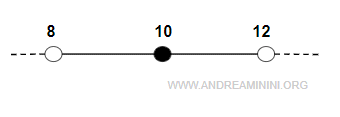
Note. Unless otherwise specified, the point x0 is considered part of the neighborhood. It may be located at the center of the interval, but this isn’t always the case. In some contexts, x0 can even coincide with one of the interval’s endpoints.