
Right-Hand and Left-Hand Limits of a Function
The limit of a function as x approaches x0 can be evaluated either from the right (x → x0+), meaning we approach x0 with values greater than x0. This is known as the right-hand limit:
$$ \lim_{x \rightarrow x_0^+} f(x) $$ or from the left (x → x0-), meaning we approach x0 with values less than x0. This is called the left-hand limit:
$$ \lim_{x \rightarrow x_0^-} f(x) $$
The right-hand or left-hand limit may be finite or infinite.
At certain points, a function may not possess either a right-hand or left-hand limit.
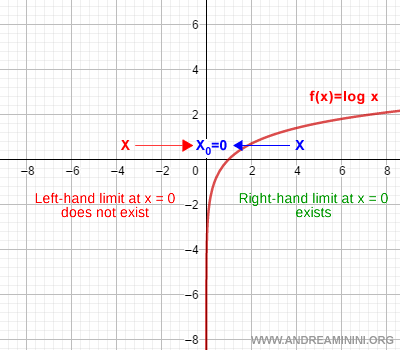
Example. The logarithmic function f(x) = log(x) is defined only for positive real numbers, i.e. x ∈ (0, +∞). As a result, the limit as x approaches 0 exists solely from the right, that is, as x → 0+. There is no left-hand limit as x approaches zero.
Right-Hand Limit of a Function
Definition of the right-hand limit:
The right-hand limit of a function f(x) as x → x0+ equals l if, for every ε > 0, there exists a δ > 0 such that |f(x) - l| < ε for all x satisfying x0 < x < x0 + δ:
$$ \lim_{x \rightarrow x_0^+} f(x) = l $$
Expressed symbolically:
$$ \lim_{x \rightarrow x_0^+} f(x) = l \Leftrightarrow \forall \epsilon>0, \exists \delta>0: |f(x)-l|<\epsilon, \forall x \in (x_0, x_0+\delta) $$
Note. The right-hand limit can also be described using sequences: if we consider a sequence xn approaching x0 from the right, then f(xn) converges to l as n grows large.
Example
The function f(x) = 1/x is undefined at x = 0:
$$ f(x) = \frac{1}{x} $$
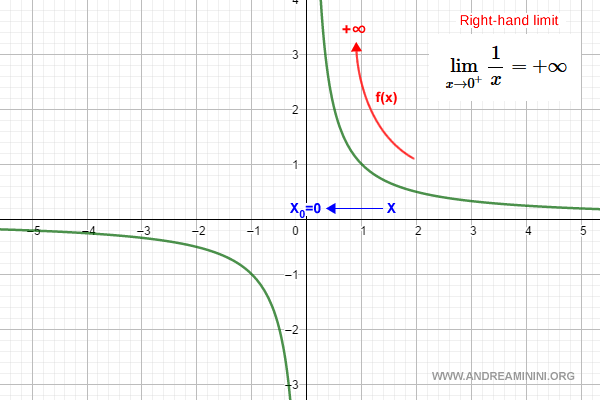
We evaluate the limit as x → 0+ from the right without ever reaching x = 0:
$$ \lim_{x \rightarrow 0^+} \frac{1}{x} $$
The right-hand limit exists and equals +∞:
$$ \lim_{x \rightarrow 0^+} \frac{1}{x} = +\infty $$
Here’s how this appears on the graph:
Left-Hand Limit of a Function
Definition of the left-hand limit:
The left-hand limit of a function f(x) as x → x0- equals l if, for every ε > 0, there exists a δ > 0 such that |f(x) - l| < ε for all x satisfying x0 - δ < x < x0:
$$ \lim_{x \rightarrow x_0^-} f(x) = l $$
Expressed symbolically:
$$ \lim_{x \rightarrow x_0^-} f(x) = l \Leftrightarrow \forall \epsilon>0, \exists \delta>0: |f(x)-l|<\epsilon, \forall x \in (x_0-\delta, x_0) $$
Note. The left-hand limit can also be defined using sequences: if we take a sequence xn approaching x0 from the left, then f(xn) approaches l as n increases.
Example
The function f(x) = 1/x is undefined at x = 0:
$$ f(x) = \frac{1}{x} $$
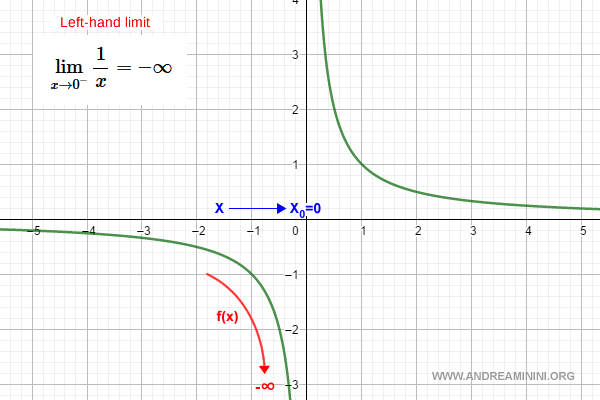
We evaluate the limit as x → 0- from the left without ever reaching x = 0:
$$ \lim_{x \rightarrow 0^-} \frac{1}{x} $$
The left-hand limit exists and equals -∞:
$$ \lim_{x \rightarrow 0^-} \frac{1}{x} = -\infty $$
Note. In this case, the limit approaches negative infinity because x approaches zero from the left. Thus, the values of x remain negative, such as x = -0.3, x = -0.1, x = -0.01, and so on.
Here’s how this is represented on the Cartesian plane:
A worked example
Let us examine a concrete example by considering the following function, defined piecewise.
\[
f(x)=
\begin{cases}
x^2 & \text{if } x<2 \\ \\
4x-4 & \text{if } x\ge 2
\end{cases}
\]
Right-hand limit
We begin by analyzing the right-hand limit at \( x=2 \).
\[ \lim_{x\to 2^+} f(x)=4 \]
Because this is a right-hand limit \( x \to 2^+ \), we only consider values of \( x \) that are greater than 2.
In this region, sufficiently close to 2, the function is described by the second branch:
\[ f(x)=4x-4 \]
By definition, saying that \( f(x) \) converges to 4 as \( x\to 2^+ \) means that for every \( \varepsilon>0 \), there exists a right-hand neighborhood of 2 such that
\[ |f(x)-4|<\varepsilon \]
whenever \( x \) belongs to that neighborhood.
Substituting \( f(x)=4x-4 \), we obtain
\[ |(4x-4)-4|<\varepsilon \]
which simplifies to
\[ |4x-8|<\varepsilon \]
Using the standard property of absolute values,
\[ |A|<\varepsilon \quad \Longleftrightarrow \quad -\varepsilon<A<\varepsilon \]
and setting \( A=4x-8 \), we get
\[ -\varepsilon<4x-8<\varepsilon \]
Adding 8 to all terms yields
\[ 8-\varepsilon<4x<8+\varepsilon \]
Dividing by 4 gives
\[ 2-\frac{\varepsilon}{4}<x<2+\frac{\varepsilon}{4} \]
Since we are interested only in values with \( x>2 \), we keep the right-hand portion:
\[ 2<x<2+\frac{\varepsilon}{4} \]
This interval is a right-hand neighborhood of 2.
Writing the condition in terms of \( \delta \), we simply set \( \delta=\frac{\varepsilon}{4} \). Then
\[ 2<x<2+\delta \]
or, equivalently,
\[ 0<x-2<\delta \]
which ensures
\[ 0<x-2<\delta \quad \Longrightarrow \quad |f(x)-4|<\varepsilon \]
Since this construction works for every \( \varepsilon>0 \), we conclude that
\[ \lim_{x\to 2^+} f(x)=4 \]
Left-hand limit
We now turn to the left-hand limit at the same point.
\[
f(x)=
\begin{cases}
x^2 & \text{if } x<2 \\ \\
4x-4 & \text{if } x\ge 2
\end{cases}
\]
We want to verify that
\[ \lim_{x\to 2^-} f(x)=4 \]
Because \( x\to 2^- \), we restrict attention to values with \( x<2 \).
In a left-hand neighborhood of 2, the function is therefore given by the first branch:
\[ f(x)=x^2 \]
By definition, \( f(x) \) converges to 4 as \( x\to 2^- \) if, for every \( \varepsilon>0 \),
\[ |f(x)-4|<\varepsilon \]
whenever \( x \) is sufficiently close to 2 from the left.
Substituting \( f(x)=x^2 \), we obtain
\[ |x^2-4|<\varepsilon \]
This expression is a difference of squares and can be factored as
\[ |x^2-4|=|(x-2)(x+2)|=|x-2|\cdot|x+2| \]
The condition becomes
\[ |x-2|\cdot|x+2|<\varepsilon \]
To control the factor \( |x+2| \), we restrict \( x \) to a small left-hand neighborhood of 2, for example
\[ 1<x<2 \]
Adding 2 to each term gives
\[ 3<x+2<4 \]
so that
\[ |x+2|<4 \]
This bound allows us to simplify the estimate. Indeed, if \(|x+2|<4 \), then
\[ |x-2|\cdot|x+2|<4|x-2| \]
It is therefore sufficient to require
\[ 4|x-2|<\varepsilon \]
which leads to
\[ |x-2|<\frac{\varepsilon}{4} \]
To ensure that we remain on the left of 2, we must also impose \( x<2 \).
In summary, the analysis relies on two conditions.
- \( 1<x<2 \), which provides a bound on the factor \( |x+2| \)
- \( |x-2|<\varepsilon/4 \), which makes the product \( |x^2-4| \) arbitrarily small
The inequality \(|x-2|<\varepsilon/4 \) is equivalent to
\[ -\frac{\varepsilon}{4}<x-2<\frac{\varepsilon}{4} \]
Adding 2 throughout, we obtain
\[ 2-\frac{\varepsilon}{4}<x<2+\frac{\varepsilon}{4} \]
Combining this with the condition \( x<2 \) yields
\[ 2-\frac{\varepsilon}{4}<x<2 \]
This interval is a left-hand neighborhood of 2.
Consequently, if $ x $ is sufficiently close to 2 from the left, then $ x^2 $ is sufficiently close to 4.
\[ \lim_{x\to 2^-} f(x)=4 \]
Therefore, the left-hand limit is also equal to 4.
And so on.


