Infinite Limits
A function \( f(x) \) diverges to infinity as \( x \to \alpha \) if its values increase without bound or decrease without bound as \( x \) approaches \( \alpha \). \[ \lim_{x \to \alpha} f(x) = \pm \infty \]
In other words, the values of the function become arbitrarily large in magnitude, either positive or negative, as \( x \) approaches \( \alpha \).
A practical example
Consider the function
\[ f(x) = \frac{1}{x - 1} \]
As \( x \to 1 \), the denominator approaches zero.
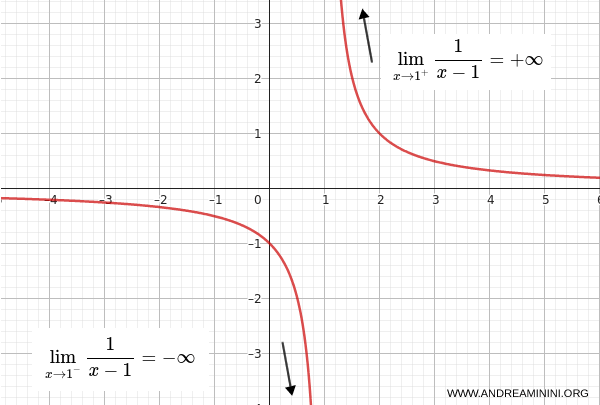
- If \( x \to 1^+ \) (from the right), the denominator \( x-1 > 0 \) becomes very small but remains positive, so the function diverges to positive infinity \( f(x) \to +\infty \) $$ \lim_{x \to 1^+} \frac{1}{x - 1} = + \infty $$
- If \( x \to 1^- \) (from the left), the denominator \( x-1 < 0 \) becomes very small but remains negative, so the function diverges to negative infinity \( f(x) \to -\infty \) $$ \lim_{x \to 1^-} \frac{1}{x - 1} = - \infty $$
Therefore, the function diverges at \( x = 1 \).
However, it does not have a limit as $ x \to 1 $, since the right-hand and left-hand limits are different.
$$ \lim_{x \to 1^+} \frac{1}{x - 1} \ne \lim_{x \to 1^-} \frac{1}{x - 1} $$
This behavior is clearly visible in the graph of the function.
Example 2
A function may also diverge to infinity as the variable itself becomes unbounded.
For example, consider the function
\[ f(x) = x^2 \]
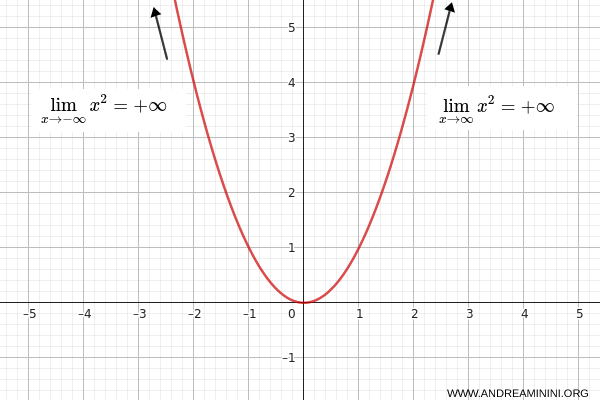
As \( x \to +\infty \), the function diverges to infinity \( x^2 \to +\infty \).
$$ \lim_{x \to \infty} x^2 = + \infty $$
The same holds as \( x \to -\infty \). In this case as well, the function diverges to infinity \( x^2 \to +\infty \).
$$ \lim_{x \to - \infty} x^2 = + \infty $$
In both cases, the function tends to positive infinity.
Simultaneous divergence to infinity
If two functions \( f(x) \) and \( g(x) \) both diverge to infinity as \( x \to \alpha \), they are said to exhibit simultaneous divergence to infinity.
Their relative growth rates determine the following classifications.
- Same order of infinity
If the limit of the ratio of the two functions is a finite nonzero constant ( \( l \ne 0 \) ), then f(x) and g(x) are of the same order of infinity. $$ \lim_{ x \to \alpha } \frac{f(x)}{g(x)} = l \ne 0 $$ - Higher order of infinity
If the limit of the ratio of the two functions is infinite ( \( \pm \infty \) ), then the function f(x) in the numerator is of higher order than g(x), since it diverges more rapidly. $$ \lim_{ x \to \alpha } \frac{f(x)}{g(x)} = \pm \infty $$ - Lower order of infinity
If the limit of the ratio of the two functions is zero, then the function f(x) in the numerator is of lower order than g(x), since it diverges more slowly. $$ \lim_{ x \to \alpha } \frac{f(x)}{g(x)} = 0 $$
If the limit of the ratio does not exist as $ x \to \alpha $, the functions are not comparable in terms of their order of infinity.
Example
Consider the functions
$$ f(x)=x^3 $$
$$ g(x)=x^2 $$
As \( x \to +\infty \), both functions diverge to infinity:
$$ \lim_{x \to + \infty} x^3 = + \infty $$
$$ \lim_{x \to + \infty} x^2 = + \infty $$
Thus, both functions exhibit simultaneous divergence to infinity as $ x \to \infty $.
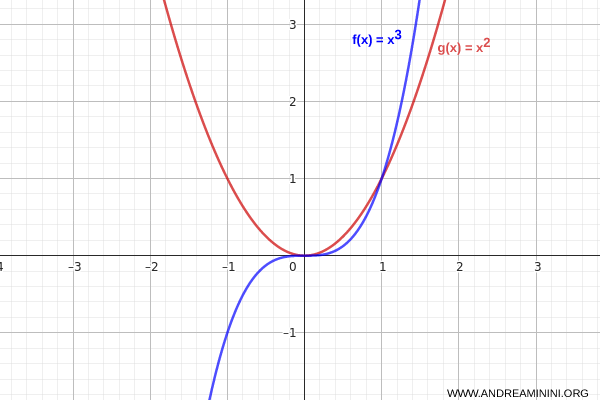
Since \( x^3 \) grows faster than \( x^2 \), it follows that \( x^3 \) is of higher order than \( x^2 \) as $ x \to \infty $.
$$ \lim_{x \to \infty} \frac{x^3}{x^2} = \lim_{x \to \infty} x = + \infty $$
Consequently, \( x^2 \) is of lower order than \( x^3 \).
Order of growth
Let \( f(x) \) and \( g(x) \) be two functions that both diverge as \( x \to a \). We say that \( f(x) \) has order \( \gamma \) with respect to \( g(x) \) if \[ \lim_{x \to a} \frac{f(x)}{[g(x)]^\gamma} = l \neq 0. \] In this case, \( f(x) \) and \( [g(x)]^\gamma \) are said to have the same order of growth.
The idea is simple: compare how fast two functions grow.
If the ratio between f(x) and a power of g(x), used as a reference function, approaches a finite nonzero value, then the two functions grow at essentially the same rate, up to a constant factor.
The exponent \( \gamma \) tells us exactly how much faster f(x) grows compared to g(x). It does not just say that a function diverges, it gives a precise way to measure and compare different rates of growth.
Reference function
If the reference function g(x) is not specified, one of the following standard choices is usually assumed:
- $ g(x) = \frac{1}{x - x_0} $ for $ x \to x_0 $
- $ g(x) = x $ for $ x \to \infty $
These functions act as standard benchmarks for comparing growth rates.
Example
Consider the function
$$ f(x) = x^2 $$
Take as the reference function
$$ g(x) = x \quad \text{for } x \to \infty $$
Now compute the order of growth of f(x) with respect to g(x)
$$ \frac{f(x)}{[g(x)]^\gamma} = \frac{x^2}{x^\gamma} $$
For the limit to be finite and nonzero, we must have
$$ 2 - \gamma = 0 \Rightarrow \gamma = 2 $$
Therefore, \( x^2 \) has order 2 with respect to \( x \).
The same method can be applied to compare any pair of functions.
Hierarchy of growth rates
As \( x \to +\infty \), the functions \( (\log_a x)^\alpha \), \( x^\beta \), and \( b^x \) all diverge, but at fundamentally different rates of growth. The corresponding asymptotic hierarchy is $$ (\log_a x)^\alpha \ll x^\beta \ll b^x $$ where $ a,b>1 $ and $ \alpha, \beta > 0 $.
In other words, logarithmic functions grow more slowly than any power function, while power functions grow more slowly than exponential functions. This hierarchy is made precise by examining limits of ratios that vanish as \( x \to +\infty \).
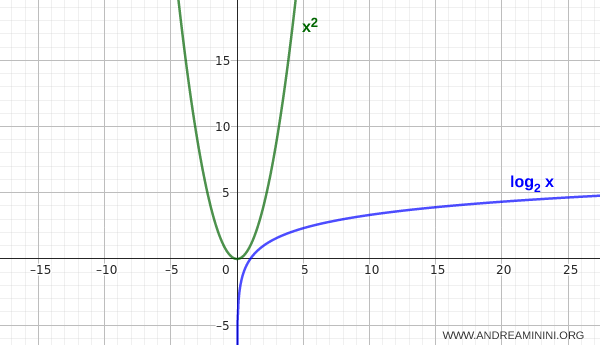
In the first comparison, we consider a power of a logarithm relative to a power of \( x \):
\[ \lim_{x \to +\infty} \frac{(\log_a x)^\alpha}{x^\beta} = 0 \]
Even when raised to an arbitrary positive power, the logarithm grows so slowly that it is asymptotically negligible compared to any polynomial in \( x \). In standard asymptotic notation, the logarithmic term is dominated by the polynomial term.
In the second comparison, between a polynomial and an exponential function, we obtain:
\[ \lim_{x \to +\infty} \frac{x^\beta}{b^x} = 0 \]
Exponential functions grow at a rate that eventually outpaces any polynomial. As a result, every power of \( x \), even with a large exponent, becomes asymptotically negligible in comparison. The exponential term therefore dominates.
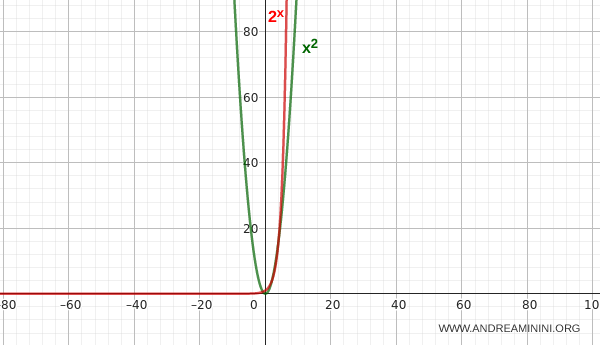
Taken together, these results establish a strict hierarchy of growth rates. For sufficiently large \( x \), each function is asymptotically dominated by the next.
Asymptotic equivalence of functions
Two functions \( f(x) \) and \( g(x) \), as \( x \to \alpha \), are said to be asymptotically equivalent if \[ \lim_{x \to \alpha} \frac{f(x)}{g(x)} = 1 \] In this case, we write \( f \sim g \).
This condition means that the two functions share the same order of growth. Since their ratio tends to 1, they grow or decay at the same rate.
Substitution principle
If \( f(x) \sim g(x) \) as \( x \to \alpha \), then \( f(x) \) may be replaced by \( g(x) \) within a limit, provided that the substitution preserves the structure of the expression.
\[ \lim_{x \to \alpha} \frac{f(x)}{h(x)} = \lim_{x \to \alpha} \frac{g(x)}{h(x)} \]
This replacement is justified because, as \( x \to \alpha \), the ratio \( \frac{f(x)}{g(x)} \) tends to 1:
\[ \lim_{x \to \alpha} \frac{f(x)}{h(x)} = \lim_{x \to \alpha} \frac{f(x)}{h(x)} \cdot \frac{g(x)}{g(x)} = \lim_{x \to \alpha} \frac{g(x)}{h(x)} \cdot \frac{f(x)}{g(x)} = \lim_{x \to \alpha} \frac{g(x)}{h(x)} \cdot 1 = \lim_{x \to \alpha} \frac{g(x)}{h(x)} \]
Note. This substitution is not universally valid. It works reliably for products and quotients, but it is not automatically applicable to sums or differences without additional analysis.
Example
Consider the limit
\[ \lim_{x \to \infty} \frac{ \sqrt{x^2+3x}}{ 2x } \]
The dominant term inside the square root is \( x^2 \), hence \( \sqrt{x^2+3x} \sim \sqrt{x^2} \). The two functions are therefore asymptotically equivalent.
\[ \lim_{x \to \infty} \frac{ \sqrt{x^2+3x}}{ \sqrt{x^2} } = 1 \]
Accordingly, we may replace \( \sqrt{x^2+3x} \) with \( \sqrt{x^2} \) in the original limit:
\[ \lim_{x \to \infty} \frac{ \sqrt{x^2+3x}}{ 2x } \]
\[ \lim_{x \to \infty} \frac{ \sqrt{x^2}}{ 2x } \]
Since \( \sqrt{x^2} = x \) as \( x \to \infty \)
\[ \lim_{x \to \infty} \frac{ x}{ 2x} = \frac{1}{2} \]
Thus, the limit evaluates to \( \frac{1}{2} \) as \( x \to \infty \).
And so on.