
Difference Quotient
What is the difference quotient?
The difference quotient of a function is $$ \frac{f(x+h)-f(x)}{h} $$
The quantity \( h \) represents the increment of the independent variable.
Understanding the difference quotient
Consider a function \( f(x) \) defined on an interval \( (a,b) \).
$$ f(x) $$
To better understand the meaning of the difference quotient, it helps to visualize the function on the Cartesian plane.
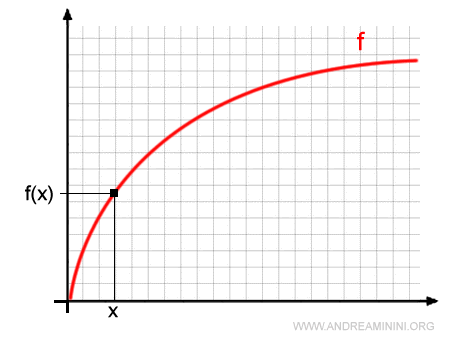
Now choose a generic value \( h \) in the interval \( (a,b) \). This value represents a change, or increment, in the independent variable \( x \).
After increasing \( x \) by \( h \), the function takes the new value
$$ f(x+h) $$
The corresponding variation can also be represented graphically.
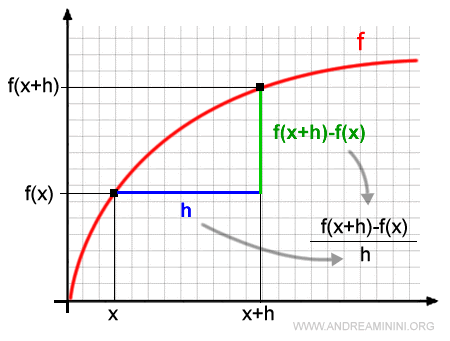
The change in the dependent variable, that is, the change in the function value, is
$$ f(x+h)-f(x) $$
The ratio between the change in the dependent variable and the change in the independent variable is called the difference quotient.
$$ \frac{f(x+h)-f(x)}{h} $$
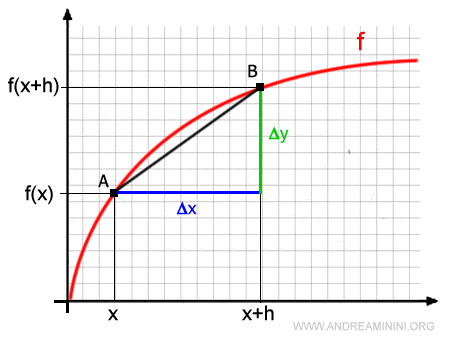
Geometrically, the difference quotient represents the slope of a secant line connecting two points on the graph of the function.
Note. The difference quotient is defined for every value of \( h \) except \( h=0 \). If \( h=0 \), the denominator becomes zero and the expression is undefined.
Given a function \( f(x) \) defined on an interval \([A,B]\), the difference quotient is equal to the slope of the secant line passing through the points A and B.
A practical example
Consider the function
\[ y=f(x)=x^2+2x \]
Now compute the difference quotient at the point with x-coordinate \( 2 \), using an increment \( h \).
Start with the definition of the difference quotient:
\[ \frac{\Delta y}{\Delta x}=\frac{f(2+h)-f(2)}{h} \]
First compute \( f(2+h) \) by substituting \( x=2+h \) into the function:
\[ f(2+h)=(2+h)^2+2(2+h) \]
Expand the expression:
\[ f(2+h) =(4+4h+h^2)+4+2h \]
\[ f(2+h) =8+6h+h^2 \]
Next compute \( f(2) \):
\[ f(2)=2^2+2 \cdot 2 \]
\[ f(2)=4+4=8 \]
Substitute the results into the difference quotient formula:
\[ \frac{f(2+h)-f(2)}{h} = \frac{(8+6h+h^2)-8}{h} \]
\[ \frac{f(2+h)-f(2)}{h} = \frac{6h+h^2}{h} \]
\[ \frac{f(2+h)-f(2)}{h} = \frac{h(6+h)}{h} \]
\[ \frac{f(2+h)-f(2)}{h} =6+h \]
This final expression represents the slope of the secant line to the parabola through the point with x-coordinate \( 2 \), as the increment \( h \) changes.
As \( h \) gets closer to zero, the secant line approaches the tangent line to the curve.


