Tangent Line to a Function
Given a function \( y=f(x) \), the tangent line at a point \( A(x_0;y_0) \) is the line that matches the direction of the graph at that specific point. Its equation is
\[ y-y_0=f'(x_0)(x-x_0) \]
This formula connects two fundamental ideas in calculus: the derivative and the slope of a line.
The equation of a line passing through a point \( (x_0;y_0) \) in the Cartesian plane is
\[ y-y_0=m(x-x_0) \]
In the case of a tangent line, the slope \( m \) is equal to the derivative of the function evaluated at the point:
\[ m=f'(x_0) \]
This is one of the most important applications of the derivative because it allows us to describe the local behavior of a function using a straight-line approximation.
Finding the tangent line step by step
Consider the function
\[ y=x^2+2x \]
I want to determine the equation of the tangent line to the graph at the point \( A(1;3) \).
Step 1. Verify that the point belongs to the curve
Before doing anything else, I check whether the point actually lies on the graph of the function.
Substituting \( x=1 \) into the equation gives
\[ y=1^2+2 \cdot 1 \]
\[ y=1+2=3 \]
Since the result is \( y=3 \), the point \( A(1;3) \) lies on the parabola.
Note. This quick check is extremely important. If the point does not belong to the graph, then a tangent line at that point cannot exist. Spending a few seconds verifying the coordinates can prevent a lot of unnecessary calculations later on.
Step 2. Write the family of lines through the point
The equation of the family of lines passing through a point \( (x_0 ; y_0 ) \) is
\[ y-y_0=m(x-x_0) \]
Substituting \( x_0=1 \) and \( y_0=3 \), I obtain
\[ y-3=m(x-1) \]
where \( m \) is the slope of the line.
Among all these lines, I now need to identify the one tangent to the curve.
Step 3. Compute the derivative
To determine the slope of the tangent line, I calculate the derivative of the function at \( x=1 \).
I start from the definition of the derivative:
\[ f'(x)=\lim_{h \to 0}\frac{f(x+h)-f(x)}{h} \]
Evaluating it at \( x=1 \):
\[ f'(1)=\lim_{h \to 0}\frac{f(1+h)-f(1)}{h} \]
Since the function is \( f(x)=x^2+2x \), we have
\[ f(1)=1^2+2 \cdot 1 \]
and
\[ f(1+h)=(1+h)^2+2(1+h) \]
Substituting into the formula:
\[ f'(1)=\lim_{h \to 0}\frac{[(1+h)^2+2(1+h)]-(1^2+2 \cdot 1)}{h} \]
Now simplify step by step:
\[ f'(1)=\lim_{h \to 0}\frac{[1+2h+h^2+2+2h]-3}{h} \]
\[ f'(1)=\lim_{h \to 0}\frac{[h^2+4h+3]-3}{h} \]
\[ f'(1)=\lim_{h \to 0}\frac{h^2+4h}{h} \]
\[ f'(1)=\lim_{h \to 0}(h+4) \]
As \( h \to 0 \), the limit becomes
\[ f'(1)=4 \]
Therefore, the slope of the tangent line is
\[ m=4 \]
Note. In this example I showed every step using the definition of the derivative so that you can clearly see how the slope of the tangent line is obtained. However, once you are comfortable working with derivatives, there is a much faster way to solve the problem. Given the function \[ y=x^2+2x \] its derivative is \[ y'=2x+2 \] To find the slope of the tangent line at the point where \( x=1 \), simply substitute this value into the derivative: \[ y'=2 \cdot 1 +2 \] \[ y'=4 \] This gives the same result, \( y'=4 \), which means the slope of the tangent line is \( m=4 \), without having to calculate the limit of the difference quotient. This approach is especially useful in exercises because, once the derivative function has been found, it can immediately be used to determine the slope \( m \) of the tangent line at any other point on the graph. All you need to do is substitute the point’s \( x \)-coordinate into the derivative.
For the function
\[ y=x^2+2x \]
the derivative is
\[ y'=2x+2 \]
To find the slope at \( x=1 \), simply substitute the value into the derivative:
\[ y'=2 \cdot 1 +2 \]
\[ y'=4 \]
The result is exactly the same, but without calculating the limit of the difference quotient. This approach is much more efficient in exercises because the derivative function can immediately be reused to find the tangent slope at any other point on the graph.
Step 4. Find the equation of the tangent line
Now substitute \( m=4 \) into the equation of the family of lines:
\[ y-3=4(x-1) \]
Simplify the equation:
\[ y-3=4x-4 \]
\[ y=4x-1 \]
This is the equation of the tangent line to the parabola at the point \( A(1;3) \).
Geometric interpretation
The function \( y=x^2+2x \) is a parabola. At the point \( x=1 \), the graph has slope 4, which means the curve is rising with the same inclination as the line \( y=4x-1 \).
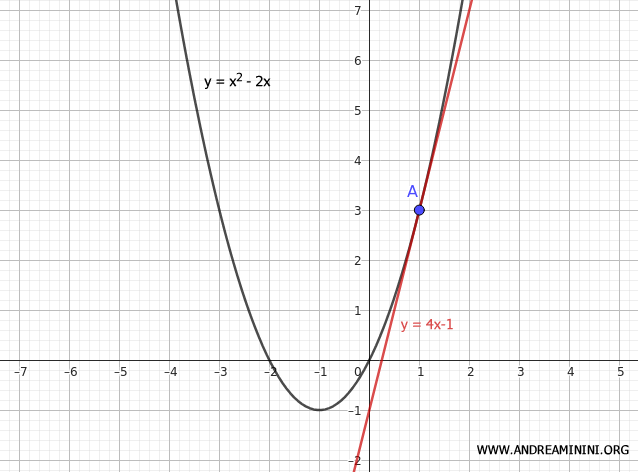
The tangent line touches the parabola at the point \( A(1;3) \) and shares the same local direction as the curve at that point.
And so on.