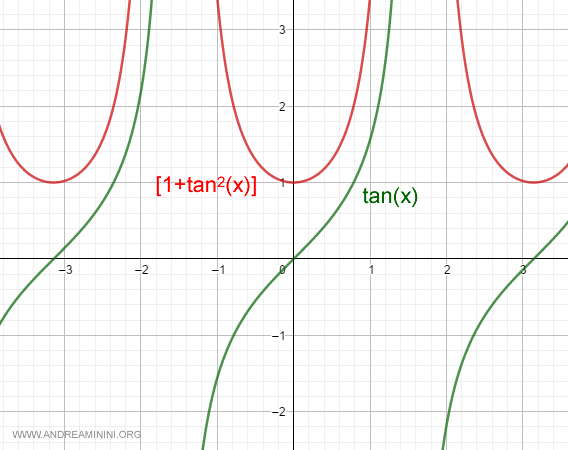
Derivative of the Tangent Function
The derivative of the tangent function is given by $$ D[\tan \: x] = \frac{1}{\cos^2 \: x} = 1 + \tan^2 \: x = \sec^2(x). $$
Proof
To derive this result, we start by recalling the differentiation rules for sine and cosine, as well as a few fundamental trigonometric identities.
$$ D[\sin \: x] = \cos \: x $$
$$ D[\cos \: x] = -\sin \: x $$
In trigonometry, the tangent function is defined as the quotient of sine and cosine:
$$ \tan \: x = \frac{\sin \: x}{\cos \: x}. $$
Therefore, to find the derivative of the tangent function, we differentiate the quotient of sine and cosine:
$$ D\left[ \frac{\sin \: x}{\cos \: x} \right]. $$
Applying the quotient rule for derivatives yields:
$$ \frac{D[\sin \: x] \cdot \cos \: x - \sin \: x \cdot D[\cos \: x]}{\left(\cos \: x\right)^2}. $$
Substituting the derivatives of sine and cosine, we have:
$$ \frac{\cos \: x \cdot \cos \: x - \sin \: x \cdot \bigl(-\sin \: x\bigr)}{\left(\cos \: x\right)^2}. $$
This simplifies to:
$$ \frac{\cos^2 \: x + \sin^2 \: x}{\cos^2 \: x}. $$
From the Pythagorean identity, we know: $$ \sin^2 \: x + \cos^2 \: x = 1. $$
Therefore, the expression becomes:
$$ \frac{\cos^2 \: x + \sin^2 \: x}{\cos^2 \: x} = \frac{1}{\cos^2 \: x}. $$
According to a trigonometric identity relating cosine and tangent: $$ \cos \: x = \frac{1}{\sqrt{1 + \tan^2 \: x}}. $$
Substituting this identity, we get:
$$ \frac{1}{\cos^2 \: x} = \frac{1}{\left(\frac{1}{\sqrt{1 + \tan^2 \: x}}\right)^2} = \frac{1}{\frac{1}{1 + \tan^2 \: x}} = 1 + \tan^2 \: x. $$
Moreover, since the square of the secant function satisfies the identity $ \sec^2(x) = 1 + \tan^2(x), $ we can conclude that the derivative of the tangent function is equal to the square of the secant function.
$$ 1 + \tan^2(x) = \sec^2(x). $$
This completes the proof of the derivative formula for the tangent function.