
Derivative of a Power Function
Definition
The differentiation rule for power functions states: $$ D[ax^b]=b \cdot a x^{b-1} $$
To illustrate how this fundamental rule works, let’s walk through a formal proof and some practical examples.
A Practical Example
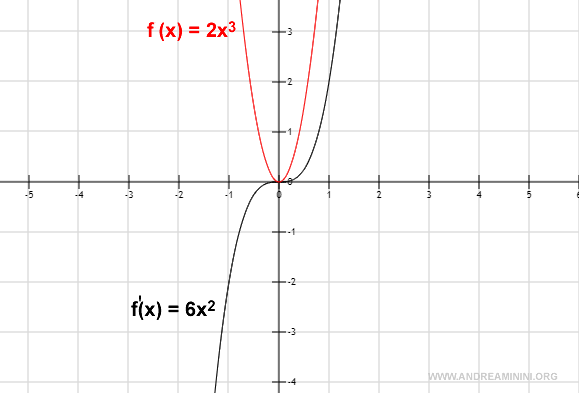
Let’s compute the derivative of 2x3.
$$ f(x) = 2x^3 $$
Applying the power rule gives:
$$ f'(x) = 3 \cdot 2x^{3-1} = 6x^2 $$
Verification
We’ll verify this by evaluating the difference quotient as h approaches zero:
$$ f'(x) = \lim_{h \rightarrow 0} \frac{f(x+h)-f(x)}{h} $$
where:
$$ f(x) = 2x^3 $$
$$ f(x+h) = 2(x+h)^3 $$
Substituting into the difference quotient yields:
$$ f'(x) = \lim_{h \rightarrow 0} \frac{2(x+h)^3 - 2x^3}{h} $$
Expanding and simplifying:
$$ f'(x) = \lim_{h \rightarrow 0} \frac{2(x^3 + 3x^2h + 3xh^2 + h^3) - 2x^3}{h} $$
$$ f'(x) = \lim_{h \rightarrow 0} \frac{6x^2h + 6xh^2 + 2h^3}{h} $$
$$ f'(x) = \lim_{h \rightarrow 0} \bigl(6x^2 + 6xh + 2h^2\bigr) $$
As h approaches zero, the terms involving h vanish, leaving:
$$ f'(x) = 6x^2 $$
This confirms that the derivative of 2x3 is indeed 6x2.
Graphical Representation
Proof
Proof by Induction
Consider first the base case where n = 1. The derivative of x1 is:
$$ D[x^1] = 1 \cdot x^0 = 1 $$
Suppose now that the differentiation rule holds for an arbitrary positive integer exponent n = k:
$$ D[x^k] = k \cdot x^{k-1} $$
We want to prove that the rule also holds for n = k + 1.
$$ D[x^{k+1}] $$
Observe that xk+1 can be expressed as a product:
$$ D[x \cdot x^k] $$
Applying the product rule of differentiation gives:
$$ D[x \cdot x^k] = 1 \cdot x^k + x \cdot k \cdot x^{k-1} $$
Simplifying, we get:
$$ D[x \cdot x^k] = x^k + k \cdot x^k $$
$$ D[x \cdot x^k] = (1 + k) \cdot x^k $$
This confirms the rule holds for k + 1.
Therefore, by induction, the power rule is proven for all positive integer exponents.
Alternative Proof of the Power Rule
We can also prove the derivative of \(x^n\) directly from the definition of the derivative.
Start with the definition of the derivative as the limit of the difference quotient as \( h \to 0 \):
\[ f'(x)=\lim_{h \to 0} \frac{(x+h)^n-x^n}{h} \]
Now expand the binomial expression \((x+h)^n\):
\[ \lim_{h \to 0} \frac{\left[x^n+n x^{n-1}h+\frac{n(n-1)}{2}x^{n-2}h^2+\dots+h^n\right]-x^n}{h} \]
The terms \(x^n\) cancel out:
\[ \require{cancel} \lim_{h \to 0} \frac{ \cancel{ x^n }+n x^{n-1}h+\frac{n(n-1)}{2}x^{n-2}h^2+\dots+h^n - \cancel{ x^n} }{h} \]
Every remaining term in the numerator contains a factor of \(h\), so we can factor it out and simplify:
\[ \lim_{h \to 0} \frac{ \cancel{h} \left[nx^{n-1}+\frac{n(n-1)}{2}x^{n-2}h+\dots+h^{n-1}\right]}{ \cancel{h} } \]
This gives:
\[ \lim_{h \to 0} nx^{n-1}+\frac{n(n-1)}{2}x^{n-2}h+\dots+h^{n-1} \]
As \( h \to 0 \), all terms containing \(h\) vanish, leaving only:
\[ D \ x^n = n x^{n-1} \]
This is the power rule for differentiation, obtained directly from the definition of the derivative.
Example
Let’s consider the following function:
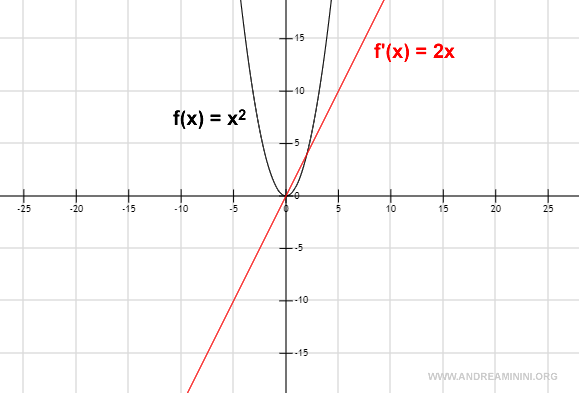
$$ f(x) = x^2 $$
Using the power rule, the first derivative of f(x) is:
$$ f'(x) = 2 \cdot x^{2-1} = 2x $$
To verify this, we can compute the limit definition of the derivative:
$$ f'(x) = \lim_{h \rightarrow 0} \frac{f(x+h)-f(x)}{h} $$
Given:
$$ f(x) = x^2 $$
$$ f(x+h) = (x+h)^2 $$
Substituting into the difference quotient gives:
$$ f'(x) = \lim_{h \rightarrow 0} \frac{(x+h)^2 - x^2}{h} $$
Expanding the numerator:
$$ f'(x) = \lim_{h \rightarrow 0} \frac{x^2 + 2xh + h^2 - x^2}{h} $$
$$ f'(x) = \lim_{h \rightarrow 0} \frac{2xh + h^2}{h} $$
$$ f'(x) = \lim_{h \rightarrow 0} \bigl(2x + h\bigr) $$
As h approaches zero, we find:
$$ f'(x) = 2x $$
So, the derivative of x2 is indeed 2x, as predicted by the power rule.
Graphical Representation
Let’s now test whether the rule also holds for k + 1 when k = 2:
$$ D[x^{2+1}] $$
Rewrite x3 as the product x · x2:
$$ D[x \cdot x^2] $$
Applying the product rule results in:
$$ D[x] \cdot x^2 + x \cdot D[x^2] $$
$$ 1 \cdot x^2 + x \cdot 2x $$
$$ x^2 + 2x^2 $$
$$ 3x^2 $$
Thus, the derivative of x3 is 3x2, confirming the rule for n = 3.
We have therefore demonstrated by induction that the power rule holds for any positive integer exponent.
Derivative of a Function with a Real Exponent
The derivative of the function \( f(x)=x^\alpha \), where \(\alpha \in \mathbb{R}\) and \(x>0\), is \[ f'(x)=\alpha x^{\alpha-1} \] in compact notation \[ D \ x^\alpha = \alpha x^{\alpha-1} \]
This is one of the most important rules in differential calculus because it allows us to differentiate powers with any type of real exponent: integers, fractions, negative numbers, and irrational numbers.
The formula is valid for every real exponent \(\alpha\), provided that the condition \(x>0\) is satisfied.
\[ D \ x^\alpha=\alpha x^{\alpha-1} \]
Why is the condition \(x>0\) required?
In some cases, a power function can also be defined for negative values of \(x\).
For example,
\[ x^{\frac{1}{3}}=\sqrt[3]{x} \]
is defined even when \(x<0\), because the cube root of a negative number exists in the real number system.
However, the general definition of a real power requires the condition \(x>0\). This is because the expression \(x^\alpha\) is not always defined in the real numbers when \(x \le 0\).
Note. When the exponent \( \alpha \) is irrational, the real power is defined using logarithms: \[ x^\alpha=e^{ \ln x^ \alpha} = e^{\alpha \ln x} \] Since the real logarithm \( \ln x \) exists only for \( x>0 \), both the function \( x^\alpha \) and its derivative require the same domain restriction.
Example
Compute the derivative of the function
\[ y=\sqrt[4]{x^3} \]
First, rewrite the radical as a power:
\[ y=x^{\frac{3}{4}} \]
Now apply the power rule:
\[ y'=\frac{3}{4}x^{\frac{3}{4}-1} \]
\[ y'=\frac{3}{4}x^{-\frac{1}{4}} \]
Therefore,
\[ y'=\frac{3}{4\sqrt[4]{x}} \]
Since the radical in the denominator has an even index, the condition \( x>0 \) must be imposed. In addition, because \( x \) appears in the denominator, it cannot be equal to zero.
Example 2
Compute the derivative of
\[ y=\frac{1}{x^4} \]
Rewrite the function using a negative exponent:
\[ y=x^{-4} \]
Apply the rule:
\[ y'=-4x^{-5} \]
Therefore,
\[ y'=-\frac{4}{x^5} \]
Since \( x \) appears in the denominator, the condition \( x\neq 0 \) must be added.
Example 3
Compute the derivative of
\[ y=\sqrt[3]{x^5} \]
Rewrite the radical as a power:
\[ y=x^{\frac{5}{3}} \]
Apply the rule:
\[ y'=\frac{5}{3}x^{\frac{5}{3}-1} \]
\[ y'=\frac{5}{3}x^{\frac{2}{3}} \]
Therefore,
\[ y'=\frac{5}{3}\sqrt[3]{x^2} \]
In this case, the function is defined for all real numbers because the index of the radical is odd.
\[ x\in \mathbb{R} \]
Example 4. The square root case
If the exponent is
\[ \alpha=\frac{1}{2} \]
the power becomes a square root:
\[ x^{ \frac{1}{2} } = \sqrt{x} \]
Applying the power rule gives
\[ D \ x^{\frac{1}{2}} = \frac{1}{2}x^{-\frac{1}{2}} \]
Since
\[ x^{-\frac{1}{2}}=\frac{1}{\sqrt{x}} \]
we obtain the familiar derivative formula for the square root function:
\[ D\sqrt{x}=\frac{1}{2\sqrt{x}} \]
Because the radical in the denominator has an even index, the condition \( x>0 \) must be imposed. Furthermore, since the radical appears in the denominator, the value \( x=0 \) must be excluded to avoid division by zero.
Note. The function \(\sqrt{x}\) is defined at \(x=0\). However, it is not differentiable at that point because the derivative \[ \frac{1}{2\sqrt{x}} \] is undefined when \(x=0\).
Example 5
Compute the derivative of
\[ y=x^\pi \]
Since \(\pi\) is a real constant, the same rule applies:
\[ y'=\pi x^{\pi-1} \]
Because the exponent is irrational, the condition \( x>0 \) must be imposed.
Example 6
Now compute the derivative of
\[ y=x^{\sqrt{2}} \]
\(\sqrt{2}\) is also a real constant. Therefore,
\[ y'=\sqrt{2}x^{\sqrt{2}-1} \]
Once again, the exponent is irrational, so the condition \( x>0 \) must be imposed.
Proof
By definition, the derivative of \(f(x)\) is
\[ f'(x)=\lim_{h \to 0}\frac{f(x+h)-f(x)}{h} \]
Since \(f(x)=x^\alpha\), we obtain
\[ f'(x)=\lim_{h \to 0}\frac{(x+h)^\alpha-x^\alpha}{h} \]
Factor out \(x^\alpha\) from the numerator:
\[ f'(x)= \lim_{h \to 0} \frac{ \left[ x \left (1+\frac{h}{x}\right) \right] ^\alpha-x^\alpha}{h} \]
\[ f'(x)= \lim_{h \to 0} \frac{ x^\alpha \left (1+\frac{h}{x}\right) ^\alpha-x^\alpha}{h} \]
\[ f'(x)= \lim_{h \to 0} \frac{x^\alpha \left[\left(1+\frac{h}{x}\right)^\alpha-1\right]}{h} \]
Since \(x^\alpha\) does not depend on \(h\), it can be factored outside the limit:
\[ f'(x)= x^\alpha \lim_{h \to 0} \frac{\left(1+\frac{h}{x}\right)^\alpha-1}{h} \]
Now rewrite the denominator in terms of \(\frac{h}{x}\). Since
\[ h=x \cdot \frac{h}{x} \]
it follows that
\[ \frac{1}{h}=\frac{1}{x}\cdot \frac{1}{\frac{h}{x}} \]
Therefore,
\[ f'(x)= x^\alpha \cdot \frac{1}{x} \lim_{h \to 0} \frac{\left(1+\frac{h}{x}\right)^\alpha-1}{\frac{h}{x}} \]
Since
\[ x^\alpha \cdot \frac{1}{x}=x^{\alpha-1} \]
we obtain
\[ f'(x)= x^{\alpha-1} \lim_{h \to 0} \frac{\left(1+\frac{h}{x}\right)^\alpha-1}{\frac{h}{x}} \]
As \(h \to 0\), we also have
\[ \frac{h}{x}\to 0 \]
because \(x\) is constant and \(x>0\).
Now apply the standard limit with
\[ u=\frac{h}{x} \qquad k=\alpha \]
\[ \lim_{u \to 0} \frac{(1+u)^k-1}{u}=k \]
Therefore,
\[ f'(x)=x^{\alpha-1}\alpha \]
Hence, the final result is
\[ D \ x^\alpha=\alpha x^{\alpha-1} \]
which completes the proof.


