Geometric Interpretation of the Derivative
Geometrically speaking, the derivative of a function describes the slope of its graph at a point x0 - that is, the gradient of the tangent line at x0.
The equation of the tangent line to the graph at the point (x0, f(x0)) is:
$$ y = f(x_0) + f'(x_0) \cdot (x - x_0) $$
Proof
The function f(x) is defined in a neighborhood around x0.
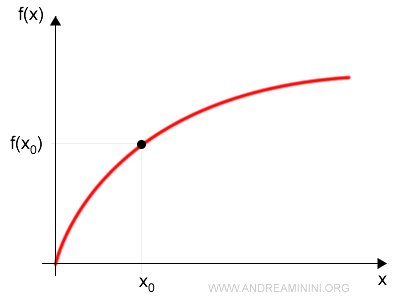
The equation of a line passing through x0 can be written as:
$$ f(x_0) = m x_0 + q $$
Note. The variables m and q are unknowns. This equation therefore represents infinitely many lines passing through the point x0, forming what’s known as a pencil of lines centered at that point. Among these lines is the unique tangent line at x0.
Now, let’s consider another point x within the domain of the function.
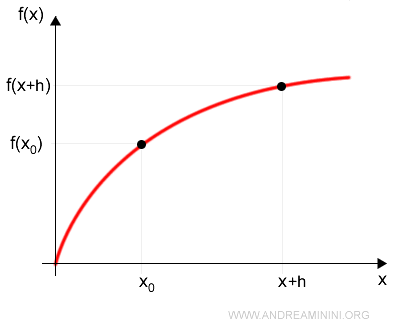
The equation of a line passing through x is:
$$ f(x_0 + h) = m (x_0 + h) + q $$
Note. Again, m and q are unknowns. Thus, this equation describes all lines passing through the point x, forming another pencil of lines centered at that point.
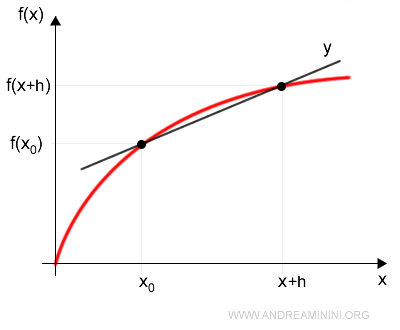
As a result, the secant line passing through the points x0 and x can be determined by the following system of equations:
$$ \begin{cases} f(x_0) = m x_0 + q \\ f(x_0 + h) = m (x_0 + h) + q \end{cases} $$
The unknowns m and q can be solved from this system, first finding m and then q.
This yields the equation of the secant line through x0 and x:
$$ y = f(x_0) + \frac{f(x_0 + h) - f(x_0)}{h} \, (x - x_0) $$
Note. The algebraic steps are as follows: $$ \begin{cases} f(x_0) = m x_0 + q \\ f(x_0 + h) = m (x_0 + h) + q \end{cases} $$ $$ \begin{cases} q = f(x_0) - m x_0 \\ f(x_0 + h) = m (x_0 + h) + \bigl(f(x_0) - m x_0\bigr) \end{cases} $$ $$ \begin{cases} q = f(x_0) - m x_0 \\ f(x_0 + h) = m x_0 + m h + f(x_0) - m x_0 \end{cases} $$ $$ \begin{cases} q = f(x_0) - m x_0 \\ \frac{f(x_0 + h) - f(x_0)}{h} = m \end{cases} $$ $$ \begin{cases} q = f(x_0) - \left(\frac{f(x_0 + h) - f(x_0)}{h}\right) x_0 \\ m = \frac{f(x_0 + h) - f(x_0)}{h} \end{cases} $$ We’ve thus determined the values of m and q for the secant line y = m x + q $$ y = m x + q $$ $$ y = \frac{f(x_0 + h) - f(x_0)}{h} \, x + f(x_0) - \left(\frac{f(x_0 + h) - f(x_0)}{h}\right) x_0 $$ $$ y = \frac{f(x_0 + h) - f(x_0)}{h} (x - x_0) + f(x_0) $$
Graphically, the secant line appears as follows:
To determine the equation of the tangent line at x0, we take the limit of the secant line as h approaches zero:
$$ y_t = \lim_{h \rightarrow 0} \left[ f(x_0) + \frac{f(x_0 + h) - f(x_0)}{h} \, (x - x_0) \right] $$
$$ y_t = f(x_0) + \lim_{h \rightarrow 0} \frac{f(x_0 + h) - f(x_0)}{h} \, (x - x_0) $$
$$ y_t = f(x_0) + f'(x_0) \cdot (x - x_0) $$
This shows that the slope of the tangent line is equal to the derivative of the function f'(x) evaluated at x0.
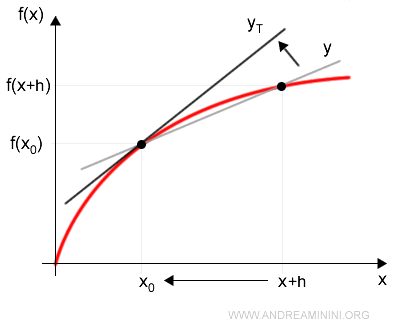
In short, the derivative of a function at x0 determines the slope of the tangent line at that point.
And so on.