Derivative of a Constant
The derivative of any constant function is zero. $$ f(x)=k \:\: \rightarrow \:\: f'(x)=0 $$
This result is easy to prove.
Proof
Consider a function f(x) defined on the interval (a, b), and let x be any point within its domain.
$$ f(x)= k $$
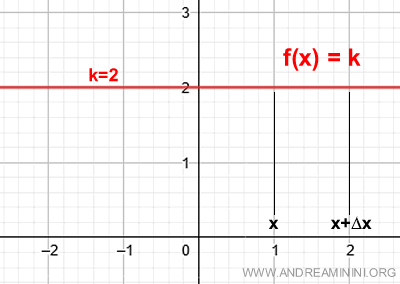
For every value in the domain, the function f(x) consistently returns the same value k.
The graph of such a function appears as follows:
To determine the derivative of the function, we calculate the limit of the difference quotient:
$$ \lim_{\Delta x \rightarrow 0} \frac{f(x+\Delta x)-f(x)}{\Delta x} $$
We already know that:
- f(x) = k
- f(x + Δx) = k
Therefore, we can rewrite the difference quotient as follows:
$$ \lim_{\Delta x \rightarrow 0} \frac{k - k}{\Delta x} = \lim_{\Delta x \rightarrow 0} \frac{0}{\Delta x} = 0 $$
Thus, we’ve shown that the derivative of a constant function is indeed zero.
A Practical Example
Let’s examine the following function:
$$ f(x) = 2 $$
We calculate the limit of the difference quotient as Δx approaches zero:
$$ \lim_{\Delta x \rightarrow 0} \frac{f(x+\Delta x)-f(x)}{\Delta x} $$
Given that:
- f(x) = 2
- f(x + Δx) = 2
The limit simplifies to:
$$ \lim_{\Delta x \rightarrow 0} \frac{2 - 2}{\Delta x} = 0 $$
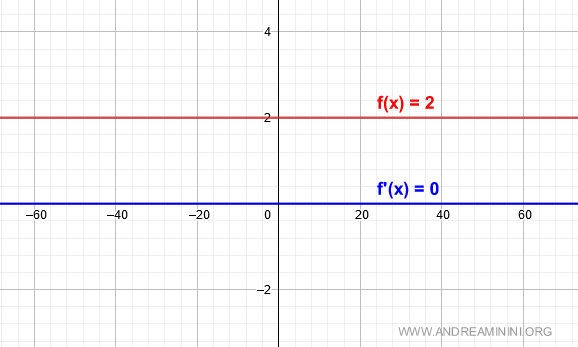
Therefore, the derivative f'(x) equals zero for every point in the function’s domain.
And so on.