
Derivative of the Sine Function
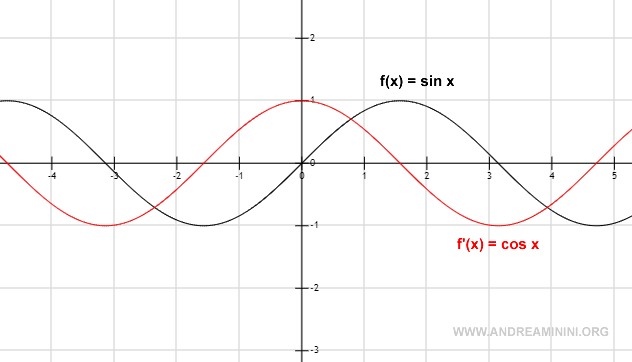
The derivative of the sine function is the cosine function. $$ D[\sin x] = \cos x $$
The formula above is valid when the angle \( x \) is expressed in radians.
If \( x \) is instead measured in degrees, the derivative must include the angular conversion factor \( \frac{\pi}{180^\circ} \):
\[ D[\sin x]=\frac{\pi}{180^\circ}\cos x \]
A Practical Example
Consider the following example:
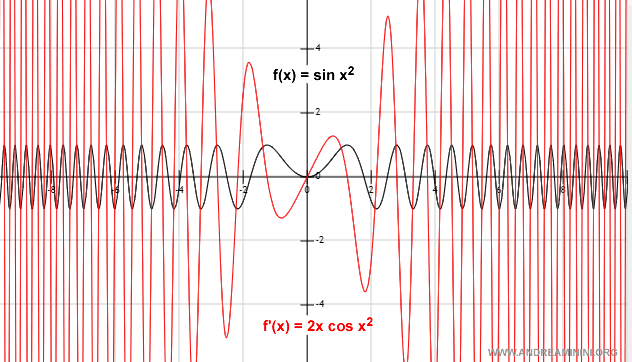
$$ f(x) = \sin (x^2) $$
Note: When the argument of the sine function is something other than simply \( x \), we cannot directly apply the elementary derivative rule. Instead, we are dealing with a composite function of the form \( f(g(x)) \). Therefore, the derivative of this function is not simply \(\cos(x^2)\).
This is a classic case of a composite function, so we must apply the chain rule:
$$ f'(x) = f'(g(x)) \cdot g'(x) $$
In this case:
$$ f'(g(x)) = D[\sin(g(x))] = \cos(x^2) $$
$$ g'(x) = D[x^2] = 2x $$
Substituting these into the chain rule gives:
$$ f'(x) = \cos(x^2) \cdot 2x $$
Thus, the derivative of \(\sin(x^2)\) is:
$$ f'(x) = 2x \cdot \cos(x^2) $$
Graphical Representation
Proof
To prove this fundamental rule of differentiation, we start with the sine function:
$$ f(x) = \sin x $$
We then consider the limit definition of the derivative:
$$ \lim_{h \rightarrow 0} \frac{f(x+h) - f(x)}{h} $$
where:
$$ f(x) = \sin x $$
$$ f(x+h) = \sin (x + h) $$
Substituting these into the difference quotient, we get:
$$ \lim_{h \rightarrow 0} \frac{\sin (x + h) - \sin (x)}{h} $$
Using the trigonometric identity: $$ \sin a - \sin b = 2 \cdot \sin \left(\frac{a - b}{2}\right) \cdot \cos \left(\frac{a + b}{2}\right) $$
we can rewrite the numerator as:
$$ \lim_{h \rightarrow 0} \frac{2 \cdot \sin \left(\frac{h}{2}\right) \cdot \cos \left(x + \frac{h}{2}\right)}{h} $$
Rewriting the expression gives:
$$ \lim_{h \rightarrow 0} \frac{\sin \left(\frac{h}{2}\right) \cdot \cos \left(x + \frac{h}{2}\right)}{\frac{h}{2}} $$
This allows us to split the limit into two parts:
$$ \lim_{h \rightarrow 0} \frac{\sin \left(\frac{h}{2}\right)}{\frac{h}{2}} \cdot \lim_{h \rightarrow 0} \cos \left(x + \frac{h}{2}\right) $$
The first limit is a standard result:
$$ \lim_{t \rightarrow 0} \frac{\sin t}{t} = 1 $$
Therefore, the expression simplifies to:
$$ 1 \cdot \lim_{h \rightarrow 0} \cos \left(x + \frac{h}{2}\right) $$
As \( h \) approaches zero, this limit evaluates to \(\cos x\):
$$ 1 \cdot \cos x $$
Thus, the derivative of \(\sin(x)\) is:
$$ f'(x) = \cos x $$
We have therefore established that the derivative of the sine function is the cosine function.
Graphical Representation
An Alternative Derivation of the Derivative of the Sine Function
One of the most important results in differential calculus is that the derivative of the sine function is the cosine function. In this derivation, we will prove the result directly from the definition of the derivative.
We begin with the definition of the derivative:
\[ f'(x)=\lim_{h \to 0} \frac{f(x+h)-f(x)}{h} \]
Since the function is \( f(x)=\sin x \), we substitute it into the formula:
\[ f'(x)=\lim_{h \to 0} \frac{\sin(x+h)-\sin x}{h} \]
At this point, we use the angle addition formula for sine:
\[ \sin(x+h)=\sin x \cos h+\cos x \sin h \]
Substituting this identity into the limit gives
\[ f'(x)=\lim_{h \to 0} \frac{\sin x \cos h+\cos x \sin h-\sin x}{h} \]
Now we group together the terms containing \( \sin x \):
\[ f'(x)=\lim_{h \to 0} \frac{\sin x(\cos h-1)+\cos x \sin h}{h} \]
Next, we split the expression into two separate fractions:
\[ f'(x)=\lim_{h \to 0} \left[ \sin x \cdot \frac{\cos h-1}{h} + \cos x \cdot \frac{\sin h}{h} \right] \]
Using the linearity property of limits, we can rewrite the expression as
\[ f'(x)=\lim_{h \to 0} \left[ \sin x \cdot \frac{\cos h-1}{h} \right] + \lim_{h \to 0} \left[ \cos x \cdot \frac{\sin h}{h} \right] \]
Because \( \sin x \) and \( \cos x \) do not depend on \( h \), they behave as constants with respect to the limit:
\[ f'(x)= \sin x \cdot \lim_{h \to 0} \left[ \frac{\cos h-1}{h} \right] + \cos x \cdot \lim_{h \to 0} \left[ \frac{\sin h}{h} \right] \]
We now recognize two fundamental trigonometric limits:
- \( \lim_{h \to 0} \frac{\sin h}{h}=1 \)
- \( \lim_{h \to 0} \frac{\cos h-1}{h}=0 \)
Substituting these limits into the expression, we obtain
\[ f'(x)=\sin x \cdot 0+\cos x \cdot 1 \]
which simplifies immediately to
\[ f'(x)=\cos x \]
Therefore, the derivative of the sine function is the cosine function:
\[ D[\sin x]=\cos x \]
This derivation is a classic example of how trigonometric identities and fundamental limits work together in differential calculus to produce one of the most elegant results in mathematics.
And so on.


