Derivative of the Cosine Function
Definition
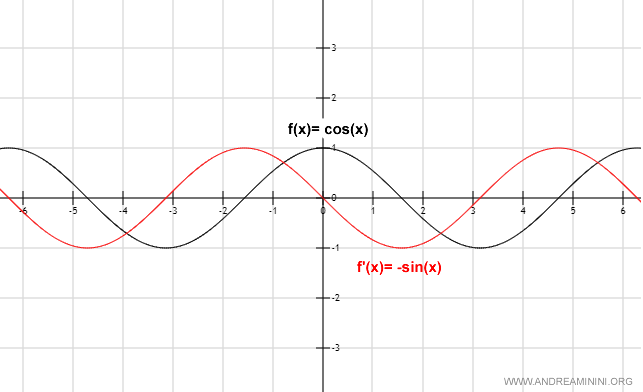
The derivative of the cosine function is: $$ D[\cos x] = -\sin x $$
This result holds when the angle is expressed in radians.
If \( x \) is measured in degrees instead, the derivative includes a conversion factor:
\[ D \cos x = -\frac{\pi}{180^\circ}\sin x \]
A Practical Example
Let’s examine the following function:
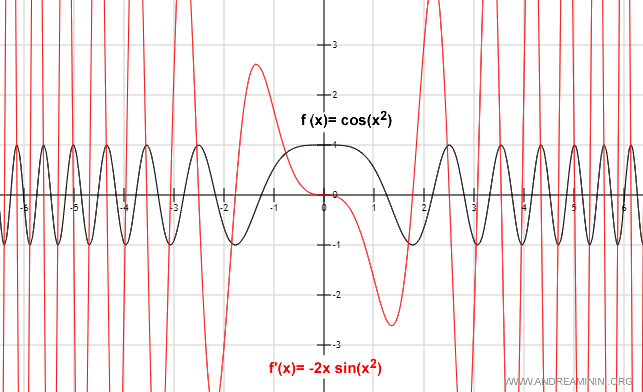
$$ f(x) = \cos (x^2) $$
Note: When the argument of the cosine function is not simply \( x \), we’re dealing with a composite function of the form \( f(g(x)) \). Therefore, the derivative is not simply \(-\sin(x^2)\); we need to apply the chain rule.
Since this is a composite function, we apply the chain rule:
$$ f'(x) = f'(g(x)) \cdot g'(x) $$
In this case:
$$ f'(g(x)) = D[\cos(g(x))] = -\sin(x^2) $$
$$ g'(x) = D[x^2] = 2x $$
Substituting these into the chain rule gives:
$$ f'(x) = -\sin(x^2) \cdot 2x $$
Hence, the derivative of \(\cos(x^2)\) is:
$$ f'(x) = -2x \cdot \sin(x^2) $$
Graphical Representation
Proof
Let’s derive this result by evaluating the difference quotient for the cosine function:
$$ \lim_{h \rightarrow 0} \frac{\cos(x+h) - \cos(x)}{h} $$
We start by using the following trigonometric identity:
$$ \cos a - \cos b = -2 \sin \left(\frac{a - b}{2}\right) \cdot \sin \left(\frac{a + b}{2}\right) $$
Applying this identity to the numerator, we set:
$$ a = x + h $$
$$ b = x $$
This transforms the difference quotient into:
$$ \lim_{h \rightarrow 0} \frac{-2 \cdot \sin \left(\frac{h}{2}\right) \cdot \sin \left(x + \frac{h}{2}\right)}{h} $$
Multiplying the numerator and denominator by \( \frac{1}{2} \) allows us to simplify the expression further:
$$ \lim_{h \rightarrow 0} \frac{-\sin \left(\frac{h}{2}\right) \cdot \sin \left(x + \frac{h}{2}\right)}{\frac{h}{2}} $$
We can separate this limit into two parts:
$$ \lim_{h \rightarrow 0} \frac{-\sin \left(\frac{h}{2}\right)}{\frac{h}{2}} \cdot \lim_{h \rightarrow 0} \sin \left(x + \frac{h}{2}\right) $$
Let’s evaluate these limits individually.
The first limit is a well-known standard limit in calculus:
$$ \lim_{t \rightarrow 0} \frac{\sin t}{t} = 1 $$
Substituting \( t = \frac{h}{2} \), we find:
$$ \lim_{h \rightarrow 0} \frac{-\sin \left(\frac{h}{2}\right)}{\frac{h}{2}} = -1 $$
The second limit is straightforward:
$$ \lim_{h \rightarrow 0} \sin \left(x + \frac{h}{2}\right) = \sin x $$
Combining these results, we get:
$$ \lim_{h \rightarrow 0} \frac{-\sin \left(\frac{h}{2}\right)}{\frac{h}{2}} \cdot \lim_{h \rightarrow 0} \sin \left(x + \frac{h}{2}\right) = -1 \cdot \sin x $$
Therefore, the derivative of \(\cos x\) is:
$$ f'(x) = -\sin x $$
We have thus proven that the derivative of the cosine function is indeed \(-\sin x\).
Graphical Representation
An Alternative Proof of the Derivative of Cosine
Let’s derive the derivative of the cosine function starting directly from the definition of the derivative.
Consider the function
\[ f(x)=\cos x \]
By definition, the derivative is
\[ f'(x)=\lim_{h \to 0}\frac{f(x+h)-f(x)}{h} \]
Replacing \( f(x) \) with \( \cos x \), we get:
\[ f'(x)=\lim_{h \to 0}\frac{\cos(x+h)-\cos x}{h} \]
To simplify the numerator, we use the cosine addition formula:
\[ \cos(x+h)=\cos x \cos h-\sin x \sin h \]
Substituting this identity into the limit expression gives:
\[ f'(x)= \lim_{h \to 0} \frac{\cos x \cos h-\sin x \sin h-\cos x}{h} \]
Now factor out \( \cos x \) from the terms where it appears:
\[ f'(x)= \lim_{h \to 0} \frac{\cos x(\cos h-1)-\sin x \sin h}{h} \]
Next, split the expression into two separate fractions:
\[ f'(x)= \lim_{h \to 0} \left[ \cos x \cdot \frac{\cos h-1}{h} - \sin x \cdot \frac{\sin h}{h} \right] \]
Since \( \cos x \) and \( \sin x \) do not depend on \( h \), they behave like constants with respect to the limit.
At this point, we apply the standard trigonometric limits:
\[ \lim_{h \to 0}\frac{\sin h}{h}=1 \]
and
\[ \lim_{h \to 0}\frac{\cos h-1}{h}=0 \]
Substituting these values into the expression, we obtain:
\[ f'(x)= \cos x \cdot 0 - \sin x \cdot 1 \]
Therefore,
\[ f'(x)=-\sin x \]
So the derivative of the cosine function is the negative of the sine function:
\[ \frac{d}{dx}(\cos x) = -\sin x \]
This completes the proof.
And so on.