
Right-Hand Derivative
Consider a function defined on an interval extending to the right of the point x0. We say that f(x) is right-differentiable at x0 if the right-hand limit of the difference quotient between x0 and x exists and is finite as x approaches x0 from the right. $$ f'_+(x_0) = \lim_{x \rightarrow x_0^+} \frac{f(x)-f(x_0)}{x - x_0} $$ Since Δx = x - x0, this can also be expressed as $$ f'_+(x_0) = \lim_{Δx \rightarrow 0^+} \frac{f(x_0 + Δx) - f(x_0)}{Δx} $$ which is known as the right-hand derivative of f(x).
In this definition, we’re only concerned with the values of x lying to the right of x0.
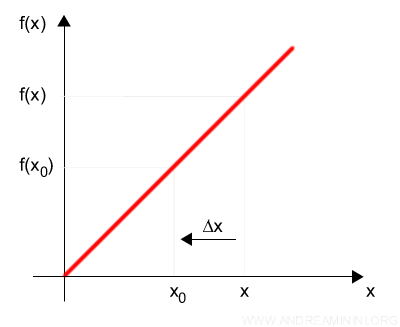
The interval to the left of x0 isn’t taken into account.
Note. In some textbooks, the point x is written as x0 + δ, but the idea is exactly the same. It simply refers to a point located to the right of x0 that approaches x0 as the limit is taken.
A Practical Example
Let’s check whether the right-hand derivative of the function f(x) = |x| exists at the point x0 = 2.
$$ f(x) = 2 $$
We calculate the limit as x approaches x0 from the right:
$$ f'_+(x_0) = \lim_{x \rightarrow x_0^+} \frac{f(x) - f(x_0)}{x - x_0} $$
$$ f'_+(2) = \lim_{x \rightarrow 2^+} \frac{f(x) - f(2)}{x - 2} $$
$$ f'_+(2) = \lim_{x \rightarrow 2^+} \frac{|x| - |2|}{x - 2} $$
Since x remains positive in this limit, we have:
$$ f'_+(2) = \lim_{x \rightarrow 2^+} \frac{x - 2}{x - 2} = +1 $$
So, the right-hand derivative of f(x) at x0 = 2 is +1.
And that’s how it works.


