
Differentiability Implies Continuity
If a function f(x) is differentiable at a point x, then it must also be continuous at that point. $$ \lim_{x \rightarrow x_0} f(x)=f(x_0) $$ or equivalently $$ \lim_{h \rightarrow 0} f(x+h)=f(x) $$
This theorem establishes one of the fundamental connections in calculus between differentiability and continuity.
If a function has a derivative at a point, its graph cannot “break” or “jump” at that point. Differentiability automatically guarantees continuity.
However, the converse is not always true. A function can be continuous at a point without being differentiable there.
In other words, every differentiable function is continuous, but not every continuous function is differentiable.
The set of differentiable functions is therefore a subset of the set of continuous functions.
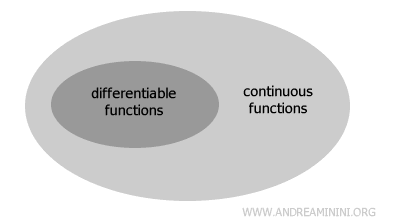
For this reason, continuity is considered a necessary condition for differentiability, but not a sufficient one.
Proof
If a function is differentiable at x, then the limit of its difference quotient exists as h approaches 0:
$$ \lim_{h \rightarrow 0} \frac{f(x+h)-f(x)}{h} $$
For the function f(x) to be continuous at x, the following condition must hold:
$$ \lim_{h \rightarrow 0} f(x+h) = f(x) $$
In other words:
$$ \lim_{h \rightarrow 0} \bigl(f(x+h) - f(x)\bigr) = 0 $$
Note. The formal condition for the continuity of a function is: $$ \lim_{x \rightarrow x_0} f(x) = f(x_0) $$ $$ \lim_{x+h \rightarrow x} f(x+h) = f(x) \quad \text{with} \quad x = x + h \quad \text{and} \quad x_0 = x $$ $$ \lim_{h \rightarrow x-x} f(x+h) = f(x) $$ $$ \lim_{h \rightarrow 0} f(x+h) = f(x) $$
Let’s rewrite the expression f(x+h) - f(x) in an equivalent algebraic form.
We multiply and divide by h:
$$ f(x+h)-f(x)=\frac{f(x+h)-f(x)}{h} \cdot h $$
This identity is always true: the left-hand side equals the right-hand side.
Now let’s take the limit on both sides of this equation:
$$ \lim_{h \rightarrow 0} \bigl(f(x+h) - f(x)\bigr) = \lim_{h \rightarrow 0} \frac{f(x+h)-f(x)}{h} \cdot h $$
By the properties of limits, we can separate the limits on the right-hand side:
$$ \lim_{h \rightarrow 0} \bigl(f(x+h) - f(x)\bigr) = \left( \lim_{h \rightarrow 0} \frac{f(x+h)-f(x)}{h} \right) \cdot \left( \lim_{h \rightarrow 0} h \right) $$
The second limit equals zero, which makes the entire right-hand side zero as well:
$$ \lim_{h \rightarrow 0} \bigl(f(x+h) - f(x)\bigr) = \lim_{h \rightarrow 0} \frac{f(x+h)-f(x)}{h} \cdot 0 $$
$$ \lim_{h \rightarrow 0} \bigl(f(x+h) - f(x)\bigr) = 0 $$
Since the right-hand side equals zero, it follows that the left-hand side must also equal zero.
This completes the proof that differentiable functions are continuous.
$$ \lim_{h \rightarrow 0} \bigl(f(x+h) - f(x)\bigr) = 0 $$
An Alternative Proof
Assume that the function \( f(x) \) is differentiable at the point \( x_0 \).
By definition, this means that the derivative exists at \( x_0 \), namely:
\[ \lim_{h \to 0} \frac{f(x_0+h)-f(x_0)}{h}=f'(x_0) \]
We want to prove that \( f(x) \) is also continuous at the same point. In other words, we want to show that:
\[ \lim_{x \to x_0} f(x)=f(x_0) \]
To study continuity, consider the value of the function near \( x_0 \):
\[ f(x_0+h) \]
Now rewrite this expression in a form that contains the difference quotient. This is useful because the limit of the difference quotient is already known from the differentiability assumption.
\[ f(x_0+h) = \frac{ f(x_0+h) - f(x_0) }{h} \cdot h + f(x_0) \]
Note. This is simply an identity. After simplification, the right-hand side reduces exactly to the left-hand side: \[ \require{cancel} f(x_0+h) = \frac{ f(x_0+h) - f(x_0) }{ \cancel{h} } \cdot \cancel{h} + f(x_0) \] \[ f(x_0+h) = f(x_0+h) - \cancel{ f(x_0) } + \cancel{ f(x_0) } \] \[ f(x_0+h) = f(x_0+h) \]
Next, take the limit as \( h \to 0 \) on both sides of the equation:
\[ \lim_{h \to 0} f(x_0+h) = \lim_{h \to 0} \left[ \frac{ f(x_0+h) - f(x_0) }{h} \cdot h + f(x_0) \right] \]
Using the limit law for sums, we can separate the two terms:
\[ \lim_{h \to 0} f(x_0+h) = \lim_{h \to 0} \left[ \frac{ f(x_0+h) - f(x_0) }{h} \cdot h \right] + \lim_{h \to 0} f(x_0) \]
Since \( f(x_0) \) is a constant, its limit is simply:
\[ \lim_{h \to 0} f(x_0)=f(x_0) \]
Therefore:
\[ \lim_{h \to 0} f(x_0+h) = \lim_{h \to 0} \left[ \frac{ f(x_0+h) - f(x_0) }{h} \cdot h \right] + f(x_0) \]
Now apply the limit law for products:
\[ \lim_{h \to 0} f(x_0+h) = f(x_0) + \lim_{h \to 0} \left[ \frac{ f(x_0+h) - f(x_0) }{h} \right] \cdot \lim_{h \to 0} h \]
The first limit is exactly the derivative of the function at \( x_0 \):
\[ \lim_{h \to 0} \left[ \frac{ f(x_0+h) - f(x_0) }{h} \right] = f'(x_0) \]
Substituting this into the equation gives:
\[ \lim_{h \to 0} f(x_0+h) = f(x_0) + f'(x_0)\cdot \lim_{h \to 0} h \]
Since:
\[ \lim_{h \to 0} h = 0 \]
we obtain:
\[ \lim_{h \to 0} f(x_0+h) = f(x_0) + f'(x_0)\cdot 0 \]
\[ \lim_{h \to 0} f(x_0+h) = f(x_0) \]
Finally, by setting \( x=x_0+h \), the condition \( h \to 0 \) becomes \( x \to x_0 \). Hence:
\[ \lim_{x \to x_0} f(x)=f(x_0) \]
This proves that the function is continuous at \( x_0 \).
Therefore, the statement
\[ \lim_{h \to 0} f(x_0+h)=f(x_0) \]
is equivalent to
\[ \lim_{x \to x_0} f(x)=f(x_0) \]
In conclusion, every function that is differentiable at a point is also continuous at that point.
Why Continuity Doesn’t Necessarily Imply Differentiability
A classic counterexample is the absolute value function:
$$ f(x)=|x| $$
This function is continuous at x = 0 but is not differentiable there, because the left-hand and right-hand limits of the difference quotient do not agree.
$$ \lim_{h \rightarrow 0^-} \frac{f(0+h)-f(0)}{h} = \lim_{h \rightarrow 0^-} \frac{|h|}{h} = \lim_{h \rightarrow 0^-} \frac{h}{-h} = -1 $$
$$ \lim_{h \rightarrow 0^+} \frac{f(0+h)-f(0)}{h} = \lim_{h \rightarrow 0^+} \frac{|h|}{h} = \lim_{h \rightarrow 0^+} \frac{h}{h} = +1 $$
Therefore, in this case, the function is continuous at x = 0 but not differentiable there.
Continuity alone is not a sufficient condition for differentiability.


