Differentiability of a Function at a Point
A function is differentiable at a point c if the left-hand and right-hand limits of the difference quotient both exist and are equal. $$ f'(x) = \lim_{Δx \rightarrow 0^-} \frac{f(x + Δx) - f(x)}{Δx} \\ \\ f'(x) = \lim_{Δx \rightarrow 0^+} \frac{f(x + Δx) - f(x)}{Δx} $$
The left-hand limit of the difference quotient is called the left-hand derivative.
$$ f'(x) = \lim_{Δx \rightarrow 0^-} \frac{f(x + Δx) - f(x)}{Δx} $$
Similarly, the right-hand limit is called the right-hand derivative.
$$ f'(x) = \lim_{Δx \rightarrow 0^+} \frac{f(x + Δx) - f(x)}{Δx} $$
Two scenarios are possible:
- If both limits exist and are equal, the function is differentiable at the point c.
- If the two limits are not equal, the function is not differentiable at c.
Points where f(x) fails to be differentiable are known as singular points.
A Practical Example
Consider the absolute value function:
$$ f(x) = |x| $$
To determine whether it’s differentiable at x = 0, let’s first examine the right-hand limit.
$$ f'(0) = \lim_{Δx \rightarrow 0^+} \frac{f(x + Δx) - f(x)}{Δx} $$
$$ f'(0) = \lim_{Δx \rightarrow 0^+} \frac{|x + Δx| - |x|}{Δx} $$
$$ f'(0) = \lim_{Δx \rightarrow 0^+} \frac{|0 + Δx - 0|}{Δx} $$
$$ f'(0) = \lim_{Δx \rightarrow 0^+} \frac{|Δx|}{Δx} = +1 $$
Since Δx approaches zero from the right, it remains positive, so the limit evaluates to +1.
Now, let’s compute the left-hand limit at x = 0:
$$ f'(0) = \lim_{Δx \rightarrow 0^-} \frac{f(x + Δx) - f(x)}{Δx} $$
$$ f'(0) = \lim_{Δx \rightarrow 0^-} \frac{|x + Δx| - |x|}{Δx} $$
$$ f'(0) = \lim_{Δx \rightarrow 0^-} \frac{|0 + Δx - 0|}{Δx} $$
$$ f'(0) = \lim_{Δx \rightarrow 0^-} \frac{|Δx|}{Δx} = -1 $$
Here, Δx approaches zero from the left, so it’s negative, resulting in a limit of -1.
Conclusion
The left-hand and right-hand limits of the difference quotient at x = 0 are not equal:
$$ f'(0^+) = \lim_{Δx \rightarrow 0^+} \frac{|Δx|}{Δx} = +1 $$
$$ f'(0^-) = \lim_{Δx \rightarrow 0^-} \frac{|Δx|}{Δx} = -1 $$
Therefore, although the graph of the function meets at a single point, at x = 0, the function f(x) = |x| is not differentiable because the left-hand and right-hand limits differ (+1 ≠ -1).
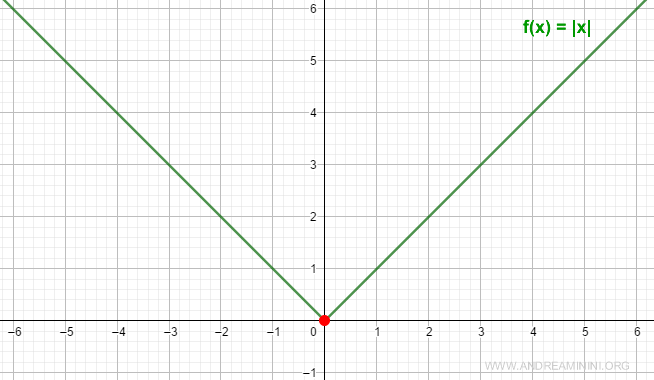
Note. This example also illustrates that continuity of a function at a point is a necessary condition for differentiability, but not sufficient. The function |x| is continuous at x = 0 but not differentiable there.
And so on.