
Function Analysis Exercise 10
In this exercise, we analyze the exponential function using standard techniques from calculus:
$$ f(x)= e^{- \frac{1}{x}} $$
Domain
The function is defined for all real numbers except \( x = 0 \):
$$ D_f = \mathbb{R} \setminus \{ 0 \} $$
This exclusion arises because the exponent \( \frac{1}{x} \) is undefined at zero due to division by zero.
Intercepts
Let’s now check whether the graph of the function intersects the coordinate axes:
- y-intercept
Since the function is undefined at \( x = 0 \), there is no y-intercept. - x-intercept
To determine if the graph crosses the x-axis, we solve: $$ f(x) = 0 \Rightarrow e^{- \frac{1}{x}} = 0 $$ Taking the natural logarithm of both sides: $$ \ln\left(e^{- \frac{1}{x}}\right) = \ln(0) $$ $$ -\frac{1}{x} = \ln(0) $$ However, \( \ln(0) \) is undefined. Hence, this equation has no solution, and the function does not intersect the x-axis.
Conclusion: The function does not intersect either axis.
Sign
The sign of the function is easy to determine. The exponential function is always positive, so:
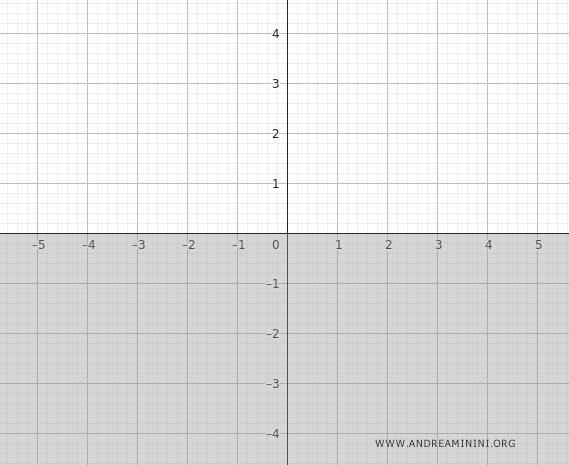
$$ f(x) = e^{- \frac{1}{x}} > 0 \quad \forall x \in D_f $$
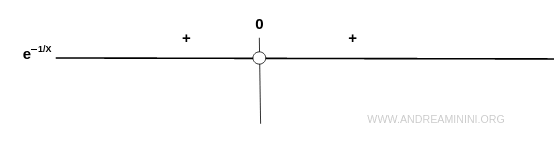
This means the graph lies entirely in the first and second quadrants of the Cartesian plane.
Vertical Asymptotes
We examine the behavior near the discontinuity at \( x = 0 \):
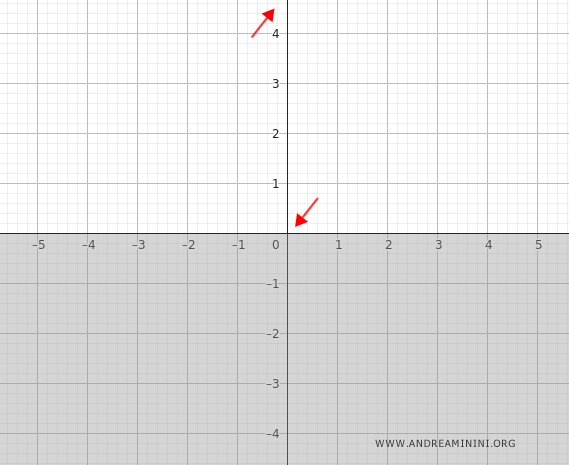
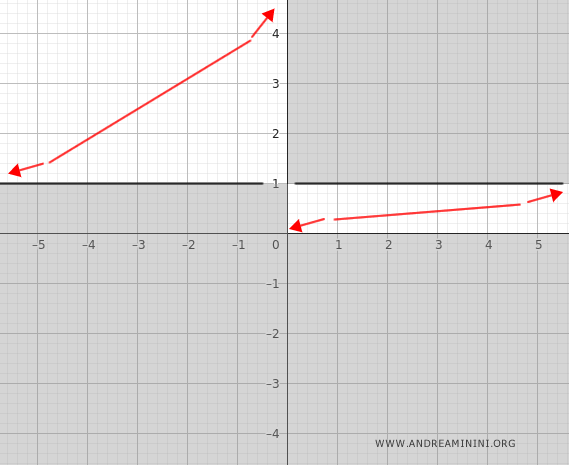
As \( x \to 0^- \), the exponent \( -\frac{1}{x} \to +\infty \), so:
$$ \lim_{x \to 0^-} e^{- \frac{1}{x}} = \infty $$
As \( x \to 0^+ \), \( -\frac{1}{x} \to -\infty \), and hence:
$$ \lim_{x \to 0^+} e^{- \frac{1}{x}} = 0 $$
Since the left and right limits are not equal, the function has a discontinuity at \( x = 0 \) but no vertical asymptote.
Horizontal Asymptotes
We now consider the behavior as \( x \to \pm \infty \):
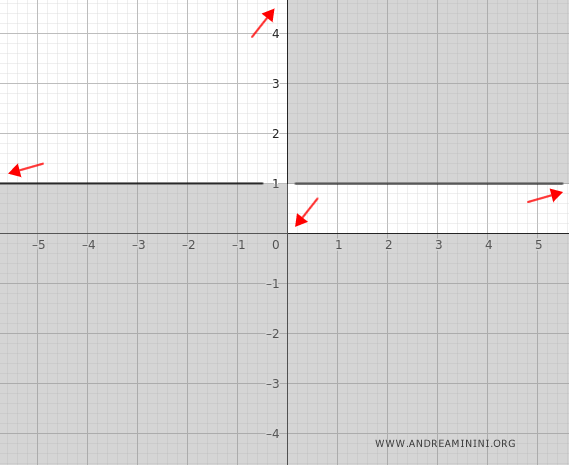
As \( x \to +\infty \):
$$ \lim_{x \to +\infty} e^{- \frac{1}{x}} = \frac{1}{e^{\frac{1}{x}}} \to \frac{1}{1} = 1^- $$
Explanation: As \( x \) grows large, \( \frac{1}{x} \to 0^+ \), and since \( e^{\frac{1}{x}} > 1 \), we have \( \frac{1}{e^{1/x}} < 1 \).
As \( x \to -\infty \):
$$ \lim_{x \to -\infty} e^{- \frac{1}{x}} = \frac{1}{e^{\frac{1}{x}}} \to \frac{1}{1} = 1^+ $$
Explanation: Now \( \frac{1}{x} \to 0^- \), so \( e^{\frac{1}{x}} < 1 \), and therefore \( \frac{1}{e^{1/x}} > 1 \).
Conclusion: The function has a horizontal asymptote at \( y = 1 \).
Monotonicity
To study the function's increasing/decreasing behavior, we compute the first derivative:
$$ f'(x) = \frac{d}{dx} \left( e^{- \frac{1}{x}} \right) = e^{- \frac{1}{x}} \cdot \frac{1}{x^2} $$

Since both factors are strictly positive, \( f'(x) > 0 \) on the entire domain.
Therefore, the function is strictly increasing for all \( x \in D_f \).
Concavity and Inflection Points
Now we study the concavity by computing the second derivative:
$$ f''(x) = \frac{d}{dx} \left( x^{-2} \cdot e^{- \frac{1}{x}} \right) $$
Using the product rule:
$$ f''(x) = -2x^{-3} \cdot e^{- \frac{1}{x}} + x^{-2} \cdot \left( \frac{1}{x^2} \cdot e^{- \frac{1}{x}} \right) $$
$$ f''(x) = e^{- \frac{1}{x}} \cdot \left( -2x^{-3} + x^{-4} \right) $$
Factoring gives:
$$ f''(x) = e^{- \frac{1}{x}} \cdot x^{-3} \cdot \left( -2 + \frac{1}{x} \right) $$
$$ f''(x) = e^{- \frac{1}{x}} \cdot \frac{1 - 2x}{x^4} $$
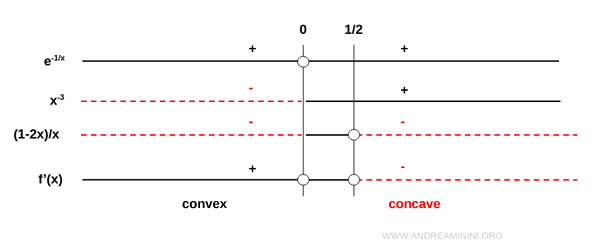
Note: The sign of the second derivative depends on the rational expression \( \frac{1 - 2x}{x} \). It is positive when \( 0 < x < \frac{1}{2} \).
Thus, we conclude:
- The function is concave upward (convex) on \( (-\infty, \frac{1}{2}) \)
- The function is concave downward on \( (\frac{1}{2}, +\infty) \)
At \( x = \frac{1}{2} \), the second derivative changes sign, indicating a point of inflection.
This allows us to complete the function's graph:
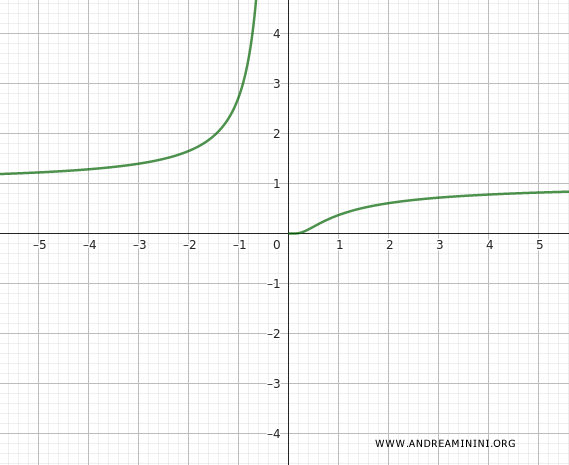
And that concludes the analysis.


