
Homogeneous Linear Systems and Vector Subspaces
The solution set of a homogeneous linear system forms a vector subspace.
What is a linear system?
A linear system is a collection of m equations with n unknown variables (x) and n constant terms (b).
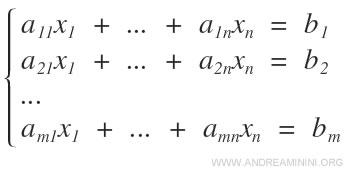
A linear system can also be written in matrix form as AX=B.
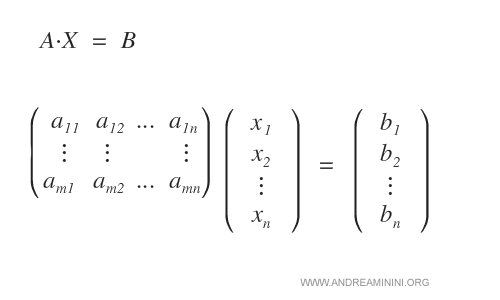
In this representation, A is the m x n coefficient matrix, X is the n x 1 column matrix ( vector ) containing the unknowns x1,...,xn, and B is the n x 1 column matrix of constant terms.
A linear system is called homogeneous when all the constant terms are equal to zero.
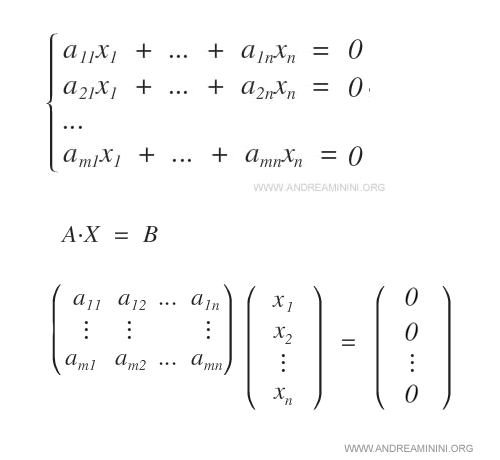
Why the solutions form a vector subspace
The solution set X of a homogeneous linear system is a subset of the vector space Rn.
\(X \in R^n \)
More specifically, X is a vector subspace of Rn.
To prove this, we only need to verify the two defining properties of vector subspaces:
- closure under addition
- closure under scalar multiplication
Closure under addition
If two vectors belong to a vector subspace, then their sum must also belong to the same subspace.

Take two arbitrary solutions X1 and X2 of the homogeneous system.
Since both vectors are solutions, they satisfy the equation
\(AX_1 = 0 \)
\(AX_2 = 0 \)
Now consider their sum:
\(A(X_1 + X_2) = AX_1 + AX_2 \)
Substituting the previous results gives
\(AX_1 + AX_2 = 0 + 0 = 0 \)
Therefore,
\(A(X_1 + X_2)=0 \)
This shows that the vector X1+X2 is also a solution of the system.
So, the set X is closed under addition.
A homogeneous system always contains the trivial solution, namely the zero vector { 0, ... , 0 }.
Closure under scalar multiplication
A vector subspace must also remain closed under scalar multiplication.

Take an arbitrary solution X1 in X and a scalar λ belonging to the field of real numbers R.
We now check whether the scalar multiple λX1 is still a solution of the system.
\( A(\lambda X_1)=\lambda AX_1 \)
Since X1 is a solution,
\( AX_1=0 \)
Substituting into the previous expression gives
\( A(\lambda X_1)=\lambda \cdot 0 =0 \)
Therefore, the vector λX1 also belongs to X.
The set X is closed under scalar multiplication.
The solution set X satisfies both defining properties of vector subspaces. It is closed under addition and scalar multiplication. Therefore, X is a vector subspace of Rn.
Non-homogeneous linear systems
A non-homogeneous linear system is not a vector subspace of Rn.
In general, its solution set does not contain the trivial solution, so it does not satisfy the defining properties required for a vector subspace.


