Structure Theorem for the Solution Set of a Linear System
Consider the following two linear systems.
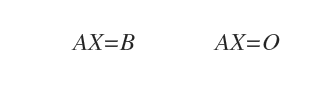
- ΣB is a nonhomogeneous linear system AX=B. Its solution set is denoted by SB.
- ΣO is the associated homogeneous linear system AX=O. Its solution set is denoted by SO.
Note. In matrix form, both systems have the same coefficient matrix A and the same vector of unknowns X. The only difference is the constant vector, namely B in the first system and O in the second. Since ΣO is homogeneous, its constant vector is made entirely of zeros.
In this context, two different situations may occur:
- SB=∅.
- SB=SO+X'
(where X' is an element of SB).
In the second case, every solution of the nonhomogeneous system ΣB can be obtained by adding a particular solution X' to each solution of the associated homogeneous system ΣO.
A practical example
Consider the following linear system with three equations and three unknowns.
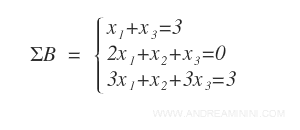
The coefficient matrix A and the augmented matrix A|B are the following:
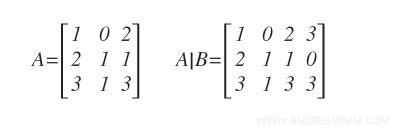
Using Gaussian elimination, I transform the augmented matrix A|B into row echelon form.
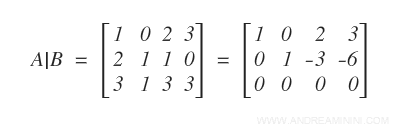
Once the matrix is in row echelon form, the third equation becomes identically zero. This allows me to eliminate it and treat the variable x3 as a free parameter t.
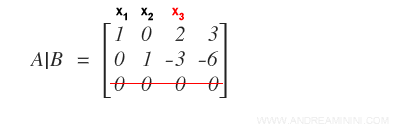
The reduced form of the augmented matrix A|B is the following:
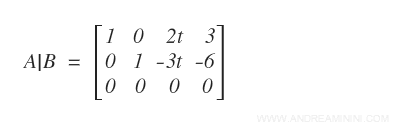
I can now rewrite the linear system ΣB in reduced form:
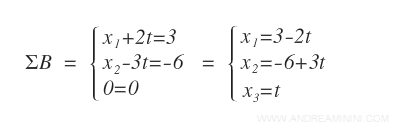
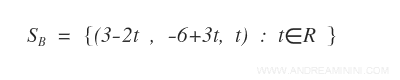
This gives the solution set SB of the system ΣB.
Next, I apply the same procedure to the associated homogeneous system ΣO.
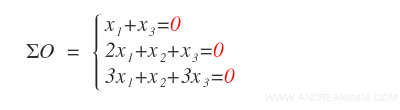
In matrix form, the homogeneous system is written as the matrix equation AX=O.
The coefficient matrix A and the augmented matrix A|B are the following:
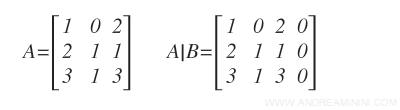
Again, I use Gaussian elimination to transform the augmented matrix A|B into row echelon form.
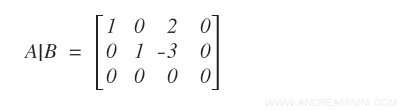
After the reduction process, the third row can be removed and the variable x3 becomes a free parameter.
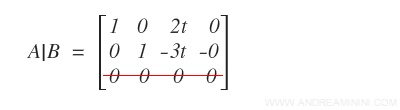
I can therefore rewrite the homogeneous system ΣO in reduced form:
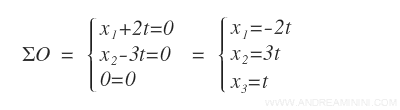
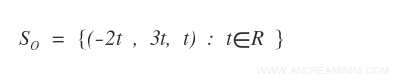
This gives the solution set SO of the homogeneous system ΣO.
According to the structure theorem, the solution set SB is equal to the sum of the solution set SO of the homogeneous system and a particular solution X' belonging to SB.
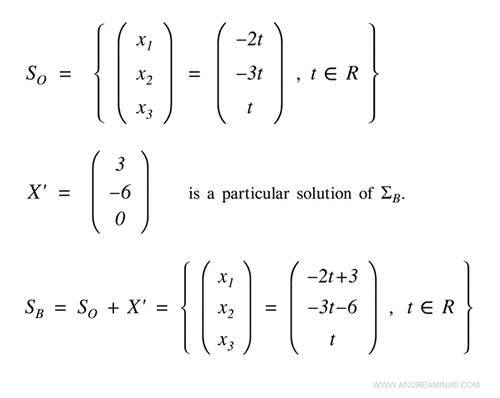
Therefore, the general solution of the system is
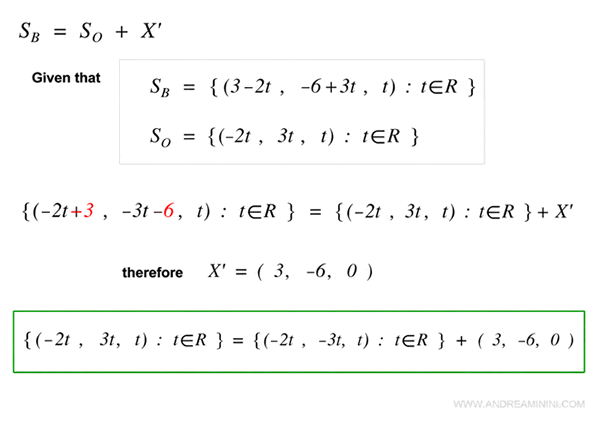
In conclusion, the solution set SB of the system ΣB is obtained by adding a particular solution X' to the solution set SO of the associated homogeneous system ΣO.
Proof of the structure theorem
A proof of the structure theorem for linear systems is shown below:
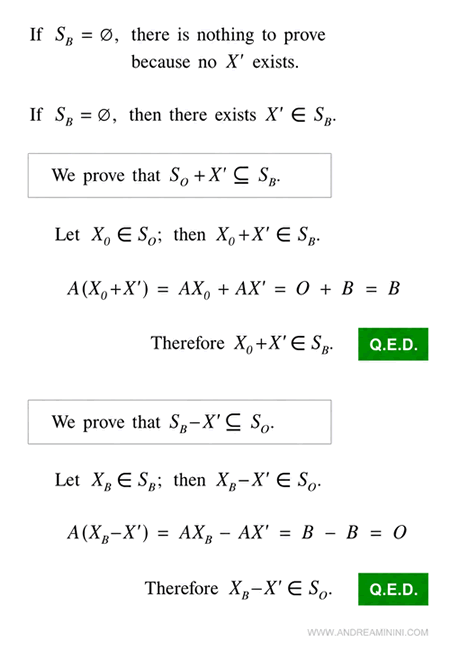
Note. If the solution set SB is empty, there is nothing to prove because no particular solution X' exists.