Solving Linear Systems Using Matrices
A linear system is made up of m equations with n unknowns.
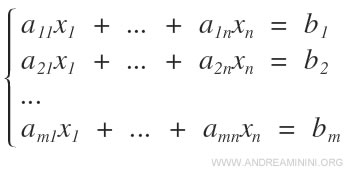
Linear systems can also be rewritten in matrix form and solved using matrix operations. This approach is widely used in linear algebra because it provides a compact and efficient way to study and solve systems of equations.
Representing a Linear System in Matrix Form
To express a linear system in matrix form, the system is separated into three main components:
- the augmented matrix
- the coefficient matrix
- the vectors associated with the unknowns and the constant terms
The Augmented Matrix
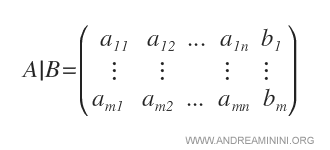
The augmented matrix A|B contains both the coefficients a of the unknowns and the constant terms b of the system.
The Coefficient Matrix
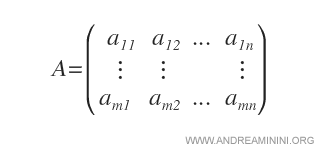
The coefficient matrix A contains only the coefficients of the linear system.
The Vector of Unknowns
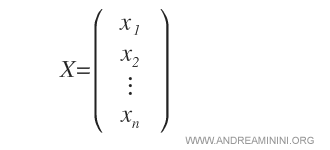
The vector of unknowns X is a column matrix whose entries are the unknown variables x1,...,xn of the system.
The Constant Vector
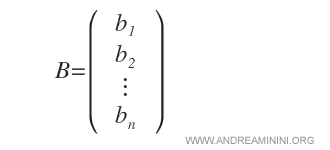
The constant vector B is the column matrix formed by the constant terms of the equations in the system.
The Matrix Form of a Linear System
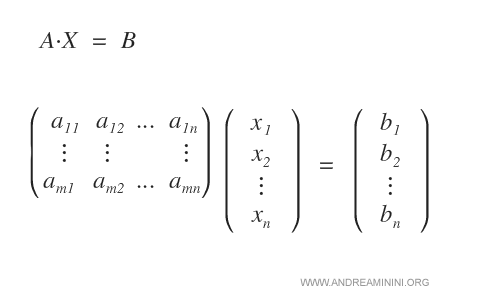
Once these elements have been defined, the linear system can be written in compact matrix form.
The product of the coefficient matrix and the column vector of unknowns X is equal to the constant vector B.
The Rouché-Capelli Theorem
The Rouché-Capelli theorem is used to determine whether a linear system has solutions and how many solutions exist.
Note. The theorem determines the number of solutions of the system, but it does not provide the actual values of the solutions.
Cramer's Rule
Cramer's rule can be used to compute the solution of a linear system when the coefficient matrix is square.
The Gauss-Jordan Elimination Method
Another common technique for solving linear systems is the Gauss-Jordan elimination method.
This method is especially useful because it extends the use of Cramer's rule to rectangular linear systems, that is, systems whose coefficient matrix is not square.