
Worked Example Function Analysis 5
In this example, we will analyze the following function and sketch its graph:
$$ f(x) = \frac{x}{1-x} $$
This is a rational function.
Undefined Points
We first identify any points where the function is undefined:
$$ 1 - x = 0 $$
$$ x = 1 $$
The function is undefined at x = 1, because the denominator equals zero, and division by zero is not defined.
Domain of the Function
The function is therefore defined for all real numbers except x = 1:
$$ D_f = (-\infty, 1) \cup (1, \infty) $$
Intercepts with the Axes
At x = 0, the function evaluates to:
$$ f(0) = \frac{0}{1-0} = 0 $$
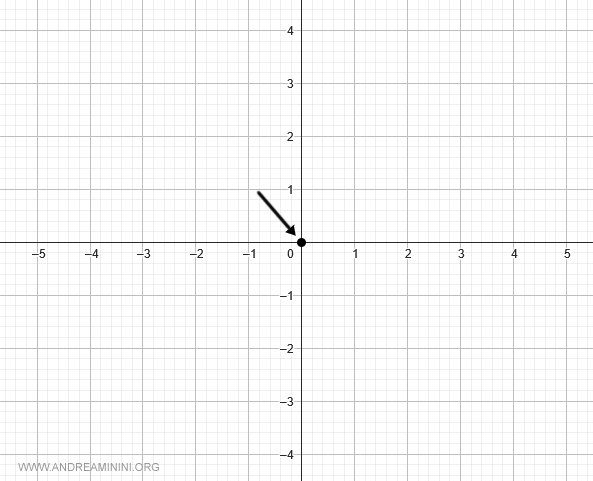
Thus, the graph passes through the origin, O = (0, 0):
Sign Analysis
Next, we analyze the sign of the function:

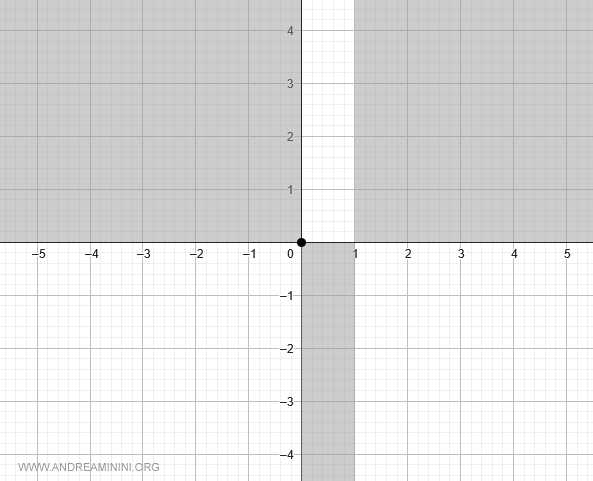
Within its domain, f(x) is positive on the interval (0, 1), zero at x = 0, and negative elsewhere.
This information allows us to outline the key regions of interest on the Cartesian plane:
Horizontal Asymptotes
We now study the end behavior of the function as x approaches positive infinity:
$$ \lim_{x \rightarrow +\infty} \frac{x}{1-x} = \frac{\infty}{-\infty} $$
This is an indeterminate form of type ∞/∞, which we resolve using L'Hôpital’s Rule:
$$ \lim_{x \rightarrow +\infty} \frac{D[x]}{D[1-x]} = \frac{1}{-1} = -1 $$
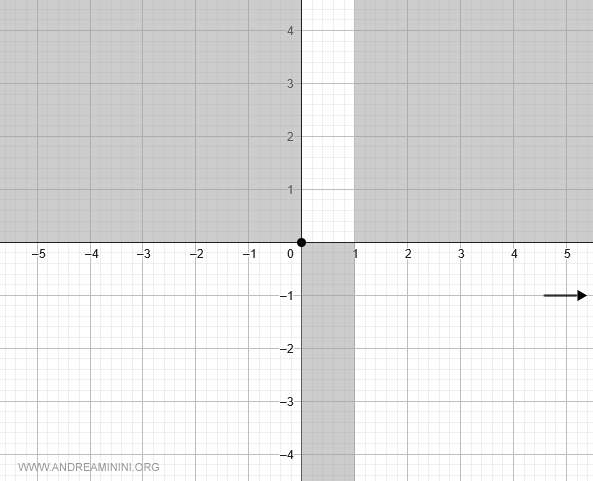
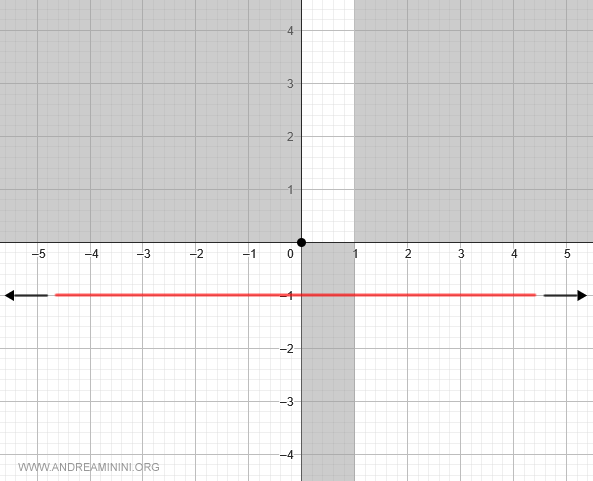
Thus, as x → +∞, the function approaches y = -1:
Similarly, for x → -∞:
$$ \lim_{x \rightarrow -\infty} \frac{x}{1-x} = \frac{-\infty}{\infty} $$
Applying L'Hôpital’s Rule again:
$$ \lim_{x \rightarrow -\infty} \frac{D[x]}{D[1-x]} = \frac{1}{-1} = -1 $$
Thus, as x → -∞, the function also approaches y = -1:
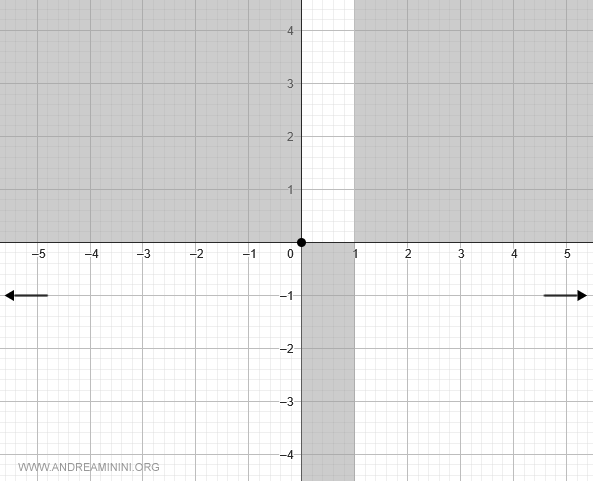
Since both limits converge to the same value, the function has a horizontal asymptote at y = -1:
Vertical Asymptotes
Vertical asymptotes occur where the function is undefined - in this case, at x = 1.
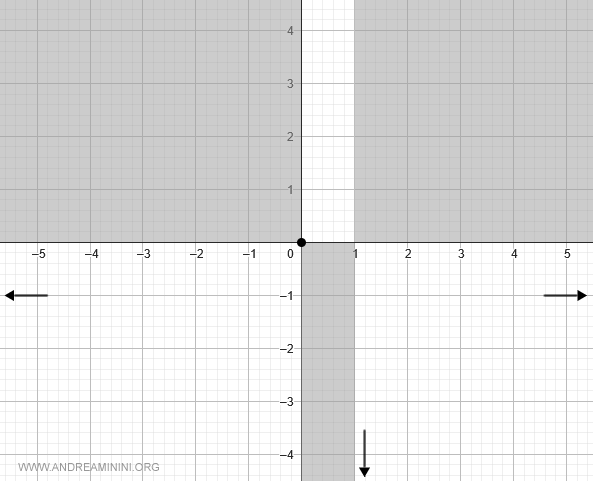
Approaching from the right:
$$ \lim_{x \rightarrow 1^+} \frac{x}{1-x} = -\infty $$
Which we show on the graph:
Approaching from the left:
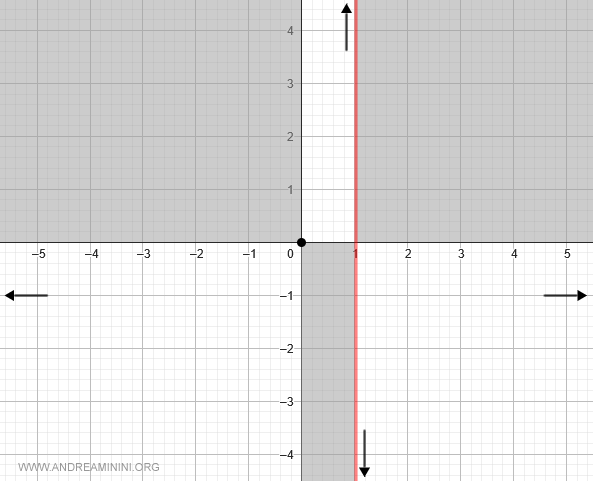
$$ \lim_{x \rightarrow 1^-} \frac{x}{1-x} = +\infty $$
Which is also shown on the graph:
Increasing and Decreasing Intervals
To determine where the function is increasing or decreasing, we compute the first derivative:
$$ f'(x) = D\left[ \frac{x}{1-x} \right] $$
Applying the quotient rule:
Note. The derivative of a quotient is: $$ \frac{f'(x)g(x) - f(x)g'(x)}{[g(x)]^2} $$
$$ f'(x) = \frac{1 \cdot (1-x) - x \cdot (-1)}{(1-x)^2} $$
$$ f'(x) = \frac{1 - x + x}{(1-x)^2} $$
Thus:
$$ f'(x) = \frac{1}{(1-x)^2} $$
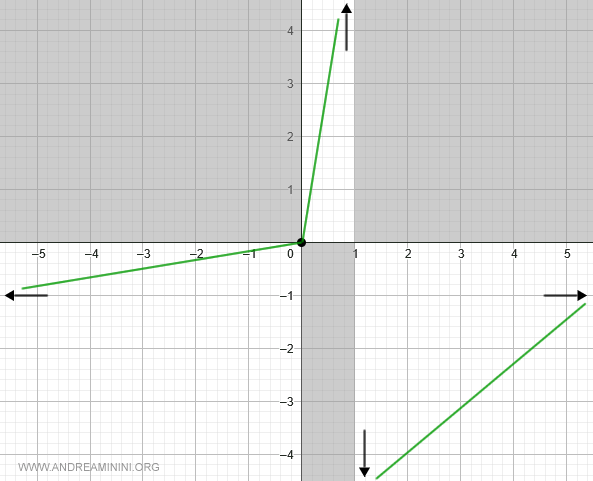
The numerator is always positive, and the denominator is squared, so f'(x) > 0 for all x in the domain:
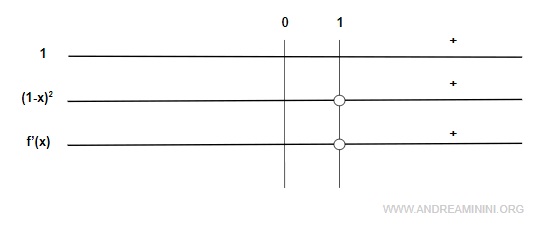
Therefore, the function is strictly increasing throughout its entire domain.
Since f'(x) ≠ 0, there are no local minima or maxima.
We can now update the graph accordingly:
Concavity and Convexity
To determine concavity and convexity, we compute the second derivative:
$$ f''(x) = D\left[ \frac{1}{(1-x)^2} \right] $$
$$ f''(x) = \frac{2}{(1-x)^3} $$
We now analyze the sign of f''(x):
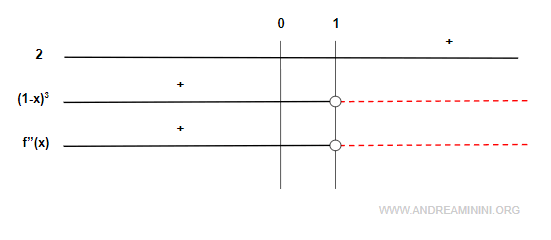
This gives us the final information needed to complete the graph:
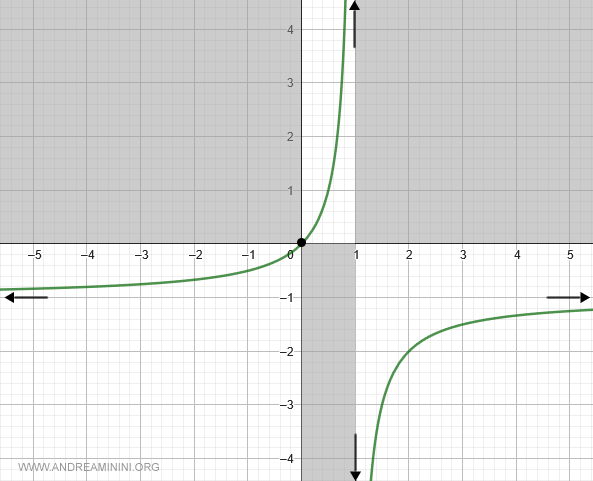
- f''(x) > 0 on (-∞, 1), so the function is convex on this interval.
- f''(x) < 0 on (1, ∞), so the function is concave on this interval.
The final graph of the function is as follows:
And so on.


