Length Contraction
Einstein’s theory of relativity changes how we think about both time and space. It tells us that space isn’t fixed and rigid, but can actually shrink when something moves fast enough.
Just as motion slows down the passage of time, it also compresses space. Objects in motion appear shorter along the direction of travel when seen from an observer at rest.
What’s really happening?
Imagine watching an object that’s moving past you. From your point of view, its length looks slightly reduced compared to when it’s standing still. That’s not an optical illusion - it’s a real physical effect predicted by relativity.
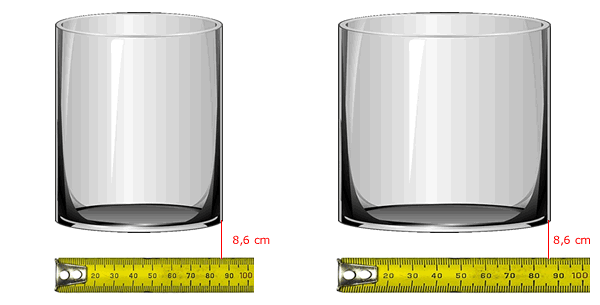
Example. Suppose an object measures 8.6 centimeters when it’s at rest. If it moves at a very high speed, its true size doesn’t change, but to a stationary observer it appears shorter because the space it moves through is compressed.
Proper length and observed length
The proper length of an object is its length measured in its own rest frame. That’s the “true” length, when it’s not moving relative to the observer.
When measured from a frame where the object is moving, the length appears smaller. The faster it moves, the greater the contraction along the direction of motion.
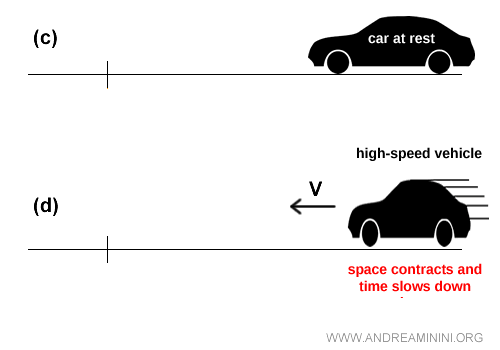
A moving object always looks shorter than when it’s at rest.
This effect becomes noticeable only when the object’s speed approaches that of light. At everyday speeds, the change is so tiny that it’s impossible to detect without precision instruments.
The mathematical expression
This behavior can be described by a simple formula that connects the proper length of an object with its observed length when in motion.
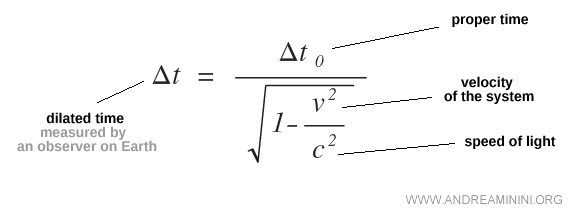
When the object is at rest, its velocity is zero ( v = 0 ), so its observed length L equals its proper length L0. As the object speeds up ( v > 0 ), its length L becomes shorter.
At extreme speeds, near the speed of light, this contraction becomes one of the most striking demonstrations of how deeply motion reshapes space and time.