
Theory of Relativity
The theory of relativity is an attempt to unify physical and electromagnetic phenomena under a single framework of physical laws.
Note. In the 19th century, physical phenomena were explained by Newton’s classical mechanics and his law of gravitation, while electromagnetic phenomena were described by Maxwell’s theory of electromagnetism.
Who developed the theory of relativity?
The theory was introduced by Albert Einstein in the early 20th century. In 1905, he published the special theory of relativity, and in 1915 the general theory of relativity.
What’s the difference between special and general relativity?
Special relativity applies to systems moving in uniform straight-line motion, while general relativity extends to all kinds of motion, including accelerated and non-uniform motion.
How to make sense of relativity
The clearest way is through a practical example. According to Newtonian mechanics, if you throw a ball from rest with a force F, it lands at a distance d1 from the thrower (fig. A).
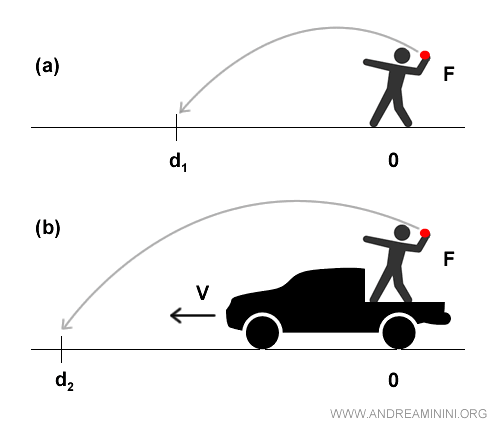
If the same ball is thrown from the same point with the same force, but this time from a moving car, it travels farther-up to d2. That’s because the velocity V of the car adds to the force F of the throw (fig. B).
This principle holds for material bodies, but not for light
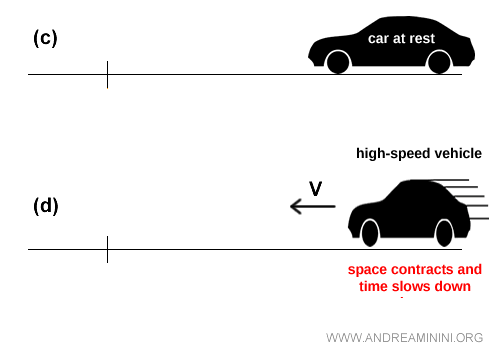
Now imagine switching on the headlights of a stationary car (fig. C) and then of a moving car (fig. D).
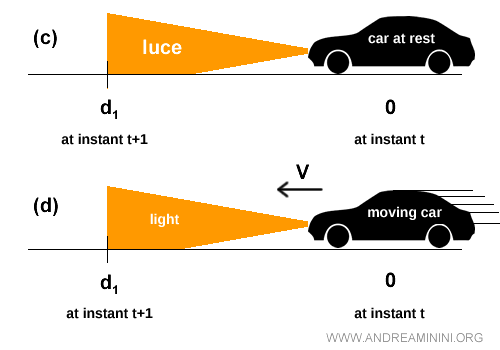
In principle, the light from the moving car should travel faster… but it doesn’t. In both cases, light always moves at the same speed.
Note. In the figure above, after a time interval t+1 the light beam has covered the same distance d1, whether the car is stationary or moving.
Why?
The reason is straightforward: the speed of light is constant (299,000 km/s) and does not depend on the motion of its source. This is an established fact.
A theoretical dilemma
Maxwell’s equations require the speed of light to be constant. Newton’s mechanics, on the other hand, cannot accommodate such constancy.
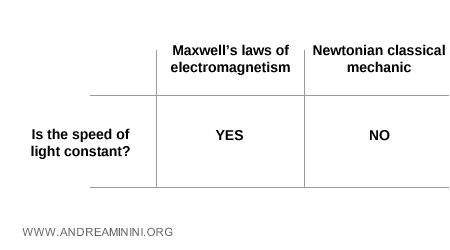
This contradiction forced late 19th-century scientists to search for a unifying theory.
What solution did Einstein propose?
To resolve the conflict between Maxwell’s laws and Newtonian mechanics, Einstein proposed revising Newton’s framework and introducing the concept of space-time relativity.
What does relative space-time mean?
Up until the 19th century, space and time were regarded as absolute-unchanging and independent of each other.
A practical illustration
Imagine two identical clocks. One remains at home (A), while the other travels at very high speed (B).
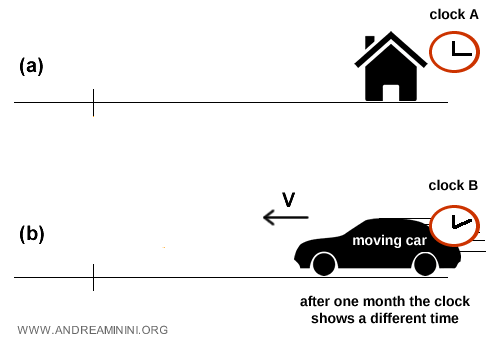
After a month, you would expect both to show the same time-but they don’t. The clock in motion runs behind the stationary one.
Thus, time is not absolute; it is affected by velocity.
On this basis, Einstein developed the idea of the relativity of time.
What does relative time mean?
The passage of time is not universal but depends on position, velocity, and context.
At speeds close to that of light, time flows more slowly (C) compared to time on Earth (A).
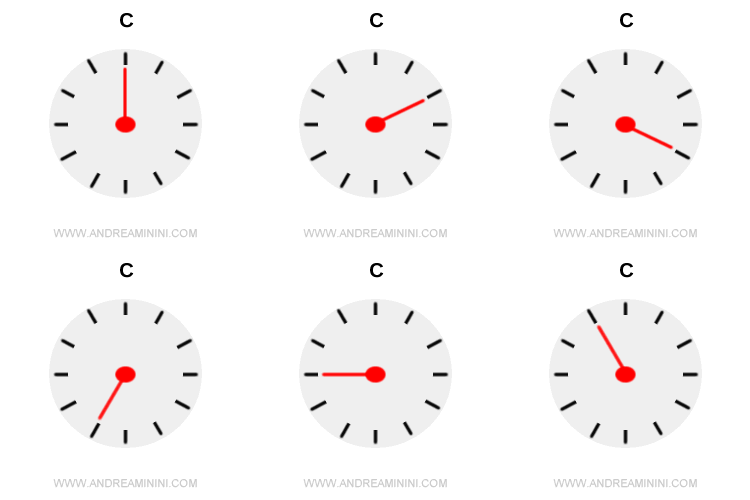
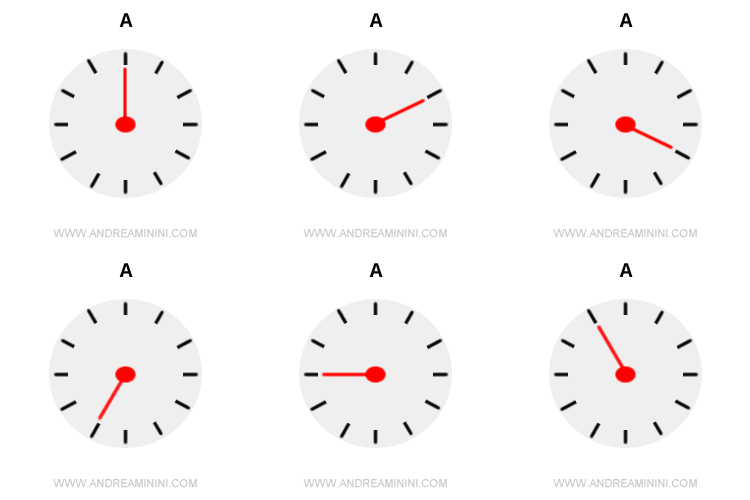
Example. On a spaceship traveling near the speed of light, one second lasts much longer than a second on Earth. So while time on Earth flows normally, aboard the ship it slows down. This effect is famously illustrated by the twin paradox.
The graph below shows the relationship between velocity and time dilation.

As velocity (v) approaches the speed of light (c), the unit of time stretches: one second (t’) lasts longer compared to a second on Earth (t).
Not only time-space is relative too
Einstein showed that space and time are both relative and interdependent (space-time relativity).
Together they form a single physical entity called space-time. And space-time itself is relative.
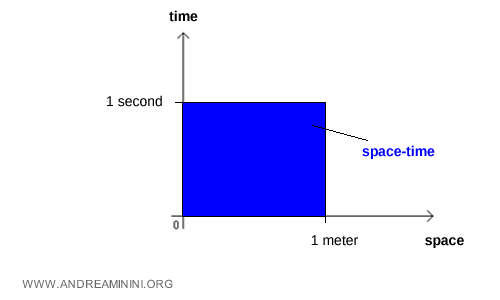
If space contracts, time slows; if space expands, time quickens.
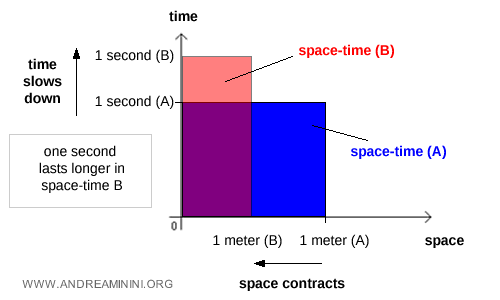
Example. Moving from space-time A to space-time B, space contracts while the duration of time expands. In other words, a second lasts relatively longer. In space-time B, time flows more slowly than in space-time A.
When does space contract?
Space contracts under two conditions:
- as velocity increases
- as gravity increases
When we observe an object moving at high speed, it appears shortened. Velocity contracts space.
For the person on board, time slows down; for an external observer, it flows normally.
Note. Time passes more slowly aboard the spaceship than on Earth. If we could watch the astronaut inside, we would perceive their movements in slow motion. Yet to the astronaut, time feels normal. No difference is experienced. I’ve stressed this before, but it’s worth repeating: it is a key point.
Relativistic mass
According to Einstein, all fundamental physical quantities are relative: length, time, and mass.
Thus, not only time and space (length), but also mass is relative. Every body has a rest mass and a relativistic mass that depends on its velocity.
The two postulates of special relativity
With these concepts in place, we can better understand the meaning of Einstein’s two postulates of special relativity:
- First postulate. The laws of physics are the same in all inertial frames of reference.
- Second postulate. The speed of light is constant and independent of the motion of its source.
The general theory of relativity
In 1915, Einstein extended relativity to non-inertial systems-those in accelerated motion (motion with changing velocity).
This new framework became known as general relativity.
Note. The general theory of relativity (1915) is distinct from the special theory (1905). They are separate, though closely related.
General relativity is above all a theory of gravitation. Einstein used the concept of space-time to explain the origin of gravitational force.
In conclusion
That, in the simplest possible terms, is Einstein’s theory of relativity.
I hope this overview is clear and accessible, and that it helps build an initial understanding before moving on to the details.


