Cauchy Problem
Understanding the Cauchy Problem
The Cauchy problem involves finding a particular solution to a differential equation for a function \( y = f(x) \), where the corresponding integral curve passes through a given point \( (x_0, y_0) \): $$ \begin{cases} y' = F(x, y) \\ y_0 = f(x_0) \end{cases} $$
The condition \( y_0 = f(x_0) \) is known as the problem’s initial condition.
To solve a Cauchy problem, we must select - among the infinitely many solutions to the differential equation - the one that satisfies the prescribed initial condition.
In other words, we are looking for a function \( y = f(x) \) that both solves the differential equation and passes through the point \( (x_0, y_0) \).
Note. A Cauchy problem may involve one or more initial conditions. In general, the Cauchy problem for an \( n \)th-order differential equation consists of the equation itself along with \( n \) conditions specified at the same point \( x_0 \), where \( x_0 \in I \) and \( y_0, y_1, \dots, y_{n-1} \) are the values assigned to \( y, y', y'', \dots, y^{(n-1)} \): $$ \begin{cases} y^{(n)} = f(x, y(x), \dots, y^{(n-1)}(x)) \\ y(x_0) = y_0 \\ y'(x_0) = y_1 \\ \vdots \\ y^{(n-1)}(x_0) = y_{n-1} \end{cases} $$ A function \( y \in C^n(I) \) is a solution to the Cauchy problem if it satisfies the differential equation at every point \( x \in I \) and fulfills all \( n \) initial conditions. Here, \( C^n(I) \) denotes the set of functions that are \( n \)-times differentiable on the interval \( I \).
The number of initial conditions must match the number of arbitrary constants in the general solution. Furthermore, all initial values must be specified at the same point \( x_0 \).
A Practical Example
Consider the following first-order Cauchy problem:
$$ \begin{cases} y' - 2x = 3 \\ f(2) = 3 \end{cases} $$
Rewriting the equation explicitly:
$$ y' = 3 + 2x $$
We integrate to find the general solution:
$$ \int y' \, dx = \int (3 + 2x) \, dx $$
$$ y = 3x + x^2 + c $$
Now we apply the initial condition \( y(2) = 3 \):
$$ 3 = 3 \cdot 2 + 2^2 + c $$
$$ 3 = 6 + 4 + c $$
Solving for \( c \):
$$ c = -7 $$
Thus, the particular solution is:
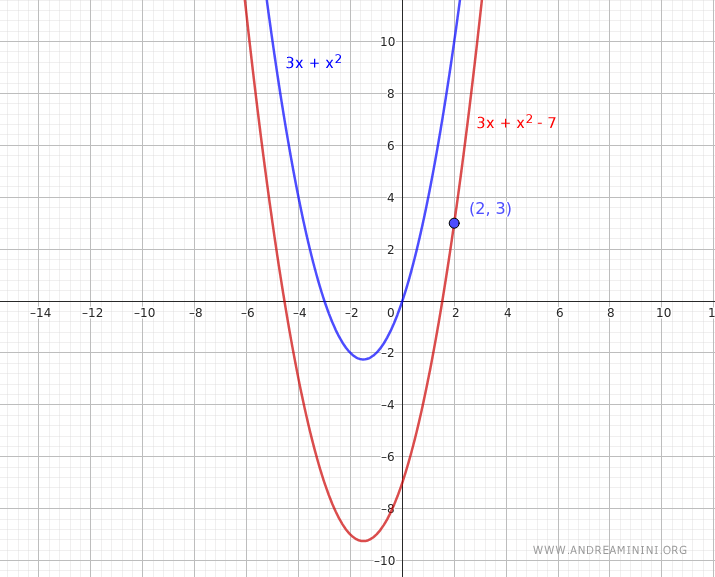
$$ y = 3x + x^2 - 7 $$
This solution satisfies the initial condition and passes through the point \( (2, 3) \).
Example 2
Now consider a simpler first-order equation:
$$ \begin{cases} y' = -e^{-x} \\ y(0) = 3 \end{cases} $$
Integrating the right-hand side:
$$ y = \int -e^{-x} \, dx = e^{-x} + c $$
Applying the initial condition \( y(0) = 3 \):
$$ 3 = 1 + c \Rightarrow c = 2 $$
The particular solution is:
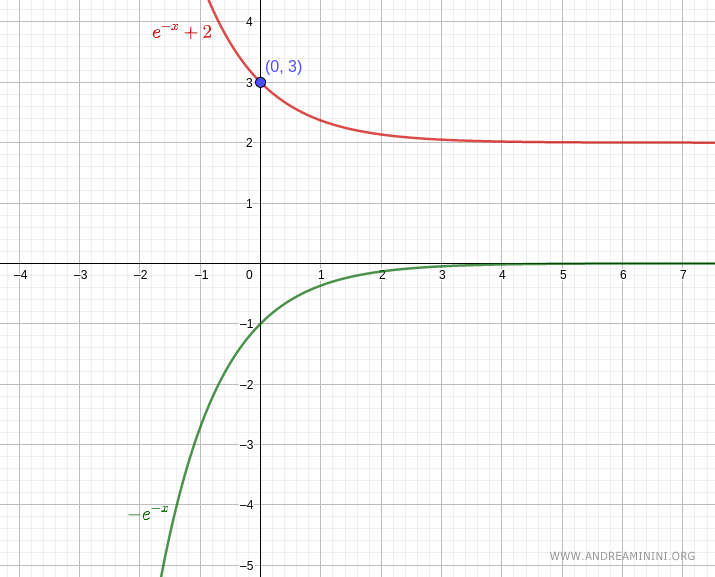
$$ y = e^{-x} + 2 $$
which passes through the point \( (0, 3) \).
Example 3
Now let’s look at a second-order case:
$$ \begin{cases} y'' = 2x \\ y'(1) = 2 \\ y(1) = 3 \end{cases} $$
There are two initial conditions, so we expect the general solution to include two arbitrary constants.
First, integrate \( y'' \) to obtain \( y' \):
$$ y' = \int 2x \, dx = x^2 + c_1 $$
Next, integrate \( y' \) to find \( y \):
$$ y = \int (x^2 + c_1) \, dx = \frac{1}{3}x^3 + c_1 x + c_2 $$
This is the general solution of the second-order equation.
Apply \( y'(1) = 2 \) to solve for \( c_1 \):
$$ 2 = 1^2 + c_1 \Rightarrow c_1 = 1 $$
Substitute \( c_1 = 1 \) into the general solution and apply \( y(1) = 3 \) to solve for \( c_2 \):
$$ 3 = \frac{1}{3}(1)^3 + 1(1) + c_2 = \frac{4}{3} + c_2 $$
$$ c_2 = 3 - \frac{4}{3} = \frac{5}{3} $$
So the particular solution is:
$$ y = \frac{1}{3}x^3 + x + \frac{5}{3} $$
This function satisfies both initial conditions:
$$ \begin{cases} y'' = 2x \\ y'(1) = 2 \\ y(1) = 3 \end{cases} $$
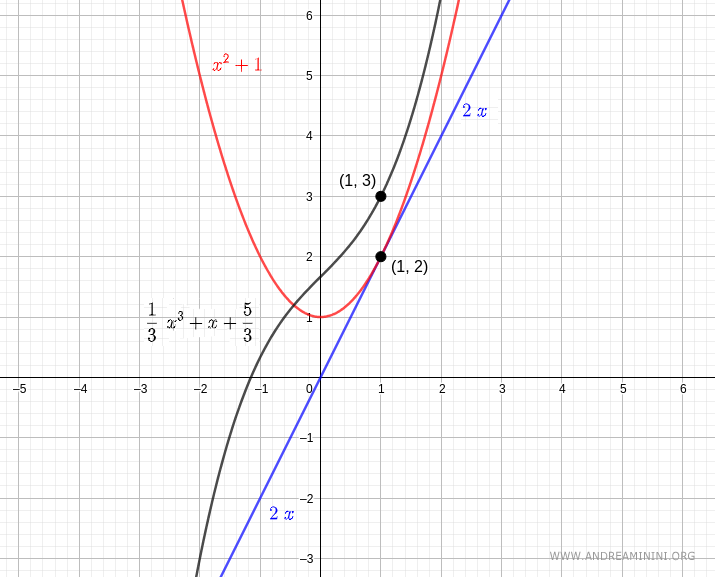
The first derivative \( y' = x^2 + 1 \) (shown in red) passes through the point \( (1, 2) \), while the solution \( y = \frac{1}{3}x^3 + x + \frac{5}{3} \) (in black) passes through \( (1, 3) \).
And so on.