
Finding the Inverse Matrix with Gaussian Elimination
Gaussian elimination offers an alternative approach to computing the inverse of a matrix.
It’s particularly useful when the matrix is large and direct formulas become cumbersome.
Step-by-step: Inverting a matrix with Gaussian elimination
Start by placing the identity matrix I to the right of the matrix M.
This creates an augmented matrix, written as M|I.
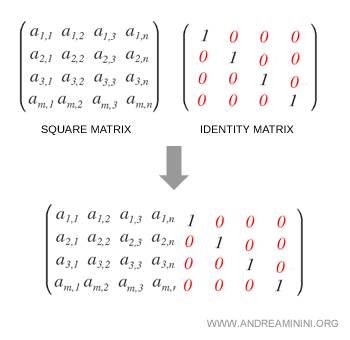
In this augmented matrix, the identity matrix appears on the right-hand side (shown in red).
The goal is to use Gaussian row operations to turn the left block into the identity matrix.

Note. The basic row operations are: swapping two rows, multiplying a row by a nonzero scalar k, and adding a multiple of one row to another.
If the left-hand block becomes the identity, then the block on the right will be the inverse matrix of M.

A worked example
Consider the 2×2 matrix:
$$ M = \begin{pmatrix} 2 & 1 \\ -1 & 1 \end{pmatrix} $$
We want to compute its inverse, M-1, using Gaussian elimination.
Attach the 2×2 identity matrix on the right:
$$ M|I = \begin{pmatrix} 2 & 1 & 1 & 0 \\ -1 & 1 & 0 & 1 \end{pmatrix} $$
Now we’ll transform the left block into the identity matrix by performing row operations.
First, swap the two rows: R1 ⇔ R2
$$ M|I = \begin{pmatrix} -1 & 1 & 0 & 1 \\ 2 & 1 & 1 & 0 \end{pmatrix} $$
Next, add twice the first row to the second: R2 = R2 + 2·R1
$$ M|I = \begin{pmatrix} -1 & 1 & 0 & 1 \\ 2 + (-1) \cdot 2 & 1 + 1 \cdot 2 & 1 + 0 \cdot 2 & 0 + 1 \cdot 2 \end{pmatrix} $$
$$ M|I = \begin{pmatrix} -1 & 1 & 0 & 1 \\ \color{red}0 & 3 & 1 & 2 \end{pmatrix} $$
Now eliminate the entry above the 3 by subtracting one third of the second row from the first: R1 = R1 + (−1/3)·R2
$$ M|I = \begin{pmatrix} -1 - 0 \cdot \frac{1}{3} & 1 - 3 \cdot \frac{1}{3} & 0 - 1 \cdot \frac{1}{3} & 1 - 2 \cdot \frac{1}{3} \\ 0 & 3 & 1 & 2 \end{pmatrix} $$
$$ M|I = \begin{pmatrix} -1 & \color{red}0 & - \frac{1}{3} & \frac{1}{3} \\ 0 & 3 & 1 & 2 \end{pmatrix} $$
Multiply the first row by −1: R1 = (−1)·R1
$$ M|I = \begin{pmatrix} -1 \cdot (-1) & 0 \cdot (-1) & - \frac{1}{3} \cdot (-1) & \frac{1}{3} \cdot (-1) \\ 0 & 3 & 1 & 2 \end{pmatrix} $$
$$ M|I = \begin{pmatrix} \color{red}1 & 0 & \frac{1}{3} & - \frac{1}{3} \\ 0 & 3 & 1 & 2 \end{pmatrix} $$
Finally, divide the second row by 3: R2 = (1/3)·R2
$$ M|I = \begin{pmatrix} 1 & 0 & \frac{1}{3} & - \frac{1}{3} \\ 0 \cdot \frac{1}{3} & 3 \cdot \frac{1}{3} & 1 \cdot \frac{1}{3} & 2 \cdot \frac{1}{3} \end{pmatrix} $$
$$ M|I = \begin{pmatrix} 1 & 0 & \frac{1}{3} & - \frac{1}{3} \\ 0 & \color{red}1 & \frac{1}{3} & \frac{2}{3} \end{pmatrix} $$
At this point, the left-hand block is the identity matrix.
$$ M|I = \begin{pmatrix} \color{red} 1 & \color{red}0 & \frac{1}{3} & - \frac{1}{3} \\ \color{red}0 & \color{red}1 & \frac{1}{3} & \frac{2}{3} \end{pmatrix} $$
So, M is indeed invertible.
The inverse matrix is the block on the right:
$$ M^{-1} = \begin{pmatrix} \frac{1}{3} & - \frac{1}{3} \\ \frac{1}{3} & \frac{2}{3} \end{pmatrix} $$
Note. I also solved this small “toy problem” using other methods for finding inverses, and of course the result came out the same.


