
Asymmetric Relations
What Is an Asymmetric Relation?
A relation on a set X is said to be asymmetric if, whenever an element a is related to an element b, the reverse relation - b to a - does not hold. $$ a R b \ \ \Rightarrow b \require{cancel} \cancel{R} a $$
In an asymmetric relation, no two distinct elements are mutually related.
For instance, the relation “A is the mother of B” is asymmetric: if A is the mother of B, then B cannot be the mother of A.
Asymmetric relations belong to the broader class of relations defined on a set.
A Practical Example
Consider the set:
$$ I = \{ 1, 2, 3, 4 \} $$
Let R be the relation “x is greater than y”:
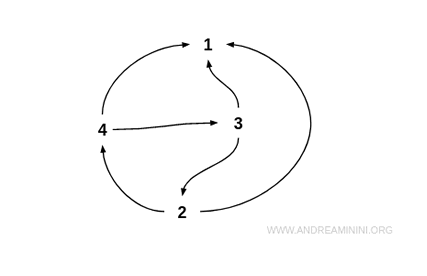
$$ R = \{ (4;3), (4;2), (4;1), (3;2), (3;1), (2;1) \} $$
This relation is asymmetric because if x is greater than y, then y cannot be greater than x.
Note. For example, 4 is greater than 3: $$ 4 > 3 $$ but 3 is not greater than 4: $$ 3 < 4 $$ Thus, the relation satisfies the condition for asymmetry.
When represented as a graph, an asymmetric relation has no bidirectional edges between any pair of distinct nodes.
Asymmetry vs. Antisymmetry
Asymmetry and antisymmetry are often confused, but they refer to different properties.
- Antisymmetric relation
- In an antisymmetric relation, two elements can be mutually related only if they are identical. In formal terms: if \( aRb \) and \( bRa \), then \( a = b \). Hence, if \( a \ne b \), it must follow that \( b \not\!Ra \). $$ aRb \ ,\ a \ne b \ \Rightarrow b \require{cancel} \cancel{R} a $$
- Asymmetric relation
- An asymmetric relation, on the other hand, forbids all reciprocal relations - no exceptions. Even if \( a = b \), the pair \( (a,a) \) cannot belong to the relation. $$ aRb \ \ \Rightarrow b \require{cancel} \cancel{R} a $$
In short, antisymmetry allows mutual relations only when the elements are equal, whereas asymmetry prohibits them entirely.
Further Remarks
Some key observations about asymmetric relations:
- Not all relations are symmetric or asymmetric. If a relation is not asymmetric, that does not imply it is symmetric, and vice versa.
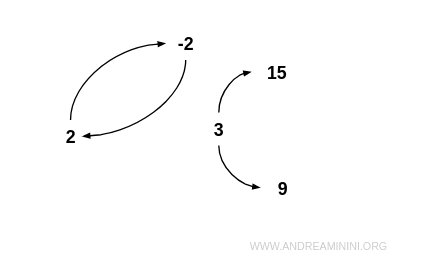
Example. Consider the set $$ I = \{ -2, 2, 3, 9, 15 \} $$ and the relation R defined as “x is a proper divisor of y”: $$ R = \{ (-2;2), (2;-2), (3;9), (3;15) \} $$ This relation is not asymmetric because - 2 and 2 are mutually related. However, it is not symmetric either, as the relation from 3 to 9 is not reciprocated. Therefore, R is neither symmetric nor asymmetric. In the graph, a two-way connection appears between - 2 and 2, but not among all node pairs.
And so on.


