
Transitive Relations
What Is a Transitive Relation?
A relation is considered transitive if, for any three elements a, b, and c in a set I, whenever a is related to b and b is related to c, then a must also be related to c. $$ \forall \ a,b,c \in I \ | \ aRb \ , \ bRc \ \Rightarrow aRc $$ This can be illustrated visually as follows:
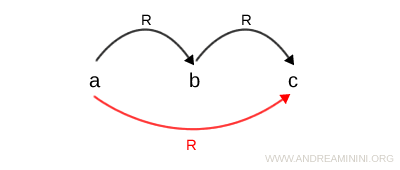
They’re called transitive because they satisfy the transitive property.
For example, if A is the brother of B and B is the brother of C, then A is also the brother of C.
Transitive relations are part of the broader category of relations defined on a set.
Note: Not all relations are transitive. For instance, if A is the mother of B and B is the mother of C, that doesn’t make A the mother of C - so this relation is not transitive.
A Practical Example
Let’s consider the set I:
$$ I = \{ 2 , 4, 6, 8, 10 \} $$
The relation R connects pairs of even numbers.
For instance, 2 and 4 are related because they’re both even:
$$ 2R4 $$
Likewise, 4 and 6 are related for the same reason:
$$ 4R6 $$
By the transitive property, 2 and 6 must also be related - since 2 and 4 form a pair of even numbers, and so do 4 and 6, then 2 and 6 form a valid pair as well:
$$ 2R6 $$
In this case, the transitive property holds for every possible combination of elements in the set I = {2, 4, 6, 8, 10}.
Therefore, the relation R is transitive over the set I.
Note: Transitive relations are often represented using graphs. In a graph, the transitive property is easy to spot through the connections between nodes (the elements of the set). For instance, if there’s an arrow from 2 to 4 and another from 4 to 6, then there must also be a direct arrow from 2 to 6.
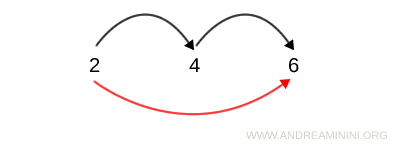
In contrast, two-way tables and Cartesian diagrams don’t readily highlight the transitive property.
Additional Examples
- The relation "x is perpendicular to y" is NOT transitive. If line x forms a 90° angle with line y, and y forms a 90° angle with line z, then x and z form either a 180° angle (a straight line) or a 0° angle (they coincide). In either case, x and z are not perpendicular.
And so on.


