
Symmetric Relations
What Is a Symmetric Relation?
A relation is said to be symmetric if, whenever an element a is related to an element b, then b is also related to a. $$ \forall a,b \in X \ , \ aRb \Rightarrow bRa $$
They’re called "symmetric" because their structure exhibits a visual symmetry when represented graphically.
For example, if X is the brother of Y, then Y is also the brother of X.
Symmetric relations form a subset of the relations defined on a set.
Note. A symmetric relation is classified as an equivalence relation if it is also reflexive and transitive.
A Practical Example
Let’s consider the set:
$$ A = \{ -1, -2, -3, 1, 2, 3 \} $$
Define a relation R that associates each number with its additive inverse.
$$ R = \{ (-1;1), (-2;2), (-3;3), (1;-1), (2;-2), (3;-3) \} $$
This relation is a subset of the Cartesian product AxA.
We can visualize it using a double-entry table.

The table reveals a clear symmetry across the main diagonal.
For every cell that satisfies the relation (highlighted in color), its mirror image across the diagonal also satisfies the relation - both cells are marked identically.
For instance, - 2 is the opposite of 2, and likewise, 2 is the opposite of - 2.
This symmetry becomes even more apparent when the relation is graphed on a Cartesian plane.
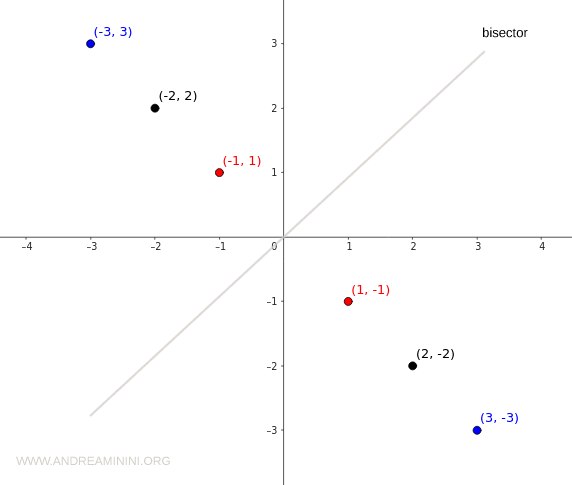
In this case, the symmetry is reflected along the bisector of the diagram.
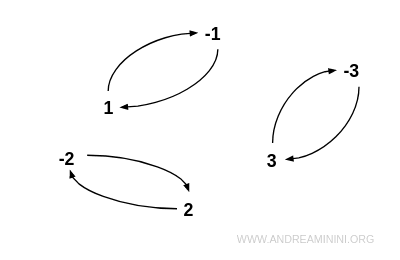
Note. In a graph-based representation of a symmetric relation, every directed edge from one vertex to another is accompanied by an edge going in the reverse direction.
Additional Examples
- The relation "x is perpendicular to y" is symmetric because if line x forms a right angle with line y, then line y also forms a right angle with line x.
Further Remarks
Here are some key points to keep in mind about symmetric relations:
- If a relation is not symmetric, it doesn’t necessarily mean it is asymmetric. There exist relations that are neither symmetric nor asymmetric.
- Symmetry is not the opposite of antisymmetry. It’s possible for a relation to be neither symmetric nor antisymmetric.
And so on.


