
Inverse Relation
Given a relation aRb defined on the Cartesian product A×B, its inverse relation bR-1a is a subset of B×A consisting of all pairs (b, a) such that aRb holds true.
In simpler terms, if aRb is a relation from set A to set B, then the inverse relation bR-1a maps from B back to A.
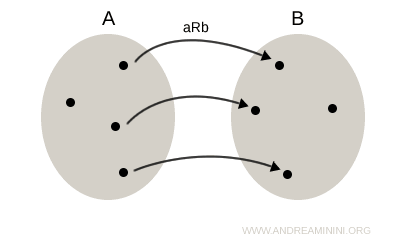
The inverse relation R-1 is formed by reversing the order of each pair (a, b) to obtain (b, a).
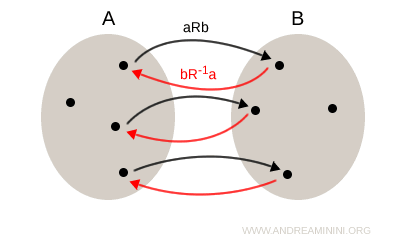
Visually, the inverse relation is represented by reversing the direction of the arrows: for every arrow aRb from A to B, there is a corresponding arrow bR-1a from B back to A.
As a result, the domain of the inverse relation is the codomain of the original:
$$ \text{domain} \ R^{-1} = \text{codomain} \ R $$
And the codomain of the inverse relation is the domain of the original:
$$ \text{codomain} \ R^{-1} = \text{domain} \ R $$
Note: The inverse relation bR-1a holds if and only if the original relation aRb holds. $$ bR^{-1}a \Leftrightarrow aRb $$
A Practical Example
Let’s consider two finite sets A and B:
$$ A = \{2,3,4,5,6 \} $$
$$ B = \{4,9,16,25,36 \} $$
The relation R maps each element of A to its square in B:
$$ aRb \ : \ b = a^2 $$
This relation is a subset of the Cartesian product A×B, consisting of ordered pairs (a, b):
$$ aRb = \{ (2,4), (3,9), (4,16), (5,25), (6,36) \} \subset A×B $$
Here is the sagittal diagram illustrating the relation aRb:

The inverse relation R-1 links


