Euler’s Method for Numerical Integration
Euler’s method is a numerical technique for estimating the value of a definite integral of a function \( y = f(t) \) through an iterative process: $$ \int_a^b f(t) \, dt $$ Given an initial condition \( y_0, t_0 \), the method updates the solution using the formula: $$ y_j = y_{j-1} + \frac{dy}{dt}\big|_{t = t_{j-1}} \cdot \Delta t $$ where \( \Delta t \) is the integration step size: $$ t_j = t_{j-1} + \Delta t $$
For a general integral over the interval \([a, b]\):
$$ \int_a^b f(t) \, dt $$
we divide the interval into \( n \) equal parts, yielding a step size:
$$ \Delta t = \frac{b - a}{n} $$
We then choose an initial point \( t_0 \) and evaluate the function at that point:
$$ y_0 = f(0) $$
To approximate the next value, we apply:
$$ y_1 = y_0 + \frac{dy}{dt}\big|_{t = t_0} \cdot \Delta t $$
That is, we multiply the derivative of the function at \( t_0 \) by the step size to obtain an estimate for the value at \( t_1 \).
Note: Since this is an approximation, the result is not exact. The error tends to accumulate progressively over the integration interval.
Explanation
To illustrate the method, we consider the graph of a function \( y = f(t) \) defined over the interval \([a, b]\):
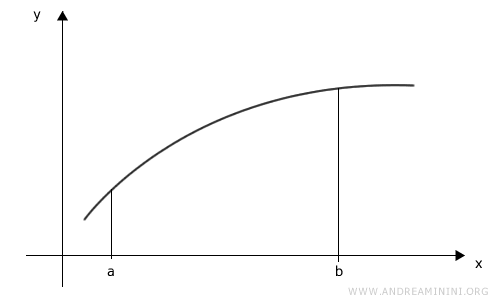
We partition the interval \([a, b]\) into three equal subintervals (\(n = 3\)):
$$ \Delta x = \frac{b - a}{n} $$
Each subinterval has the same width \( \Delta x \):
![partition of the interval [a, b]](/data/andreaminininet/euleras-method-for-numerical-integration-amnet-2025-2.gif)
Note: For illustrative purposes, we’re using only three intervals. As a result, the final approximation will be fairly rough. Euler’s method becomes more accurate as the number of intervals increases.
We begin with an initial point \( x_0 \), and use the function \( f(x) \) to compute the corresponding value \( y_0 \).
Thus, the starting point of the calculation is \( (x_0, y_0) \):
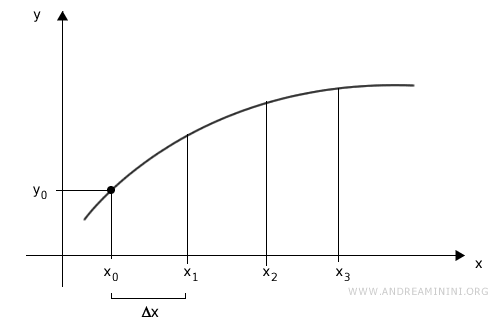
We then compute the next approximation \( (x_1, y_1) \):
$$ \begin{cases} x_1 = x_0 + \Delta x \\\\ y_1 = y_0 + \frac{dy}{dx}\big|_{x = x_0} \cdot \Delta x \end{cases} $$
In this step, we evaluate the derivative at \( x_0 \) - that is, the slope of the tangent line at \( (x_0, y_0) \) - and use it to project a linear estimate reaching \( x_1 \).
This gives us an approximation of the point \( (x_1, y_1) \):
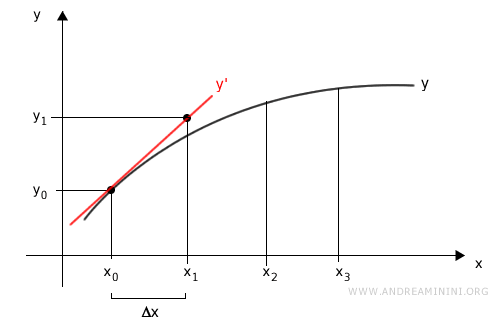
We repeat this process to estimate the next point \( (x_2, y_2) \):
$$ \begin{cases} x_2 = x_1 + \Delta x \\\\ y_2 = y_1 + \frac{dy}{dx}\big|_{x = x_1} \cdot \Delta x \end{cases} $$
This time, we evaluate the derivative at \( x_1 \) and shift the tangent line to pass through the previously computed point \( (x_1, y_1) \).
This yields the next approximation \( (x_2, y_2) \):
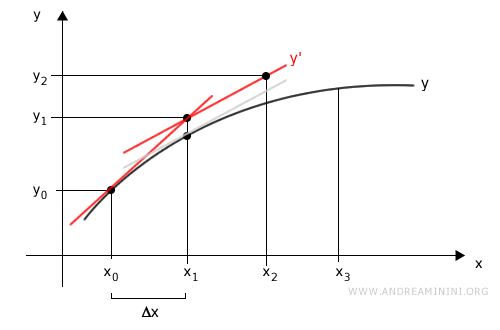
Finally, we perform the same calculations to obtain the last estimate \( (x_3, y_3) \):
$$ \begin{cases} x_3 = x_2 + \Delta x \\\\ y_3 = y_2 + \frac{dy}{dx}\big|_{x = x_2} \cdot \Delta x \end{cases} $$
Once again, we compute the derivative at \( x_2 \) and shift the tangent line through the point \( (x_2, y_2) \) to estimate:
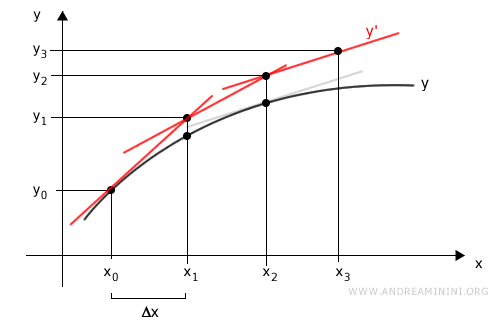
We now have a piecewise linear approximation \( y^* \) to the function \( f(x) \).
This allows us to estimate the area under the curve \( y^* \) and thus approximate the definite integral of \( f(x) \) over the interval \([a, b]\), by summing the areas between: \[ [x_0, x_1],\ [x_1, x_2],\ [x_2, x_3] \]
Since the approximation is linear over each segment, we can compute these areas using basic geometry - rectangles and triangles.
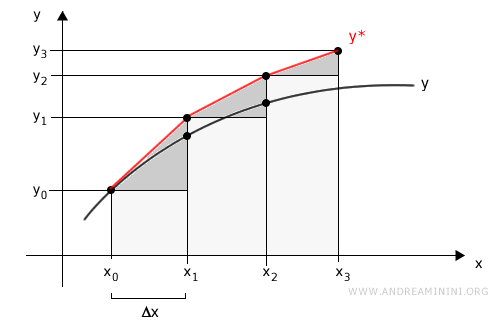
Summing these gives an estimate for the integral of \( f(x) \) over \([a, b]\):
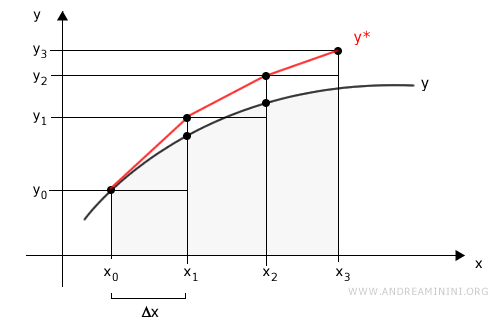
And so on.