
Theorem of a Diameter Perpendicular to a Chord
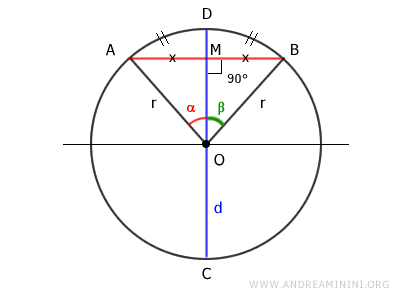
In a circle, if a diameter is perpendicular to a chord, then the chord, the central angle, and the corresponding arc are all divided equally in half.
Proof
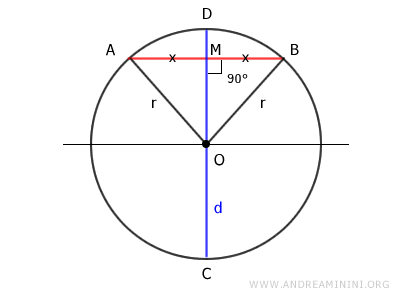
Let’s take a circle with center O, a chord AB, and a diameter CD.
By our initial assumption, the diameter is perpendicular to the chord.
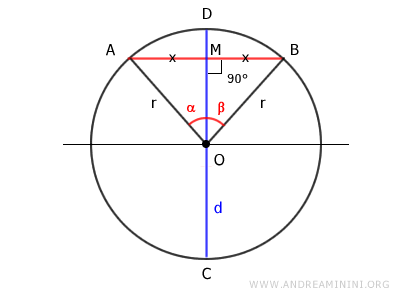
Draw the segments OA and OB.
This forms triangle OAB.
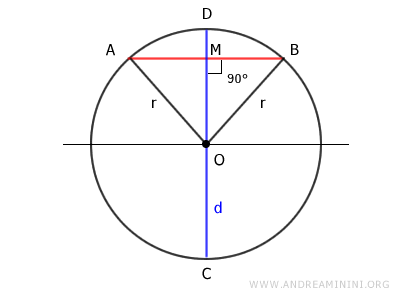
The segment OM serves as the altitude of the triangle, since it lies along diameter CD and, by our assumption, the diameter is perpendicular to the chord.
The segments OA and OB are both radii of the circle, so OA = r and OB = r. Therefore, they’re congruent, meaning OA ≅ OB.
Since OA and OB are congruent sides, triangle OAB is an isosceles triangle.
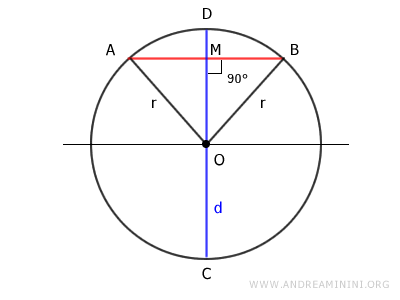
In an isosceles triangle, the median coincides with the altitude OM.
Thus, point M is the midpoint of segment AB, dividing it into two equal parts: AM = MB.
This shows that the diameter bisects the chord AB.
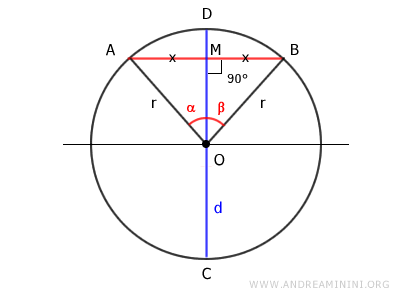
Furthermore, in an isosceles triangle, the angle bisector also coincides with the altitude OM.
Therefore, the central angle is split into two equal angles, so α ≡ β.
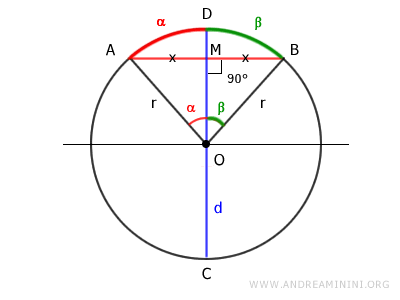
And because in a circle, two equal central angles α ≅ β correspond to two congruent arcs AD ≅ BD, the arc is likewise divided in half.
And so on.


