
Operational Definition of a Physical Quantity
An operational definition of a physical quantity explains how that quantity is measured in practice. It specifies the procedures to follow, the instruments to use, and how the measurement result should be interpreted.
Every physical quantity, such as time, length, mass, or force, is associated with specific measuring instruments and a well-defined measurement procedure.
Operational definitions are a cornerstone of experimental physics because they ensure that measurements can be repeated and verified by different observers under the same conditions.
A Practical Example
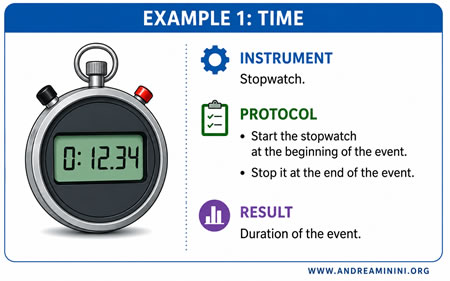
Consider the measurement of a time interval. To measure time, you need both an appropriate instrument and a clear procedure.
- Instrument: Stopwatch.
- Protocol: Start the stopwatch when the event begins and stop it when the event ends. The elapsed time shown on the display is the duration of the event.
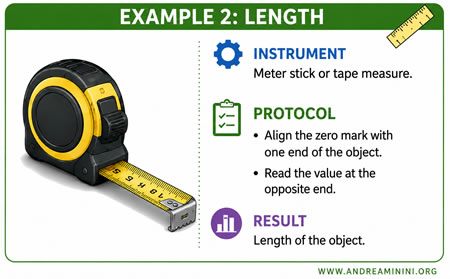
Measuring length requires a different instrument and procedure.
- Instrument: Meter stick.
- Protocol: Place the zero mark of the meter stick at one end of the object and read the value on the scale that corresponds to the other end.
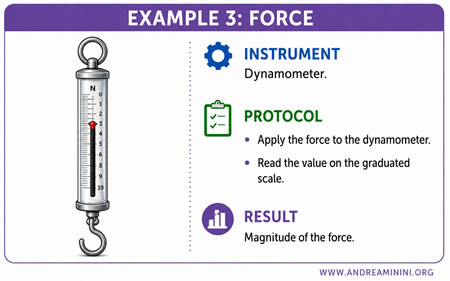
Force is measured using another instrument and protocol.
- Instrument: Dynamometer (an instrument used to measure force).
- Protocol: Apply the force to the dynamometer and read the value shown on its calibrated scale. The measurement is determined by the amount the internal spring stretches or compresses.
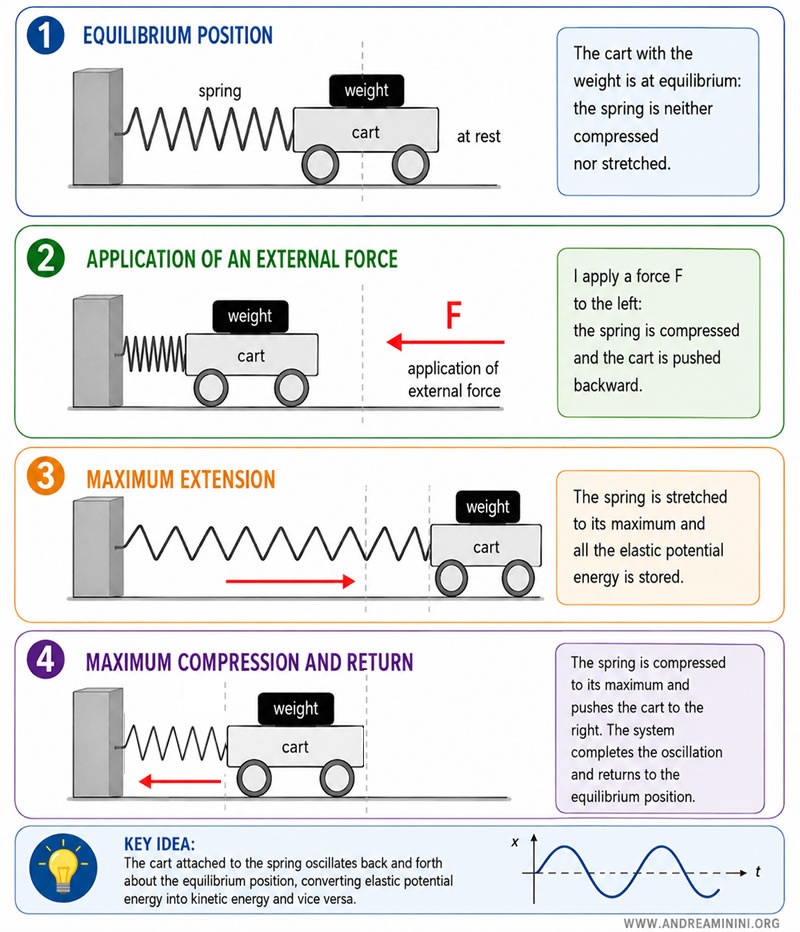
Mass can also be defined operationally through a specific measurement procedure.
- Instrument: Inertial balance.
- Protocol: To verify that an object has a mass of 3 kg, place it on the inertial balance and observe its oscillation period. If the period matches that produced by three standard 1 kg masses on the same balance, the object's mass is confirmed to be 3 kg.
These examples illustrate the idea behind an operational definition.
In practice, an operational definition tells us exactly which instrument should be used to measure a particular physical quantity and which procedure must be followed to obtain the measurement.
By linking an abstract physical concept to a concrete measurement process, operational definitions make scientific measurements objective, reproducible, and comparable across different observers and experiments.
And so on.


