Time
Time is a physical quantity that allows us to order events and measure the intervals between them. It provides the framework for distinguishing between the past, present, and future, and for describing how events unfold.
Time may seem like an obvious concept because we experience it every day. Yet it is one of the most fascinating and complex ideas in both science and philosophy.
In physics, time is one of the four dimensions of spacetime and plays a central role in describing how physical systems change and evolve.
Unit of Time
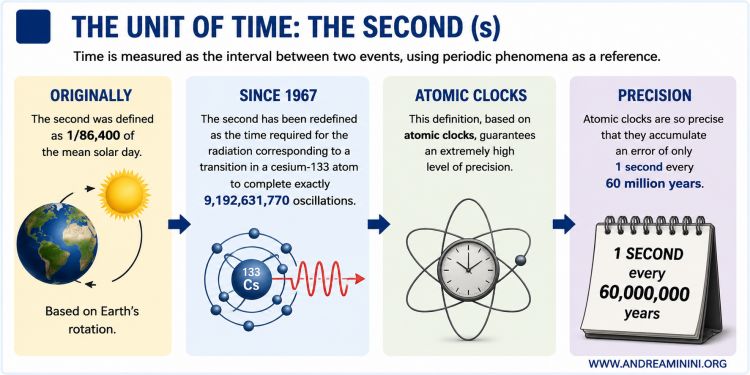
Time is measured as the interval between two events, using periodic phenomena as a reference. The SI unit of time is the second (s).
For centuries, the second was defined as a fraction of the mean solar day, specifically 1/86,400 of a mean solar day. In other words, it was based on Earth's rotation.
However, Earth's rotation is not perfectly regular. Small variations in its speed make it unsuitable as an ultra-precise standard of time.
To overcome this limitation, a more reliable definition was adopted. Since 1967, the second has been defined as the duration of 9,192,631,770 periods of the radiation associated with the transition between two hyperfine energy levels of the ground state of the cesium-133 atom.
This definition is the foundation of modern timekeeping and allows scientists to measure time with extraordinary precision.
Note. Atomic clocks are so precise that they accumulate an error of only about one second every 60 million years. The NIST-F1 is a cesium fountain atomic clock that serves as one of the primary frequency standards in the United States. It is located at the National Institute of Standards and Technology (NIST) in Boulder, Colorado. The clock works by launching cesium-133 atoms upward in a fountain-like trajectory. As the atoms rise and fall under gravity, their transition frequency is measured with remarkable accuracy.
In recent years, optical clocks have pushed precision even further. Instead of using microwave frequencies like traditional atomic clocks, they rely on optical-frequency transitions, which can be measured much more accurately.
Their uncertainty is estimated at roughly one second over about 15 billion years, longer than the current age of the universe.
Put another way, an optical atomic clock operating at this level of precision would gain or lose only about one second over the entire history of the universe.
This corresponds to approximately 0.2 picoseconds (ps) of error per day.
Since 1 picosecond equals \(10^{-12}\) seconds, we can calculate the daily error of an optical clock as follows:
$$ 0.2 \, \text{ps} = 0.2 \cdot 10^{-12} \, \text{seconds} = 2 \cdot 10^{-13} \, \text{seconds/day} $$
Therefore, an optical clock loses \( 2 \cdot 10^{-13} \) seconds per day, or 0.0000000000002 seconds each day.
Note. This number may seem abstract, but it highlights just how accurate modern clocks have become. To put it into perspective, consider the age of the universe, approximately 13.8 billion years. Starting from a daily error of \( 2 \cdot 10^{-13} \) seconds, we can estimate the total accumulated error over that period. \[
T = 13.8 \cdot 10^9 \, \text{years} = 13.8 \cdot 10^9 \cdot 365 \, \text{days} \approx 5.04 \cdot 10^{12} \, \text{days}
\] Since the daily error is \[ e_g = 2 \cdot 10^{-13} \, \text{seconds/day} \] the total accumulated error becomes \[ e_T = e_g \cdot T = (2 \cdot 10^{-13}) \cdot (5.04 \cdot 10^{12}) \, \text{seconds} = 1.008 \, \text{seconds} \] In other words, an optical clock would lose only about 1 second over a period equal to the age of the universe.
History of Time: From Newton's Absolute Time to Einstein's Relativity
People have been thinking about the nature of time since the earliest civilizations. The Greek philosopher Heraclitus famously described reality as a process of constant change, summarized in the phrase "Panta Rhei" ("everything flows"). According to this view, everything is in motion and nothing remains exactly the same.
Example. Time and space are closely linked. Without space, motion would be impossible. Likewise, without time, there would be no way to describe change or movement.
Beyond philosophical reflection, the scientific study of time began to take shape during the 16th and 17th centuries, a period known as the Scientific Revolution.
This period marked a major shift. Time was no longer viewed solely as an abstract philosophical concept or a feature of celestial motion. Instead, it became something that could be measured, analyzed, and incorporated into mathematical descriptions of nature.
From a scientific perspective, both space and time are considered physical quantities because they can be measured, respectively, with rulers and clocks.
Newtonian time was the first fully developed scientific model of time. Introduced by Isaac Newton as part of classical mechanics, it treated time as an absolute quantity.
In Newton's view, time flows uniformly everywhere in the universe and does so independently of physical events. Every observer shares the same universal time, regardless of their location or state of motion. Space and time are therefore regarded as separate entities.
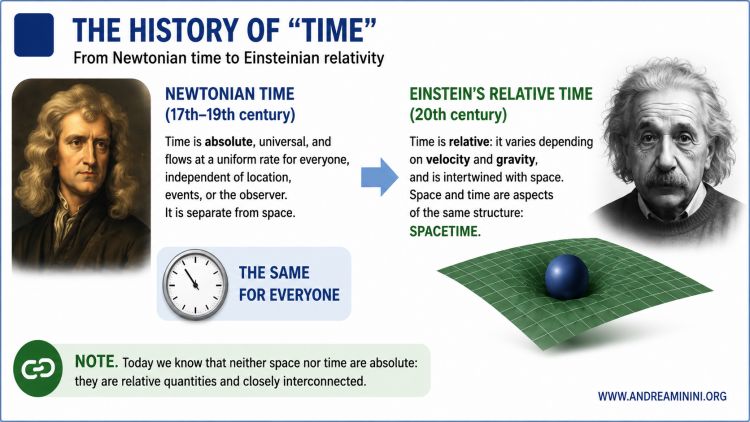
This picture remained dominant until the early twentieth century, when Albert Einstein's theory of relativity transformed our understanding of time.
Einstein showed that time is not absolute. The rate at which time passes depends on an observer's velocity and on the strength of the gravitational field in which the observer is located.
As a result, time and space are now understood as two aspects of a single four-dimensional structure called spacetime.
Note. Modern physics has shown that neither space nor time is absolute. Both depend on the observer and on the physical conditions being considered. Because they are fundamentally interconnected, physicists describe them together as spacetime.
Relativity of Time
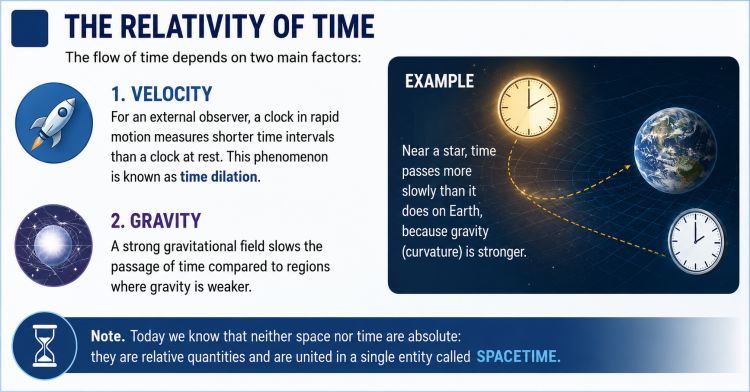
Time is not an absolute, universal, or unchanging quantity. Instead, the rate at which time passes depends on an observer's motion and on the strength of the gravitational field in which the observer is located. In other words, time is relative.
This idea was first revealed by Albert Einstein in the early twentieth century through his theory of relativity. Einstein showed that the passage of time is influenced by two key factors:
- Velocity. To an external observer, a moving clock runs more slowly than a clock at rest. This effect is known as time dilation.
- Gravity. Time passes more slowly in stronger gravitational fields than in weaker ones. This effect is known as gravitational time dilation.
Example. Near a star, time passes more slowly than it does on Earth because the gravitational field, and therefore the curvature of spacetime, is much stronger.
According to relativity, space and time are not separate entities. They are intertwined components of a single four-dimensional structure known as spacetime.
Twin Paradox
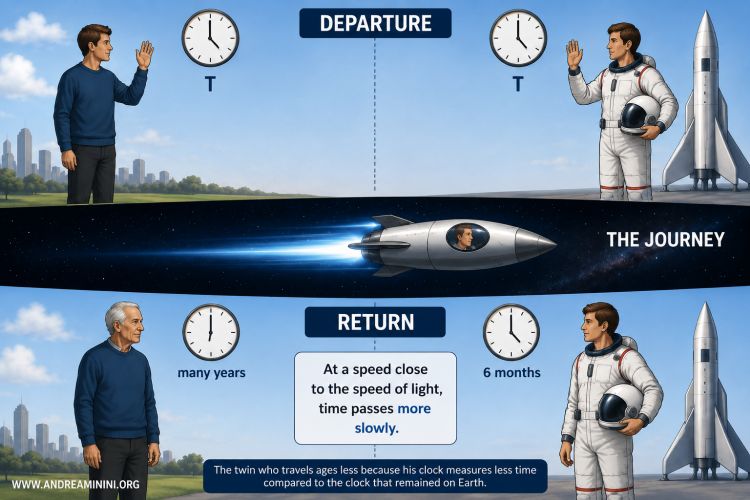
The twin paradox is one of the most famous thought experiments in physics and provides a simple way to understand the relativity of time. Imagine two twins saying goodbye. One of them boards a spacecraft that will travel for six months at a speed very close to the speed of light.
When the astronaut returns to Earth, he finds that his twin brother has aged many years more than he has.
What happened?
Because the astronaut traveled at a relativistic speed, the clock (C) aboard the spacecraft recorded less elapsed time than the clock (A) that remained on Earth.
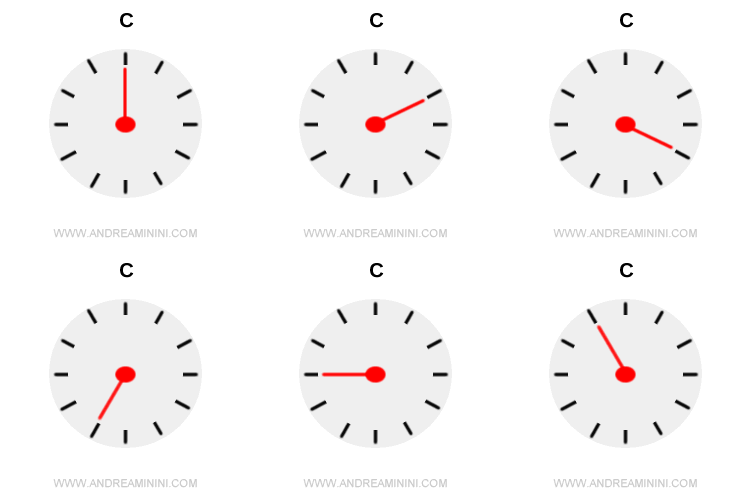
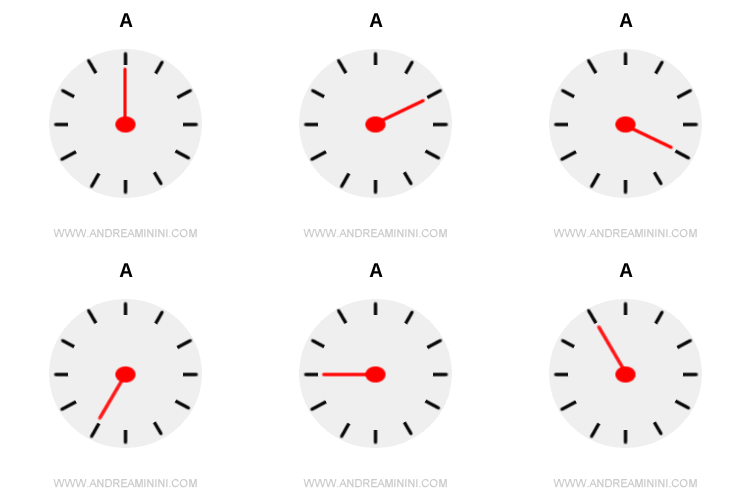
Meanwhile, on Earth, time continued to pass at its normal rate (A).
As a result, when the astronaut returns, he finds his twin brother significantly older, while he himself has aged only a relatively short amount of time.
In practical terms, during the six months experienced by the astronaut aboard the spacecraft, several years may have passed on Earth.
How Is Time Measured?
On Earth, time is commonly measured using periodic phenomena, such as Earth's orbit around the Sun or the regular oscillations of a pendulum.
However, this approach is only an approximation. In the broader context of the universe, any precise description of time must take both velocity and gravity into account.
According to Einstein, time does not pass at the same rate for all observers. The rate at which time flows depends on an observer's velocity relative to the speed of light and on the strength of the gravitational field at the observer's location.
The speed of light is constant. In a vacuum, light travels at approximately 300,000 kilometers per second (about 186,000 miles per second). According to relativity, no object with mass can reach or exceed the speed of light in a vacuum.

At speeds much lower than the speed of light, relativistic effects are so small that they can usually be ignored. In these situations, Newtonian mechanics provides an excellent approximation.
As an object's speed approaches the speed of light, however, relativistic effects become increasingly important and time begins to pass more slowly relative to a stationary observer.
The passage of time is also affected by gravity. In stronger gravitational fields, such as those near neutron stars or black holes, time flows more slowly than it does in weaker gravitational fields.
For this reason, modern physics views the passage of time as a relative phenomenon rather than an absolute one.