
Separation of a Subset by Open Sets
Let \( A \) be a subset of a topological space \( X \). The open sets \( U \) and \( V \) in \( X \) are said to form a separation of \( A \) when the following conditions hold:
- They cover \( A \) \[ A \subseteq U \cup V \]
- Each intersects \( A \) non trivially \[ U \cap A \neq \varnothing \] \[ V \cap A \neq \varnothing \]
- They are disjoint on \( A \) \[ U \cap V \cap A = \varnothing \]
In essence, the set \( A \) is split into two disjoint pieces, one lying in \( U \) and the other in \( V \), with no overlap between them inside \( A \).
This notion provides the standard topological way to express that a subset is separated.
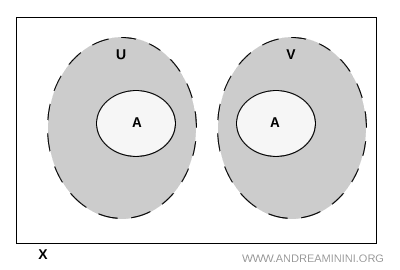
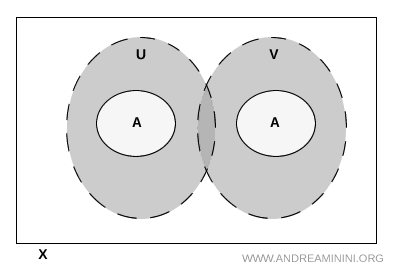
Nota. The sets \( U \) and \( V \) need not be disjoint in the entire ambient space \( X \). They may intersect outside \( A \). What matters is that their intersection does not meet \( A \).
A Practical Example
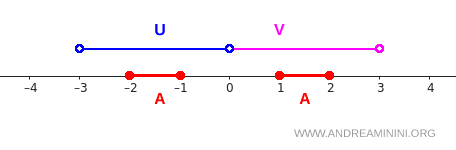
Consider the topological space \( X = \mathbb{R} \) with the standard topology, and let \( A \) consist of two disjoint closed intervals:
$$ A = [-2,-1] \cup [1,2] $$
Define the following open subsets of \( X \):
$$ U = (-3,0) $$
$$ V = (0,3) $$
The intervals can be visualized as follows:
We now verify the separation conditions.
The interval \( [-2,-1] \), which forms part of \( A \), lies entirely in \( U \).
The interval \( [1,2] \), the other component of \( A \), lies entirely in \( V \).
Hence:
$$ A \subseteq U \cup V $$
Each open set meets \( A \) in a non empty set:
$$ U \cap A = [-2,-1] \neq \varnothing $$
$$ V \cap A = [1,2] \neq \varnothing $$
And \( U \) and \( V \) do not intersect within \( A \):
$$ U \cap V \cap A = \varnothing $$
Thus the open sets \( U \) and \( V \) indeed form a separation of the subset \( A \) in the space \( X \).


